Friday, October 16, 2009
RTK Heavy Press Day OWNed me: another frickin' learning experience session
 learning experience. Usually it's been about technique. The start of this latest block, it was about reading comprehension. But no matter the type of learning, the result goes to the body - and the mind.
The first time i did the RTK pressing block i did it wrong. I did it as ETK with two kb's. Even as such, double 12's for me for five rungs, five ladders on heavy day was challenging, but it didn't hurt my brain. After this last C&J block, the ETK book arrived and so in reading it from cover to cover, rather than the Plan that is on the DVD, i noticed that my interpretation of the pressing block was in error.
I have now adjusted accordingly, such that the heavy day, the final one of the week, is double 16's. Snatching two 16's - for me- is on a whole other plane from double 12's or alternating a 16 with any other lesser size doubles work, no matter the hand.
Is this my Beautiful House?
I consider that half a year ago i was struggling to press a two consecutive left arm presses with the 16 (as part of the perfect rep quest series). Now, i'm doing DOUBLE frickin' 16's with a SNATCH at the start of each rung? When i thought about it, my brain did do a bit of a tilt. But excuse me if this is being a sissy, but again, for me, double snatching 16s is an exercise at this moment as much in intestinal fortitude as it is in strength. And also mental stickiness. By five ladders were not total 5's of 5. They were (sounding like figure skating scores) 4,4,3,3,3. Owned. Toasted. Perhaps basted.
THis is so intriguing to me: gals test with single snatching the 16 for the RKC cert, yes? so we are familiar with hiking this thing back and way up, either side. But does the physics change or what at that weight in a way that is dfferent from double 12s - and if it's not 12's for you, imagine whatever your snatch test bell is or say higher bell if it is that is at the sort of top of your single pressing for reps bent. Weird. Glad only to go there once a week. But also looking forward to seeing how this feeling changes with more reps.
Forget Something?
And speaking of mental stickiness, i'd just like to know, how many people forget to squat after the last ladder rung of a set and dash to reclaim the bells before they get all the way to the ground? Hmm? is this just me?
And may i say that on heavy day, doing those squat sets with the double kb's well i can see where someone might say it will make a man out of you. But it's really the mental toughness i think because it's doable, challenging, but not a form killer. it's a nicely balanced edge, but it's also just not nice.
KB swings for in between set Active Recovery, strength and Owning My Swing.
Continuing on from the last update, i again used a light kb to get in 100 perfect swings between ladders. I focussed on form, muscle awareness and experimented with eye position and movement for what the smoothest feel was. It did not wear me out. It was great. I'm getting in 600 swings a workout this way more or less for free, alternating standard speed with overspeed eccentrics.
I'm doing this keep the heart rate up for two reasons: one, to test the this will kill DOMS theory and two to test the Cardio Between Sets Improves Strength Gains.
I make no claims here as i will have nothing to compare against my results of not doing cardio between sets. That said, i KNOW my oxidative capacity will go up - it can't not physiologically from that kind of forced exertion. So that's nice. IT's only about 12 mins worth of cardio all told, so not a biggie, but not nothing either - plus it's 600 more opportunities every other day to own my swing.
When i get to a place where a day's RTK workout is "practice" rather than "new learning experience" i'll be sure to shout.
anon.
Related Posts
- b2d kettlebell article index - including RTK stories and Perfect Rep Stories among other moves.

 PDF
PDF

Wednesday, October 14, 2009
A gal DELIBERATELY gaining "mass" (not weight). How can this be?
 So, i'm female, like to be lean and ripped AND i'm trying to gain mass - a new way to say "gain weight." What is that about? If awhile ago someone had told me i'd be looking at mass going up rather than down i would have paled, horrified. So what's happened?
Two things:
- i've for a long time wanted defined strong and strong looking arms.
- But perhaps more importantly, over the past few years, i've learned how to do lean for me: i know what it takes to get lean dialed in, and have done it a couple of times - getting to the ideal weight, letting that slide a few pounds, going back. For me this has meant my weight has been consistently between 57 point something and 60k. Happy days.
So, with the release of Pavel's Return of the Kettlebell (start of a review series here)- geared at hypertrophy strength in particular- i thought i'm in a good enough place now to push on this strength side with RTK's double KB work and investigate the mass side promised with it. And i know for my NSCA CSCS text book - and every other sentient knowledgeable person on mass tells me so - this means eating to achieve a caloric surplus not a deficit. I have never eaten for caloric surplus deliberately in my life.
The result so far is a strange thing. Over the past 6-8 weeks i have been watching the scale go up AND i have not freaked out, i have not panicked, i have not broken into a sweat of fear.
Don't Panic
Part of the reason for this lack of panic is perhaps knowledge and control. I know something about what's going on, and i am doing it cautiously and deliberately. Whether it's optimally remains to be seen, but i'm ok with that, too, as the weight going up is not huge leaps and bounds.
Part of the ok'ness is also that in the knowledge side, i know how to evaluate the number on the scale from a few metrics. One of the most powerful ones is girth and the other is skin fold testing.
With Girth i whip out a wonderful gadget called a myotape, and cuff it around my biceps. Not
 a ton of change, but it's an honest 1/8th of an inch. And after a workout the measure is considerably greater. But we're talking post rest not post workout measures. the real stuff. I can also keep an eye on more sensitive areas like hips and waist with girth and see if this is beyond my mental tolerances or not. The best check there however is still feeling comfy in my clothes.
With skin fold measures i track what i really want to track here: improvements in lean mass. These are slower to grow than fat to be sure, but seeing weekly progress is a good thing. So far i haven't seen bigger jumps than when i've been trying to lean out and work out at the same time, but it's only been a short trial so far. The main thing is the trends are going in the right direction, and the BF% is still well within tolerable limits.
Why else am i doing this?
 I want to see if i can "get arms" (and maybe some other body parts too, but arms has always been the one for me). As far as i know there's no genetic reason why my arms shouldn't respond approriately to appropriate forces for hypertrophic adaptation. However, i also want to walk the walk.
I confer with lots of folks who are more into bodybuilding than strength. The interesting demographic is young lads and post 30's gals - in my experience anyway. So while i'm giving council like "eat more to gain" where have i been on that continuum? Strength and leanness.
So i figure now is the time to fish or cut bait. I'm not going into body building, but i am experimenting with how muscle mass growth can be stimulated, fed, supported, with what one might see as the *minimal* set of moves to achieve that goal, and where RTK right now is my main mission.
For now, part of the experiment is just figuring out how to be cool like a little fonzy with this weight gain thing while the mass gain thing comes along.
The basics: how one reacts to food.
The far more challenging part at least for me and perhaps for other women too who may want more mass (as opposed to weight, dam it. weight bad; mass good - we know what we mean) - is feeling ok about seeing the scale go in the usually dreaded direction.
The take away from this for me so far thinking about it is that it's been my work in nutrition that's let me feel comfortable exploring this uncharted territory in strength and mass (mass. ha! so far i say ha! we'll see. an eighth of an inch for pete's sake! ), not the workouts.
The workouts psychologically seem the eas(ier) part. There are certain principles to which muscle reacts when stimulated appropriately. Check. But the scale? Really, i think if i didn't have those other measures, and a faith that i know how to reduce the weight again, i couldn't do this.
The Way i've Found Thinner Peace.
I'm stealing thinner peace from a fabulous book on how we react to change and how to make habits successful called the Four day Win by Martha Beck (US || UK ) - recommended. If you want to see why, i talk about habits, and the change of pain that is changing one's dietary ways and how to do this with as little brain pain as possible over here. That's potentially a first place: to know how change can work safely. And whence from there?
For me, how i got to a place of really knowing my body in terms of nutrition is with Precision Nutrition that i've reviewed over time, and have been using now, literally for years. The thing i'd like to draw attention to here are three parts of that approach that i think are relevant to this weight going up mental safety zone.
- - the basic baselining
- - the individualization plan
- - learning about measures
We're complex systems. Why wouldn't it take that kind of time to get to know how these complex mechanisms interact with complex inputs?
So i think it's great that there's a base case from which adjustments can be made. Second, once the base case is established, time to look at parameters for individualizing to get on with one's body comp goals: where start sensibly to work towards losing weight or gaining mass? how tweak either calories or macronutrients? why? how do that again in the spirit of change one thing, maintain the change for two weeks, assess.
The third part is actually having guidance on how to do girth and skinfold measures and make sense of those measures. A lot of that material is in the PN guides that come with the huge amount of material available in the program. Much more comes from the feedback of folks on the PN forum. The experts there from a diversity of backgrounds are awesome. A breakthrough for me, for instance, happened when i'd seemingly hit a plateua doing everything i thought right, and a power lifter trainer from London, Alex Gold, said, that happened to me: i hate calorie counting, but why not check in with fitday for a couple weeks to get a reality check and see what happens?
 Wow. super. Did it for a month, actually, and, combined with what i knew at that point, and advice on tuning my workouts (also from PN) i had it nailed - the light turned on and i got what it took to tune my intake for that particular goal. Now i might not always choose to do that of course, but i know what it is - at least in that direction. I am so grateful for that collision of practice, reading, and the space in which to consult with knowledgeable and simply more experienced people. The photo on the left is from a time just after this tuning process.
Whither Voyager?
My modus operandi now seems to be figuring out how to use that knowledge from leaning up to muscling up (and then leaning again, leaving the mass in tact, more or less ).
What some folks may notice is that the above getting to know my physiology for food was a month here, two week tests at a time there - easily adding up to more than a 12 week body transformation. You bet. But, the point is, do it once, do it right, and the knowledge is there for well, so far, my life since then.
Diets suck. they're about temporary deprivation for the most part. They're not about skills or about self-knowledge to have confidence to take knowledge gained to new places.
With ETK (review) and the RKC cert (review), i learned a lot about single kettlebell work. Not everything, but a great foundation with solid moves that will also last a life time. Likewise i'm using that to transfer to the different beast (but related cousin) of double kettlebell work. I'm looking forward to the RKC II in feb 2010 to develop the vocabulary a bit further.
I guess the big thing here is foundations establishing a base of trust, and that trust comes from self-knowledge, and that the way to get that self-knowledge could be to hack around on one's own and hope to fall into it. Or it could be to get some good guidance, do some research, and find a space to ask questions to improve that practice.
With kettlebells it's been ETK and the RKC. With nutrition, it's been Precision Nutrition. In each case, i've gotten to a point where i'm gaining the confidence to fool around within the parameters of the space - play with a pump post the double pressing in RTK and explore IF that wiser people than I keep saying is cool.
The results of the good foundation and trust it perhaps this boldly going to a territory - weight gain - that previously would have devestated me and is now a new and if not undiscovered then potentially dangerous but with now acceptable levels of risk attached. That's likely a long winded way of saying it feels safe enough to have fun.
Does this process make sense to anyone else? hope if so, it helps :)
best
mc
Related Posts
- Return of the Kettlebell - double kb work prelim review
- the complete list of all the updates related to RTK at the b2d kb index
- exercise doesn't work without diet. - either way the weight goes, it seems.
- Myth busting: women are afraid to bulk up.
Sunday, October 11, 2009
Return of the kettlebell Update 4: C&J heels fix and Balancing the Press, Swing Sets and a Pain in the Quad
This entry (4th RTK update) is about high heels in the C&J, the peculiarity that is uneven pressing, and swinging between sets in practicing Return of the Kettlebell (RTK). Also a question about pistols, pain and mass gain.C&J - always learning. Dang
In my last episode i'd just lost my C&J form, and got it back noticing i was doing more of a C&J GS jump in the second hop than is appropriate for the Hard Style Way. The next session solved that hop: heavier bells. Ha! Seriously. It's harder to hop on the heavy days. Lor'! Learning to keep speed going for that second hop makes a difference in a good rep and a not so good rep. It seems that because each time one does the RTK block a variable changes - no. of sets, no. of ladders, load, that there's always going to be something new to learn. This is a good thing, to be sure. But likewise, gosh. Anyone who says they need a new program - that a few moves is going to be boring - just hasn't met ETK or RTK.
Uneven Presses
The intriguing thing about uneven pressing
- - snatching different weights and matching speed between them.
- - matching speed between pressing sides - keeping up bone rhythm
- - matching form per side - by the fourth set, the heavy bell starts to feel, well, heavy, and the later presses can let the pelvis slide over to give it a boost that the other side doesn't need. Temptation to do so is very strong.
I've been experimenting for the past few weeks on keeping my heart rate up between sets, and this for two reasons: one, it's supposed to help eliminate doms (end of this article) and two, it's supposed to help with strength gains, and i'm all for more strength gains.
Today i wore a heart rate monitor and noticed that my typical light jogging in spot or running around the place didn't get my heart up very high, so i thought, what the heck, swings.
So i did some Rannoch's 100's between sets for my 2 mins of recovery, alternating one handed and double, focusing on good clean hip snaps, as well as light overspeeds. Let me say that if you don't have a heart rate monitor, don't worry about it: doing 1oo's of any of these will keep your heart up for two minutes without wasting you.
Pistol Practice
And, just because i'd like to keep up some pistol work, and as this was light day, i got an EDT (escalating density training) set of assisted pistols in. This was done by attaching a green band to a door, and doing the squat down unaided and using the band as an assist on the way up: this was both work and let me focus on form - again with bone rhythm - especially thinking about the form of standing up straight and fast with good good form. That's cool - usually i've been so occupied with just getting up repeatedly that the difference in being able to focus on the groove of the form is pretty cool. Will be interested to see how that translates into unassisted (and gulp, loaded) practice.
What i did notice that was new is that oh, about 3/4's of the way into my EDT block my legs suddenly felt as if DOMS had just turned on about 24 hours early. So it's not DOMS. it's something else. And it's a bit of a surprise, and a rather painful one. Ow? The suddenness of going from fine to Ow was rather abrupt. Anyone?
Mass Gains - to date
It goes without saying, does it not, that strength improves on RTK with each workout? Super duper. But mass? Getting past scrawny arms? Hmm.
Gals who have worked to get lean don't often, in my experience, just surrender to adding more calories in plans of adding some mass, but i've been up for it. In the past 6 weeks, the gains have been on the scale more than on what the tape measures in my arm. Is there anything i could do better, or there just hasn't been enough time to say?
I'm religiously doing a pre and post drink as per the Nutrient Timing work i wrote about awhile ago, and am as said going clearly into caloric surplus. But Tracy Reifkinds arms remain unrivaled. That said 6 weeks may well be far too soon to anticipate real change. I shall just keep it tight, (the HS way of saying "hold my breath?") in the meantime.
Till next time...
Related Posts
- Kettlebell Article Index - including previous three RTK updates
Thursday, October 8, 2009
What's Flexion/Extension Eccentric/Concentric Negative/Positive - move basics
 I am directionally impaired. If someone asks "do you remember if we go right or left?" and i say "left" do yourself a favour and go right. Likewise when i was trying to learn about muscle action it took me ages to unpack flexion and extension from eccentric and concentric contraction.
So for any of you folks out there trying to understand what a negative contraction in flexion might look like or if an eccentric contraction can be positive and in
 extension, this post is for you.
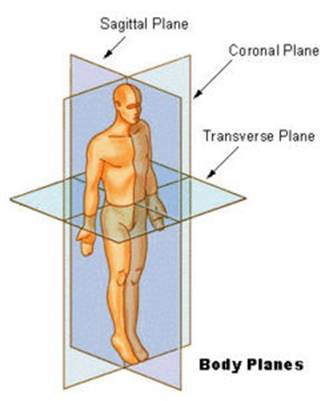
Just to start of orienteering, most stuff in kinesiology seems to refer to the midline of the body, and the body is trisected into three planes: sagittal, frontal (coronal in the image) and transverse.
These terms simply make it easier to talk about direction of a move. Eg a forward bend is mainly an action in the sagittal plane. A lateral raise is in the frontal. One might then say ok, what of your moves is working transverse? This is a big deal as transverse is associated with rotation and rotational power is important. internal/external rotation. oy.But i digress. The main thing is that there's a midline of the body. We'll see that in action.
Muscles:
To hold something, muscles contract. That's it. The interesting thing is that muscles can contract in different states - usually one of three states.
Concentric - the muscle is shortening. Like a biceps curl (the curling phase)
Eccentric - the muscle is lengthening while contracting - like overhead triceps extension (the lowering phase)
Isometric - a contraction is happening without any muscle lengthening/shortening.
Joints:
Joints have a lot of ways of being described as moving: rotation, elevation and depression; adduction (towards the midline, latin ad, to, towards), abduction (away from the midline - latin ab, from), and the more familiar extension and flexion. To these can also be applied anterior, posterior, medial and lateral. Or front, back, towards the middle towards the outside (where the body is the reference point).
Let's look at just the two most commonly discussed terms in the workout room, flexion and extension.
Extension, generally, is increasing the angle in a joint. So standing up from a squat is both knee and hip extension.
Flexion, by contrast, is decreasing the angle in a joint. So the top of biceps curl is flexion around the elbow joint.
Negatives and Positives
Another name for Eccentric contraction is a Negative. And concentric is a Positive. Why they're called that, i dunno. I'm guessing that that's because the challenge is often perceived to be in the lift, and we move something from a starting position to a finished position, and going from a finish to a start is seen as the flip side or negative.
I prefer eccentric/concentric because of the different types of effects due to different types of actions.
We're stronger in the negative phase of a move - consider how much easier it is to lower a piano than to lift one.
Interestingly eccentric contractions are less well understood than concentric contractions, but what we do know is that eccentric contractions are strongly correlated with DOMS - delayed on set muscle soreness (more on DOMS here).
Putting muscle and joint movements together
So now we have a rough vocabulary for muscle and joint action. Let's try a couple of descriptions.
Examples
In a march or sprint step practice, when the knee comes up this is an example of hip flexion as the angle at the hip socket is narrowed via the femur coming towards the pelvis. The aptly named hip flexors group of muscles will be contracting to make this move possible - to pull the joint angle together.
If the knee is likewise bent as in a marching step, there's knee flexion too. If the knee straightens out, however, as in a kick, we have knee extension with hip flexion. In this case, the knees are being pulled into extension by the quads concentrically contracting, too.
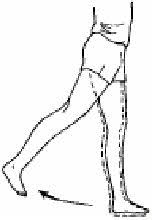
Kick that straightened leg all the way back - like the tail end of a sprint stride, and there's hip extension - where the hamstrings and glute actually contract to keep the leg from flying off in a sprint.
To see eccentric contraction, we can look at the ever popular biceps curl with flexion around the elbow. As we lower a weight, we are working against resistance, letting the joint angle increase to lower that object under control.
Directions
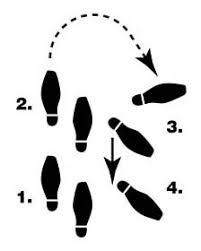
So we could now do an anterior lunge - moving the lunging leg to the front. And we'd know that the anterior lunge foregrounds knee flexion - the hamstrings and related flexors concentrically contracting to shorten and so pull the tibula/fibula towards the femor. We could talk about anterior and posterior glides of the head where we affect a "chicken neck" to move the cervical spine past the front midline of the body and then pull it in the opposite direction towards behind the midline of the body.
So we have eccentric and concentric contractions, negatives and positives being the same; flexion and extension and some directions - and the midlines of the body.
Perhaps this is all one to you and easy peasy - but for anyone else out there who struggles with directions - hope this helps. Tweet Follow @begin2dig
Wednesday, October 7, 2009
Why Wait till After Eating to work out?
Apparently one of the actual reasons for this invective
 to wait is more about blood supply. When we eat, our gut gets very active. That means a lot of the blood supply is being focused on our digestive system. You can see what's coming: exercise means that the blood supply is being wanted by our peripheral system (as we saw in the article on warm ups).
Likewise the hormonal responses around food digestion (load on the endocrine system) are different than the ones that get triggered for exercise.
So eating and working out close by each other is putting two rather opposing demands on our digestive and endocrine systems. By giving digestion a chance to do its thing, the body is more at liberty to manage the demands of our thing when we want to work out.
Sorta makes sense.
An interesting thing for peri-workout nutrition is that some fuel seems fine to ingest prior to a workout: fast digesting hydro-whey, fast carbs like dextrose, and creatine, can be taken on "right before" a work out. Some folks top up with energy drinks during a work out. So the energy requirements to process some of these fuels must be low relative to whole food.
Personally these kind of facts make it easier for me to plan how to work out and why to practice a particular way. I can calm down i guess around whether now is the right time to move or not. Maybe that's just me, but hope it might be a useful wee factoid for you, too. Tweet Follow @begin2dig
Return of the Kettlebell Update 3: Totally Losing It - the Jerk
Have you ever lost it in a practice? Like lost your form by trying to think about what you are doing? that's what happened to me today. I wish i had today's RTK practice on tape as an object lesson in self-confusion. I totally lost it with what the heck i was doing in the jerk part of the C&J.After doing the C&J happily for rounds of RTK, i started thinking about the form on the DVD vs mine. In particular i got thinking about the second dip: was i in fact doing a second dip? where was it? Where on earth did this thought come from? The result was rather odd in terms of form (i say smiling to myself). Double bottom dips with no press up. Triple hops with the bells already at the top. I'm sure there were other variants leading to utter perplexity. one set was so pooched i abandoned it to get a mental break and reset some circuits. Between sets i just kept practicing the form naked to get my groove back.
The Look, the hand grip, the jump
I think what's happening is that as i get different parts of the C&J zoning, like the looking down in the second dip (Eric Cobb is quoted in RTK as advising this - which i found after last week kinda getting that. cool) and i introduce a new refinement, occasionally i come unglued.
Here's an example. After looking carefully at the images and text for the RTK grip for the jerk and viking push press, i finally click that it's different than the press and start trying to adopt it. That part is fine, surprisingly. But that grip change comes right at the transition from the clean into the first dip of the jerk and i think that's where it all went, to quote the president in Dr. Strangelove "well, a little funny" today. The change point caused what had been a pretty seamless transition to unseam, and become what matthew chalmers calls "seamful" - and not in a good way.
I have no great analysis or take aways from this experience today - just witnessing that it happened. I guess my happiest moment was the feeling of maturity in abandoning a set that was going completely duck butt up rather than trying to force it to get back together.
That comes from the SAID principle and also not wanting to rep into my nervous system more reps of a whacky wrong pattern.
So i wish you joy of your double kettlebell work. I think i am actually gaining some mass on my arms - a unique experience where every 1/8th of an inch counts, durn it.
I'm also following the pre/post protein/carb/creatine peri drink council of the previously discussed reseasrch on nutrient timing, and am likewise experimenting just a wee bit with really light weight post recovery from the last RTK set to do one fast occlusion inducing set for triceps on C&J day or biceps on pressing days. It may make no difference. Too many variables to tell, but it's fun, and the peri drink definitely lets me dig into the sets more.
Chalk
And speaking of digging into sets? Chalk is good. I find that by the fourth ladder of the third set on medium day, and sooner on heavy with the C&J's, the handles are so sweaty that keeping them from sliding and banging around my wrists is not possible. The difference a little bit of chalk makes to a clean clean is well worth it. Me i use climbers chalk in a chalk sock from REI, put it in a hefty bag so it doesn't go all over the place, stuff my hands in the bag and grab the sock a few times in each hand. voila.
Automatically Induced Restoration - seems to work
One more thing? post these C&J sets i'm tired. I really do find even half an hour after my workout with the holosync recovery beats stuff to be restorative. I've been using that consistently for half hour to an hour after the workout and it seems to let me come back to functional level for the rest of the day. I listen to the beats and read light crap or just stare. It's a great down time recharge. I find that there is a difference between just trying to sit and read for half an hour or so and using the holosync cd's. The latter seems more effective.
So that's my totally dorky catch up on RTK for today. Amazing stuff this double KB work.
Related Posts
- B2D kettlebell article index
- occlusion training - recent applications
- nutrient timing for lean mass and hypertrophy
Sunday, October 4, 2009
B2D Readers: b2d slight reorg & invitation for you
Related Posts
lately, i've been adding links at the end of new posts to other sources of info related to that post to provide a broader context. As i hit previous articles, i'm working on inserting related posts into older articles, too.
Indices

The main change to b2d has been to create several standing indices of b2d articles. They seem to have gathered around about 5 topics, soi've moved and extended the rather truncated article listings that used to be in the right hand column into these persistent reference pages, on these five topics:
- vibram fivefingers - from fitting to wearing and the neural adaptations in between
- z-health - what is it, what are the various certs/dvds/phases about and its application
- kettlebells - firing the lats, press clean up, vo2max work and so on
- general fitness - mainly research overviews and reflections
- nutrition (forthcoming)
Related to these more neurological emphases are the more pragmatic fitness and nutrition articles. These are in the large, i think, articles that review research literature around best practice. Within fitness, the remarkable mechanism of the kettlebell, the practice of which seems to lead to so much incredible performance self-knowledge is its own topic. That's one place i feel a little more comfortable reflecting on my own experiences, and hope they may prove useful for others, too.
These new indices are listed in the right hand column, under "b2d Article Indices" just a wee bit of a scroll down from the top of the page.
Search & Browse Too.
While the new "it's in here somewhere" Google-based blog Search makes it easy to find articles you suspect are in b2d, the article indices are planned as ways to let readers browse around a bit to get a sense of what's in b2d - they're not likely exhaustive but indicative.
They'll stay fresh as i'll update them regularly as newer material is posted.
This standing list of article lists also saves some space on the right hand column so that the column can be scrolled through a little more effectively too, i hope.
Other ways of browsing are by the month links at the bottom of the right hand column. IF you're curious to the road dug so far a person can click on the earliest month/year posted. I think the article indices may be easier to browse for content however.
Invitation to B2D readers: what's your question
More than anything, each index comes with an invitation: if you have a query about one of the index topics, and it's not covered in the articles in one of the related indices, please post a query in a comment for that index.
For instance, if you have a kettlebell question that's not covered in a b2d article in the kettlebell index, please post a question in the comments, and i'll put it on the stack for an article, or try to reply on the spot - i have the happy good fortune to know far more knowledgeable people in these topics than myself and will be pleased to try to find a reply.
Thanks again for visiting &/or subscribing to B2D.
best
mc Tweet Follow @begin2dig
B2D General Fitness Practice Article Index
 deadlifting to how freeing your feet is one of the best things we can do for our well being. What does the research tell us about dealing with DOMS, or about optimizing the mitochondrial benefits of cardio, or about warm ups (and whether we need one). This index will stay current with these and other topics touched on in b2d.
The idea is just to have a page that makes it easy to scan through headers of articles b2d has covered in this space.
One on nutrition will be coming soon to complement the others listed below on
- kettlebells
- vibram fivefingers (what can i say?)
- z-health neurological mobility training
If you have a question about general physical well being and training practice not discussed here, and you think it might be good for a b2d article, please leave a comment at the bottom of this post. Looking forward to hearing from you.
Muscle Building, Hypertrophy and THE PUMP - what is it?
How many reps for hypertrophy: why that's the wrong question.
Z Health: What is It
Atheletic Body Type: Check Your Goal Which one is yours? The day this article was posted it became the most hit page ever in one day on b2d. I'm not sure why.
Respect the Fat - a quick review of how fat gets used for fuel in the body.
The P90X critique and alternatives series.
Really my goal in this was less about a critique of P90X than how to think about whether or not a particular program will match one's goals. And how to assess if what's on the label is what's in the tin
- part 1: considers muscle confusion and the various X workouts - should they be X'd? do their names really mean what's under the label?
- part 2: getting ripped and what that means in terms of 1) getting lean and 2) getting defined. We also consider who can "get ripped" when following the p90x and does one really need P90X's 7 hours a week+ to achieve that goal?
- part 3: alternatives to p90x (a) diet & p90x (b) workouts.
"The Pump" - what is it, how to get one and what does it/might it do?
DOMS part 1 - what is delayed onset muscle soreness and what doesn't work (you may be surprised.
DOMS part 2 - what works to offset what parts of DOMS
Warm Ups: what are they and (why) do we need one?
Arthrokinetic Reflex: the eyes have if for fast strength improvements.
Rannoch's 100's - it's always possible to find 100.
Lance Armstrong Dynamic Simple Strength Training.
Bones and Pistols
How to develop bones and pistols - both inspired by Adam T. GlassMovement Assessment: what it is and why have one
This one's looking at an assessment to help address movement-related pain, but can equally apply to checking movement for general performance benefitWhat if we were no longer how we defined ourselves - like strong?
Lance Armstrong training
6mins to fitness 1 - research
6mins to fitness 2 - application
Icing - safe and effective for what?
Running Shoe types - any effect on injury? how bout no?
Occlusion training - benefits for strength training - but super for rehab?
Electrical Magnetic Stimulation - for rehab and muscle adaptation
Elite Fitness Rings - gymnastic rings make pull ups FUN
Stand up or Lie down to work out
Plastic vs Elastic - two different attributes that support human performance
Renegade Rows - awesome excercise
How and Why to FREE YOUR FEET!!
One of the most important things i've found about health improvement. Considering a quarter of the bones of our body are in our feet, letting them move turns out to be a good idea.
Pull Ups, how to do One or 101
This article looks at the muscles in pull ups as well as the various approaches that have been used to help people get their first or multiple pull ups - there's bound to be an approach that will work for you.
Does Cardio interfere with strength? how 'bout "no"?
Colds - Dealing with one before and after it starts
Sunscreen Will Kill You - and other single factor myths.
Rest and Recovery Periods: How Long and What For?
This is an article i did for Dragon Door on how rest periods relate to the type of strength one wants to develop - or the type of muscular adaptation one wants to foreground - as much as reps or load do.Complexity is Not Evil
Exercise Doesn't Work Without Diet - Really
Deadlift Resources
Yoga for Back Care, References
Warrior Diet: Reviewing its Science Claims
Myth Busting: Women are afraid of Bulking Up.
Related Posts
- b2d VFF article index for experience fitting and wearing Vibram FiveFingers
- b2d Z-Health article index relating to Z-Health from R-phase to 9S:Sustenance and in between
- b2d Kettlebell article index from lat firing to the perfect rep to double kb work
Tweet Follow @begin2dig
B2D Select Kettlebell Articles Index
This page hosts links to the B2D articles investigating these questions. The goal of this wee article is to act as a one click reference point on B2D to articles relating to kettlebell practice. I'll try to keep the most recent first in the list.
If you have KB practice questions not addressed in these posts, please add a comment to this post and i'll do my best to get it addressed.
Archive: Page from hosting the First HKC in the UK.
Return of the Kettlebell - Double Effort; initial preview/review
If you've worked through Enter the Kettlebell (review here), you may want to think about double kettlebells with that ETK flavour/solidity found in RTK. These seem more and other than just extra weight, but in this second piece on RTK - a kind of different demand in lifting. This third piece is on when one can get lost in the movement in a not zen way, and what some aids for recovery might be. And then there's totally losing it with the heavy day double press.Episode 5 in this series: high heals in the C&J and Uneven Swinging & Pressing.
Epsisode 6 a gal deliberately trying to gain mass.
Episode 7 Refining the Viking Push Press
Episode 8 Checking out the Double Dip of the Hard Style Cleand & Jerk Long Cycle
Episode 9 The Swing in RTK - a new variant of running the bells.
Epsisode 10 Year End Up Date with RTK.
Review of Kenneth Jay's Viking Warrior Conditioning

Kenneth kindly participated in an interview for this discussion of his long time in the making exegisis on vo2max conditioning.
Renegade Rows (with Kettlebells)
i think this is my fave KB movement. It brings together so much: core, balance, coordination, chest, arms. awesome - and especially if you don't have a pull up bar it's an awesome companion there too.

Perfect Rep Quest for Strength Series - so far
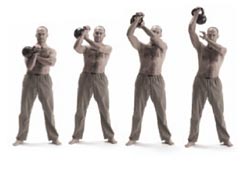
This link is a mini-index all on its own for the series that looks at the role of form, the clean, high volume and the arthrokinetic reflex all in the quest of the perfect press rep. This includes one of the most important to me: coming back to the kettlebell front squat - a reflection on the role of form for performance - that started the whole series.Cardio Workouts with KB's vs VO2max - thinking a bit about physiology
2008-11-21 Exploring the Perfect Rep: the Kettlebell Front Squat Revisisted.
This article takes a look at small adjustments in movement that have big effects - like head position in the front squat and the effect of the arthrokinetic reflex on strength.
2008-12-01 The Perfect Rep and the Role of Volume with Form
Why i got interested in Kenneth Jay's Beast Pressing protocol for improving pressing strength: what is high volume (lower weight) supposed to do for improving strength? How does the quantity of reps contribute to learning patterns? and how does this connect to strength?
2008-12-05 Perfect Rep Quest: Volume + Integrated Cardio
A quick reflection on using high cardio reps between these high volume sets to help support strength - based on research around "integrated cardio"
2008-12-14 Strength and the Perfect Rep: Volume Works
Six fold increase in heavy presses between two sessions of heavy volume work.
2008-12-15 mc's Version of KJ's Beast Pressing Protocol
Some folks wanted to know more clearly the aspects of my adaptation of Kenneth's beast pressing protocol. Basically, it's adding some EDT elements. Works for me, but i make no claims yet (a sample of one person being rather small) that this is an optimal approach. It works for me though.
2008-12-21 Perfect Rep & Insane Improvement from Breathing?
500% improvement on the heavy day from the last session? from breathing?
2008-12-31 The Perfect Rep, the Kettlebell Clean and 10 thousand Hours
This one is a longer piece about how all the above sessions came together to help fix my weaker side's clean to get the press. The problem: i could do many singles but zip series on that side. It seems the foundation laid in just over a month of high volume/low volume provided sufficient basis to unpack the clean issue and get it working to enable sequential C&P'ing. Practice really does make a difference. That seems so obvious, as i suppose the best solutions do, but the reasons why practice works seem more nuanced than anticipated.
Mitochondria and the value of steady state - despite being disparaged by some there's a role for everything. Indeed, related research shows cardio far from detracting from strength training can enhance it.Refined Turkish Get Up, Hardstyle
Running the Bells: Intense Cardio with Kettlebells
Running the Bells is a way to simulate hill workouts with kettlebells - when it's cold & wet out or the bike's up on blocks, this is a great way to get that hill series for endurance.
If you try it, please leave a comment and let me know what you think
The refined turkish get up provides an overview of what's also become known as the Kalos Sthenos TGU. A discussion of what makes the KS TGU special - the high hip bridge (and Why the High Hip Bridge in the Turkish Get Up) - is also linked, as is a series of questions about how the TGU works as a movement screen and for what.How to Prep for the RKC cert - the other stuff

The RKC certification weekend is physically demanding - there are some social/participatory aspects to consider as well to make it an awesome weekend.Learning GS style kettlebell work
Kettlebell Front Squat: how to with Will Williams, emphasis on breathing.

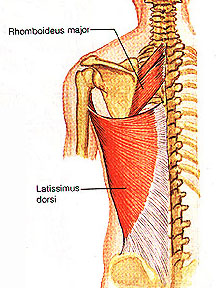 Kettlebell Swing: Why (and How) to Fire the Lats
When i started kettlebelling, i don't think i really appreciated the size of the lats, how they worked, or how to "fire" them knowingly. Here's a few tips you may find helpful on finding your lats, what the job and movement of the lat actually is, and how they may contribute to your kettlebell swing perfection.
 Kilts4Kettlebells: sources far and wide
What can i say? they seem a kind of perfect match for KB'ing?
If i've missed anything - like an article that references kettlebells isn't necessarily about kettlbells, the search function on the site should help find it.
There's also a humungous page of all articles that gets generated if you hit the kettlebell label.
Strength example
24kg, 120 in 10 snatches; gal
Related Posts
- b2d VFF article index for experience fitting and wearing Vibram FiveFingers
- b2d Z-Health article index relating to Z-Health from R-phase to 9S:Sustenance and in between
Tweet Follow @begin2dig
Saturday, October 3, 2009
Nutrient timing *may* make difference - for strength, body comp, muscle fiber...

 Could changing when you have a recovery drink have a significant effect on strength, body comp and other performance factors? It may be that simple. If you like your workout routine, but want it to produce better results, you may find that changing one thing has a not insignificant effect. There seems to be significant benefit to strength, muscle fiber, body composition and muscle glycogen uptake based simply on when nutrients are taken around a workout. Likewise this nutrient timing requires no other change to one's diet to have this effect.
Bottom line: taking Creatine Monohydrate, Protein and Carbs "just before" & "right after" workout is a really cheap win to improving strength, body comp and muscle type improvements. The other group had taken the same fuel in the AM before any other food and late in the PM after anything else so fuel ups were at least 5 hours on either side of a workout.
Effects of supplement timing and resistance exercise on skeletal muscle hypertrophy.
Exercise Metabolism Unit, Center for Ageing, Rehabilitation, Exercise and Sport; and the School of Biomedical Sciences, Victoria University, Melbourne, Victoria, Australia.
PURPOSE: Some studies report greater muscle hypertrophy during resistance exercise (RE) training from supplement timing (i.e., the strategic consumption of protein and carbohydrate before and/or after each workout). However, no studies have examined whether this strategy provides greater muscle hypertrophy or strength development compared with supplementation at other times during the day. The purpose of this study was to examine the effects of supplement timing compared with supplementation in the hours not close to the workout on muscle-fiber hypertrophy, strength, and body composition during a 10-wk RE program. METHODS: In a single-blind, randomized protocol, resistance-trained males were matched for strength and placed into one of two groups; the PRE-POST group consumed a supplement (1 g x kg(-1) body weight) containing protein/creatine/glucose immediately before and after RE. The MOR-EVE group consumed the same dose of the same supplement in the morning and late evening. All assessments were completed the week before and after 10 wk of structured, supervised RE training. Assessments included strength (1RM, three exercises), body composition (DEXA), and vastus lateralis muscle biopsies for determination of muscle fiber type (I, IIa, IIx), cross-sectional area (CSA), contractile protein, creatine (Cr), and glycogen content. RRESULTS: PRE-POST demonstrated a greater (P < 0.05) increase in lean body mass and 1RM strength in two of three assessments. The changes in body composition were supported by a greater (P < 0.05) increase in CSA of the type II fibers and contractile protein content.
CONCLUSION: Supplement timing represents a simple but effective strategy that enhances the adaptations desired from RE-training.
A cool thing about this study is that participants were used to doing resistance work; they aren't newbies (as many studies use).
Here's what they had in their drinks:
All participants were prescribed 1 g of the supplement per kilogram of body weight (1 g-1·kg-1 bw), to be consumed twice on training days only. The supplement contained (per 100 g), 40 g of protein (from whey isolate), 43 g of carbohydrate (glucose), < 0.5 g of fat, and 7 g of CrM and was provided by AST Sport Science (Golden, CO). This dose provided an 80-kg participant with 32 g of protein, 34.4 g of carbohydrate, < 0.4 g of fat, and a 5.6 g of CrM in each serving (a total of 1124 kJ). The chosen supplement dose was based on previously reported intakes of this population (18) and was similar to previous studies that had involved protein (1) or CrM (8) supplementation close to RE. The participants were instructed to maintain their habitual daily diet during the trial.
Strength & Muscle gains What the above breaks down to show is that there was a statistically significant difference (only 5% likelihood that the finding is based on chance) in STRENGTH performance improvements with the group in things like the 1RM. Intriguingly, the cross sectional area of muscle went up (hypertrophy) more than the other group of the fast twitch fibers in particular - the ones uses especially in power/strength work.
Creatine and Hypertrophy. So, nothing too surprising in what the good stuff in the drinks is. If i could redo this study, i'd take out the creatine to study separately, as the consensus there has seemed to be that one can take it anytime to be valuable. That said, the authors here in the discussion suggest that there may be particular benefit to taking creatine around time of exercise.
it could be suggested that supplement timing promotes more efficient Cr accumulation within muscle and, therefore, greater strength gains and muscle hypertrophy during RE training. However, this aspect was not examined directly. Based on the results obtained, further investigations are warranted to examine dose responses and the extent of Cr accumulation during RE, and to fully elucidate the contributions of both CrM and whey protein to chronic adaptations during training.
Body Comp - another interesting finding is that the effect of timing on body comp (bf%, lean mass) was also significant.
A group×time interaction (P <>
Muscle Glycogen. Higher in the Pre/Post group too - and at that 10 weeks after the trial finished. The authors propose an argument for this finding.
Therefore, it could be suggested that PRE-POST supplement timing not only promoted more efficient CrM accumulation within muscle, but that this strategy may have also promoted more efficient muscle glycogen restoration during the RE program. In turn, these benefits may have enabled greater work capacity during subsequent workouts, thus helping to promote greater strength improvements and muscle hypertrophy. Although work capacity was not assessed, the significantly greater hypertrophy responses (in three of three assessments) and 1RM strength improvements (two of three assessments) demonstrated by the PRE-POST group after the program support this theory.Other studies have looked at taking on board fuel close to RE, but the authors of this study claim that the unique thing here is that no one changed their diet: they just added the supplement drink. The authors write:
In conclusion, although there has been a sound theoretical basis for expecting a beneficial effect from supplement timing, this is the first study to clearly demonstrate that this strategy results in greater strength and body composition improvements (i.e., a gain in lean mass and a decrease in body fat percentage) as well as muscle hypertrophy, compared with supplementation at times outside of the workout period. Unlike previous work that has examined chronic adaptations from nutrient consumption close to RE, a significantly greater muscle hypertrophy response from supplement timing was evident at three different levels (i.e., a greater increase in LBM, hypertrophy of the type IIa and IIx fibers, and contractile protein accrual). Additionally, these results were obtained with participants maintaining their normal eating patterns throughout the program. Therefore, we conclude that supplement timing represents a simple but effective strategy to enhance the adaptations that are desired from RE training.This study is from 2006. It may be that other studies since then that i've yet to find qualify these results differently. Likewise, the authors didn't use a total control group - a group that did no extra supplementation at all - it would be interesting to see if that outside RE time supplementation had ANY benefit at all.
That said, it does seem pretty compellingly simple, as the authors suggest, that just by putting pre/post protein/cho/CrM drinks around RE workouts is an Easy Win for supporting strength.
Related Posts
- A minute with mike 1: bcaa, leucine, whey: which when and why?
- A minute with mike 2: post workout recovery window
- nutrition in general: eating is a habit, and change is pain. here's help (inside p90x article)
- free 40+ page overview of approach that uses this nutrient timing stuff (precision nutrition)
Citation:
CRIBB, P., & HAYES, A. (2006). Effects of Supplement Timing and Resistance Exercise on Skeletal Muscle Hypertrophy Medicine & Science in Sports & Exercise, 38 (11), 1918-1925 DOI: 10.1249/01.mss.0000233790.08788.3e Tweet Follow @begin2dig
Wednesday, September 30, 2009
Return of the Kettlebell check in: relax, look and breath
In the clean and jerk sessions of Return of the Kettlebell (prelim overview here) there is a still point, it seems, that comes from double kettlebell sessions and this particular move that opens up a kind of Next Level of performance - or perhaps it's just me, so let me try to explain what i mean.
When i recently wrote about starting into RTK, i said it focuses the mind. I mean it. And i *really* like that. Nothing like moving two kb's at speed, and under control, and a lot, to get that this is a kind of serious business and staying fresh not squirrelly is critical.
But there's also more than that. Again, this could just be me, but because i'm now moving two bells in synchrony, my attention on what i'm doing is different from single bell work. Qualitatively. For instance, with a one arm press, i'm checking everything in single terms: feet, glutes, gut, lats etc and on into the press itself. Perfect rep; perfect form.
But with two bells - perhaps more so in the dynamic moves like the snatch and the clean & jerk, it seems, when moving the bells, the focus can't be equally on the two arms doing the press, nor does attention split to being a bit on this side and a bit on that side. For lack of a better term the effort becomes more about the movement systemically rather than the parts.
Somthing i'm finding is that there is more focus on executing the move well and diagnosis happens post rep rather than within rep. It's as if in the ladders there are opportunities for very fast diagnostics or post mortems after doing even early rungs, that can then be applied to the next rung. Again, at least for me, i find that diagnostic happening more post move than pre move with the C&J than i do with the single arm press.
The Spot on the Door.
Here's an example. Yesterday doing medium day C&J, i was noticing a real difference in feel between the second and third rungs. The last time i'd done this block i'd also found i was getting perhaps overly intrigued about my breathing - except that i knew it didn't feel right. I also generally find myself closing my eyes when i get into a groove, and usually that's fine, but it wasn't helping as it usually does.
Then something kinda bizarre happened yesterday mid set at this tranistion point between totally sweet rungs and less perfect feeling rung. I looked at a spot on the door in front of me (i practice in a hallway). All of a sudden i noticed the move came together. For one thing, i felt like i was able to slow the pace down a bit and get more power into the clean part of each rep. There was then a sort of "ah ha" about the breathing, and then the jerk just went all zen. Not that i didn't feel the work, but it was different. Neurological harmony.
Take aways from this double kb practice for me (your mileage may very) were generally:
Slow down to feel the force in the clean, luke. I don't mean that to sound like it's a physical speed thing. I don't think the bells moved slower; i was slower inside. And i think that slowness was also where the "relaxedness" of the title comes from - i'm still focusing on hip flexor drive, tight abs etc, but it's more wound up than tossed out. More focused, less effortful in the effort. Oh grr. hard to describe.
The spaces in between. Free the Joints. The other thing on the jerk part for me was finding that spot in the door. I don't know if that spot helped anchor better arthrokinetic responses - freeing up my shoulders & neck just that bit more out of neurological threat that the jerk felt both less effortful and less fatiguing - but the difference is stunning to me. That shift in gears between the 2'nd and 3'rd ladders really quieted right down.
So what these simple moments did for me is show that, while breathing is so key to getting that coordinated effort - there are other systems in me that need to sync with that breathing. And boy does head position and the use of the eyes seem to be a powerful part of that coordination. Now i thought i knew at least about head position, but the double kb's taught it in a whole new way.
I feel like i've learned something new that i don't think i would have found this quite so clearly, or had its benefits so inscribed without the double kb challenge, and this particular big kb move.
kettlebell as instrument?
This is gonna sound flakey but one of the things i like about picking up guitars at different folks' places is that i find every single instrument from the meanest to the most extravagant has a voice - something to say. It's probably so obvious to say so does this kind of gear. I think i may be starting to get why Pavel in his conversation with Geoff Neupert a month back in the kettlebell secrets calls said barbell or kettlebell - they're great but pick one and really get it. Only advanced folks like Adam T. Glass or Brett Jones would mix them up. For a moment the other day, i think i kinda got a bit of the rationale and benefit of that. It's not just about learning new moves; it's for lack of a better term, this neurological harmony. It feels great when it all locks in (better than 'the pump').
The cool thing i sense from this expertise practice - and again marial arts folks may say nice catching up there, sport - is that really getting it with this tool means transferable skills rather than just specific skills, too - i know what this locked in in my body feels like now when challenged with double weight. I can look to find that in other moves now as well, whether kicking a ball or doing a pull up. Perhaps. Yes no?
Anyway, i was surprised. And while i enjoy Enter the Kettlebell very much (here's why) and return to it often, RTK's demands and focus sharpening are very appealing right now. And the other day, i just had what feels like an unexpected bonus outcome, too, about integration and smooth power. Tomorrow's challenge will be how to carry this practice into Heavy Day C&J.
Time to Double KB?
Just to note, if you're curious about exploring double KB work, Georff Neupert, RKC maestro of strength, is doing a series on his blog of how to think about when and how best to ramp into double kettlebell work. His Blog's a great resource in general. Thoughtful.
Look forward to hearing about your experiences.
Related Posts
- The Perfect Rep Quest - series
- kettlebell swing - about the lats - finding and firing
- better neurological form for sport - i-phase
- pull ups - from 1 to 101
- 10,000 reps of clean
Tuesday, September 29, 2009
The reusable tea infuser for Super Great Green Tea at Work Bliss
Such tea pot temperament may be fine for the ebb and flow of home life, but what about the rush and constraints of work where the convenience of the bag may cause compromise on tea pleasure?
Friends, b2d diggers, i have found The Solution: the individual reusable infuser.
Yes indeed, a simple, made in germany, reusable, gold mesh infuser. Not sure of the actual company that makes the device. I've found one in France labelled as Finum (available in the US here), and
 another recently (and cheaper) from the delightful Nothing But Tea. No postage fee either. Proprietor Helga Warzecha's on Twitter too. That's just cool. Want to know when your fave Kenyan black tea will be back in stock? Tweat! so cool. I'll be back.
As far as i can tell from the "made in Germany " type face and design branded in the base, they're identical.
Very simple to operate for green tea:
- Fill the cup with boiling water.
- let the water come down from the boil (seriously, really really do not use just boiled water and do not add water to cool off boiled water: i made a cup with a post five minute kettle, and then another that was post 15 mins. The post 15 min off the boil was so much tastier it's insane. this is nice to forget about the water for a bit)
- Note - when possible, use filtered water freshly boiled - i used boiled water from an "always hot" tank thing at work today and my goodness, what a difference in taste.
- Put the amount and type of tea desired into the filter (in the UK for green tea i like the Japanese Center in the US i've heard the Tao of Tea is good but don't have first hand knowledge)
- Dunk tea in water, with lid on filter - it just rests in the cup
- let sit for whatever is recommended - 30-90secs.
- Take off lid, flip over
- put infuser in its lid coaster. A very cool part of this simple device is that it has a wee lid for when the tea is steeping that, when flipped over, holds the infuser (and its drips).
- Enjoy that tea
Voila! crappy tasting green tea bags be gone. Your wonderful favorite tea available even at work. I'm so happy with this wee little piece of technology - the tea infuser - no doubt it would work fine for well, black tea, and maybe even coffee too. But i'm just happy - and feel pretty decadent about having this moment of bliss at work.
If you haven't tried real loose japanese tea, wow, you will be delighted. Getting into green tea can be just as intrigued as getting into dark chocolate or fine wine. But really, compared to bags, just about any loose japanese green tea will do (i like genmaicha - love that brown rice mixed in). Explore here to give it a go.
----
By the way: i'm not endorsed by Japan Center or Nothing But Tea - i just like their products and services. if you have sources you like for your fave types of loose green tea, please send a comment.
Related Posts
- Respect the Fat - the awesome wonder of fat as energy
- Alternative approaches to diet: thinking habits first - and then fasting?
- Sustenance - thinking about what goes on around food.
- Exercise - for fat loss doesnt' work without diet
- Fat burning optimization - in six minutes?
Saturday, September 26, 2009
"Lean Muscle "- muscle is lean - do you mean lean mass?
 term in the title.
The thing is, muscle *is* lean in that (a) lean means wanting in fat and (b) muscle has very little fat in it. Pretty much ever. It's very particularly designed to be that way.
The "lean muscle" may come from conflating the desire for muscle gain and fat loss on the one hand and measuring "lean mass" relative to body fat % from body composition on the other.
Or maybe it's that gaining muscle is supposed to go with burning fat and hence getting lean. Not always true by the way: see "bulking."
Anyway, lean muscle may be a redundant term but it's pretty pervasive. So let's take these terms apart then:
Lean, in lean mass refers to the measurement of the body sans adipose tissue - the fat that's under the skin (and can be measured by calipers) as opposed to visceral fat, which is the stuff around our internal organs.
Body composition by the way is formally the meanure of fat, bone, muscle tissue. So a lean person - say a man below 10% body fat with a six pack starting to show - is "lean" - as in wanting in fat (that's another great word: to want, wanting - as in to lack). He may be more or less muscular at that bf% than another person who is say
 bigger or smaller boned, so not everyone at a particular bf% looks the same to be sure.
Similarly someone can gain lean mass, or gain muscle, and not necessarily put much of a dent in lowering their body fat percentage (as seen recently with obese kids on exercise programs). In fact many folks will eat more to gain muscle mass, and pack on some more fat while doing so. This is partially why it's hard to gain muscle mass while reducing calories to get lean: the fuel to build the muscle mass (new tissue) isn't necessarily there (see discussion on hypertrophy here).
So, there's muscle, there's lean mass, and there's body fat. Muscle and bone is lean; fat is fat. Working to gain muscle doesn't necessitate getting lean(er), but eating at a caloric deficit may (scroll dow to see discussion on weight loss, nutrition, habits, change is pain, here for more).
Now, for most situations the above may be considered a nice distinction (nice is another cool word like want - means fussy or fastidious or jesuitical for that matter), but sometimes folks make the assumption that muscle gain means fat loss when thinking about "lean muscle gain" and since it doesn't, it may help to have this cleared up - help a person working on weight loss and fitness to have a better mental model of what's happening within us.
And so thar we go: muscle is lean already, to get lean is to drop fat, but building muscle is no guarantee of fat loss, though developed in the right circumstances, it can certainly help. Tweet Follow @begin2dig

 COACHING with dr. m.c.