Sunday, September 2, 2012
Interview with Drop the Fat Act & Start Living Lean Author Ryan Andrews - how bout those Deadly Fattitudes?
Follow @mcphoo
Tweet
The following is an interview with Ryan Andrew’s about his latest book Drop the Fat Act and (original b2d interview with Ryan, Aug 18, 2010 here). As said in the Aug 16, 2012 b2d review of the book, Drop the Fat Act really really is a must read for anyone interested in what getting, being and staying lean is about. In Ryan’s portrayal, Being Fat is an Act – an act that is the result of a consistent and repeated set of Fattitudes: Fat people – people who carry excess body fat – consistently share these attitudes. Change the attitudes, change the act, change from the Fat Act to Lean Living.
Because I’d never actually heard anyone put Being Fat so succinctly as a set of consistent Fattitudes (discussed in the b2d review) I asked Ryan if he’d have a wee chat with me about how these ideas developed. The following represents those conversations.
In light of all these other sources, what did you feel were some of the missing pieces in this space that you thought needed to be addressed or could be better addressed by "Drop the Fat Act"?
Where did the title come from? Why do you call this an "act" - and is therefore "lean" an act too?
 You're an experienced coach and you design for lean eating; you've done the research; you've spent the time on wards. You know this stuff, and you know that there are different learning styles and approaches to hearing a message.
Who are you particularly trying to reach with this book?
The tone of the book is a bit dunno - how would you characterise it? Impatient? Acerbic? I've read your writing, Ryan - tons of about articles, your text book and support materials for the PN Cert Course - and we've done interviews and interactions. You're a *nice* person - meant in the most positive way possible. What made you decide that this more confrontational tone would be the way to go?
a real transformation this approach as part of the PN v3 system (pdf overview to PN here), though the current discussions on the forum seem to have toned that down - how reconcile that - and being a PN person - with your stance in the book?
Also, one more PN thing - oatmeal in the morning - you suggest it but don't seem to put caveats around it about having to workout first. With Precision Nutrition, one of the fundamental heuristics around starchy carbs, especially initially, is "carb timing" as in, don't eat 'em till you deserve 'em - eg, post workout. Could you go over your rationale around your "oatmeal is good" vs PN?
Have you started talking with clients in terms of their fattitudes? has it helped to help people recognize what um, might be called having a fat head (or fat thinking)?
Interesting. Getting that sense of discipline, really. OR different attitude/focus. And thus, a wee look further ahead as folks make progress.
As you see folks shifting into the lean act from the fat act, it seems many of us start asking quesitons about how to improve the process - or perhaps this is a fatitude in itself? Questions start to come up about supplements - whether its omega threes, or protein drinks or vitamin d on the sort of top level down to magnesium, zinc, b or i'm starting to see more on coq10 of late - - do you have guidance around this one, too?
 OK then! Thanks very much for the time and extra insight into the Making Of - Drop the Fat Act and Start Living Lean.
What's coming up in Ryan World now that you have a popular press book in the bag?
As a reminder, besides now being an author of a book b2d is recommending as the Lean Living book to Share with All the Folks You Love, Ryan is also the co-author of the Precision Nutrition Certification text (and slides and voice overs for lessons) - you can engage with him on the PN Cert Forum if you're registered in this course. He's also one of the listed Lean Eating Coaches, so you can find him there. He also has been known to frequent the vegetarian questions on the general Precision Nutrition forum.
And once again, for those contemplating a purchase of this book, hesitate no more: you're doing good!
Tweet Follow @begin2dig
 |
| Ryan Andrews - Vegan Lean Living Coach and Author |
The following is an interview with Ryan Andrew’s about his latest book Drop the Fat Act and (original b2d interview with Ryan, Aug 18, 2010 here). As said in the Aug 16, 2012 b2d review of the book, Drop the Fat Act really really is a must read for anyone interested in what getting, being and staying lean is about. In Ryan’s portrayal, Being Fat is an Act – an act that is the result of a consistent and repeated set of Fattitudes: Fat people – people who carry excess body fat – consistently share these attitudes. Change the attitudes, change the act, change from the Fat Act to Lean Living.
Because I’d never actually heard anyone put Being Fat so succinctly as a set of consistent Fattitudes (discussed in the b2d review) I asked Ryan if he’d have a wee chat with me about how these ideas developed. The following represents those conversations.
Ryan Andrews Drop the Fat Act b2d Interview
One of the richest parts of Drop the Fat Act and Start Living Lean is the bibliography. You have references to a lot of great books and approaches in getting to a good place with food. The acknowledgement of all these influences and your notes around them is fabulous to see.In light of all these other sources, what did you feel were some of the missing pieces in this space that you thought needed to be addressed or could be better addressed by "Drop the Fat Act"?
It’s a collection of all the wisdom and experience I have to share. The book hits on the emotional and physical aspects of eating. I thought the opposites approach demonstrating what ISN’T working would be a fresh perspective for some people. I wanted to remind people that we can learn from our mistakes.
Where did the title come from? Why do you call this an "act" - and is therefore "lean" an act too?
I wish I had a better story for this, but it was really just a brainstorming session with my publisher that generated the title. I do believe that fatness and leanness are acts. It’s like playing a role or a character. A fat person does certain things. A lean person does certain things. Choose your character.Is Fattitude your term? If so what inspired that framing?
I was talking to a good friend a couple of years ago who has lost over 100 pounds and maintained it for over 20 years. He told me I should include the term “fattitude.” I loved it and contacted my publishers about it immediately.
Audience for Drop the Fat Act
You're an experienced coach and you design for lean eating; you've done the research; you've spent the time on wards. You know this stuff, and you know that there are different learning styles and approaches to hearing a message. Who are you particularly trying to reach with this book?
Anyone who is ready to listen. At different points in our lives, things hit us a certain way. I hope this book will help someone improve their life. One of my favorite quotes is: “When the student is ready, the teacher will appear.”Indeed, to push on that question a little more:
The tone of the book is a bit dunno - how would you characterise it? Impatient? Acerbic? I've read your writing, Ryan - tons of about articles, your text book and support materials for the PN Cert Course - and we've done interviews and interactions. You're a *nice* person - meant in the most positive way possible. What made you decide that this more confrontational tone would be the way to go?
Just to keep things fresh. Stepping back from the “nice guy/textbook” approach to nutrition can be useful. We all eat 3 times each day. So let’s get real about it.You frame Fat Folk as the Fat Eater and look at attitudes from approach to calorie restriction to types of food eaten; with fat Exerciser, it's time put into movement; Fat Life it's lack of sleep to over-confidence around weight management. How did you go about honing attitudes down to the particular attributes you list?
I started keeping notes about my clients when I was about 15 years old. That’s when I started helping people with eating and exercise. After a few years, I realized that the people with extra body fat all had the same attributes. I knew how they were living before they told me how they were living. Why not identify these attributes, learn from them, and do something different?Are there any others that you didn't put into the book, but that you think some folks may want to be aware of creeping in?
You know, the book really hits on all the biggies. Each chapter has something I see each day. No joke.Your final section is on the Fit Life, rather than the fat life, and it includes a 7 week plan. The plan is largely focused on doing more or the Lean stuff rather than less of the Fat stuff. Where we've grown acculturated to focusing on cutting out bad habits as the way to make progress, focusing on doing just more right stuff seems counter intuitive and just a little bit genius. Can you share some stories of how you've seen focusing on More of Right is better than Less of Bad?
Thanks. I’m tired of elimination. It’s been a major focus of nutrition for the past 20 years. Eliminate food X. Cut back on food Z. Before we occupy our mind space with food deductions, what are we actually consuming each day? Are we eating the nutritious stuff? The more we focus on something, the more likely it comes to fruition. Let’s focus on the positive.
The Precision Nutrition (PN) Connexion
One aside on practical: in the book, you shy away from the 6 meals a day notion, and yet PN still hasa real transformation this approach as part of the PN v3 system (pdf overview to PN here), though the current discussions on the forum seem to have toned that down - how reconcile that - and being a PN person - with your stance in the book?
We (PN) have chatted about this over the past couple of years. I think frequent meals (4-6 per day) can be useful for some people who panic when food is in short supply. Some people who eat 3 meals per day get in panic mode since the next meal is several hours away. This can lead to overeating. If having another meal in 2-3 hours prevents this overeating, then by all means, have another meal and eat frequently throughout the day.
With that being said, if someone is able to be reasonable with food intake while eating 3 meals per day, then I would stick with it. We shouldn’t all have to be preoccupied with food, food prep and carrying around coolers all day. Let’s eat a meal, get done with it, and then go live life.
Also, one more PN thing - oatmeal in the morning - you suggest it but don't seem to put caveats around it about having to workout first. With Precision Nutrition, one of the fundamental heuristics around starchy carbs, especially initially, is "carb timing" as in, don't eat 'em till you deserve 'em - eg, post workout. Could you go over your rationale around your "oatmeal is good" vs PN?
When someone eats a plant-based diet built around whole foods, carb timing isn’t quite as important. Why? Well, overall energy reduction is achieved with the general structure of the food choices and timing carbs is usually unnecessary to gain further benefits.Goodness. That's an interesting leap. And an interesting place to get to. Perhaps a key thing to pull out here is the "plant based diet based around whole foods" as an assessment. Is someone's diet at that place yet?
 |
| Featured, with permission, in Drop the Fat Act, Chpt 15: Fat People Put themselves in Fat-Inducing Situations |
Fattitudes and Clients
Now to the content again:Have you started talking with clients in terms of their fattitudes? has it helped to help people recognize what um, might be called having a fat head (or fat thinking)?
We always discuss fattitudes. I really like when they can come up with their own list (instead of me doing it for them).Have you considered a cheat sheet for "lean attitudes" (may be like the pn heuristics )
Good idea.Do you have any sense of how long it takes folks to operationalize the shift from fat head to lean head? Of any of the fattitudes you describe is there one that shows up more than any other?
The shift is different for everyone. The MOST common fattitudes are: Making dinner largest meal, eating fast, dieting, eating processed foods, using food to manage feelings.Could you expand a little more on the "it's not all about you" and how you've seen that with folks help them get to the lean action?
Are you talking about thinking outside our ourselves? Looking at the big picture with eating?Actually i was thinking the former but the latter is interesting - so how about both?
Yeah. Our ideas about eating often become pervasively selfish. We assume that our own nutrition preferences trump any obligations we have as people. Rarely do we ask, “is eating this the right thing to do?” “Does this food choice lead to the greater good?” “What are the repercussions of eating this food?”
Second point:
Certain foods make us feel good, especially in the short term. We eat sugar and fat and get pleasure. When we start turning to this burst of pleasure any time we experience an uncomfortable emotion in life, it can have negative consequences on our health/weight.
Interesting. Getting that sense of discipline, really. OR different attitude/focus. And thus, a wee look further ahead as folks make progress.
As you see folks shifting into the lean act from the fat act, it seems many of us start asking quesitons about how to improve the process - or perhaps this is a fatitude in itself? Questions start to come up about supplements - whether its omega threes, or protein drinks or vitamin d on the sort of top level down to magnesium, zinc, b or i'm starting to see more on coq10 of late - - do you have guidance around this one, too?
Overthinking can be a fattitude.Right - figuring out where the Important Bits are where a person is at right now. Related on the tuning - invariably folks experience some type of plateua in their practice - do you encourage folks to revisit their fatitudes to see which one might need more action, or what happens at this point for you?
My advice is to keep it simple. There are certain areas worthy of improving. Some areas don’t really matter. I like discussing the idea of triage with clients.
Yes. Definitely revisit limiting factors.
Ryan World, Next Steps
How did you and your publisher find each other?I submitted my book to 10 publishers. They were one of them.Do you see a volume two?
No. (smiles)
OK then! Thanks very much for the time and extra insight into the Making Of - Drop the Fat Act and Start Living Lean. What's coming up in Ryan World now that you have a popular press book in the bag?
Actually, I am now focusing more on my personal life.Cool - good luck on your mission. As super self-less lean guy, that seems really cool.
As a reminder, besides now being an author of a book b2d is recommending as the Lean Living book to Share with All the Folks You Love, Ryan is also the co-author of the Precision Nutrition Certification text (and slides and voice overs for lessons) - you can engage with him on the PN Cert Forum if you're registered in this course. He's also one of the listed Lean Eating Coaches, so you can find him there. He also has been known to frequent the vegetarian questions on the general Precision Nutrition forum.
And once again, for those contemplating a purchase of this book, hesitate no more: you're doing good!
I also like to mention that 50% of all author proceeds from the sales of my book are donated to hunger relief efforts and improving school lunch programs.You may also want to see the b2d review of Drop the Fat Act and Start Living Lean. Again, highly recommended.
Tweet Follow @begin2dig

 PDF
PDF

Thursday, August 16, 2012
Being Fat: It's an attidude? Review of Ryan Andrews's Drop the Fat Act and Start Living Lean
Follow @mcphoo
Tweet
What if being fat was not primarily about how much of we eat or how little we work out?
What if being fat were, first and foremost, an attitude? Not a physical state, but a state of mind? And what if being fat (or lean) is simply a direct consequence of those attitudes?
This idea - that fat is an attitude - is the premise of Ryan D. Andrews's new book, Drop the Fat Act and Start Living Lean: that being fat or being lean is very much first and foremost a state of mind, and those states will lead, inevitably to being fat or to being lean.
To make his case, Ryan looks at the perspectives of the Fat Eater, the Fat Exerciser and the Fat Life. He looks at, effectively, the approaches to living that people with Fat Attitudes (or "fattitudes" ) have around everything from meals (fattitude: skip breakie; make dinner the largest meal), food preparation (no time for it), processed foods (refined foods form a large part of the fat diet) calorie counting (fat people count calories), recovery (fat people don't get enough sleep), exercise (fat people are lazy). to approaches to life (fat folk focus on short term gains, and put themselves in fat-inducing situations).
Does this sound like a bit of tough love? Simply to use the term "fat people" seems rather strong, doesn't it? "Fat people are lazy" sounds down right abrupt. But that's what this book is about and what makes it so refreshing. Pulling very few punches to get real about the reality of fat-ness it cuts to the chase on the fattitudes that keep us being "fat people" living a fat act, rather than living lean - and being healthy and healthful.
The book, to be clear, is a wake up call to put the diet down and take a look at ourselves - not our diets - to assess whether leanness and health is really in our future. Do we need to drop the fat act to start living lean?
This is a fabulous book *because* it focuses not on the lean practices first but on the attitdues that keep us Fat, that keep us from DOING those lean practices like finding time to exercise, to prepare food, to get enough sleep, to think about others (yes, fattitudes are selfish).
The book is also an fun, fast read. Drop the Fat Act is something i have enjoyed reading in an evening myself and have had some rather profound "hmm" moments with it. I've also returned to it frequently to check up on a fattitude. The book is also something one can share easily - with love - with anyone we know who may be looking (possibly for the nth time) for a path of getting lean. It's certainly informed how i've been chatting with clients of late, putting copies into their hands.
This book is so atypical of other tomes around body comp change (losing weight/losing fat - whatever we call it) - if not the least because of its rather straight talking stype - but also because it cuts to the chase-ness about attitudes.
There are a bunch of great books on how to build better strategies towards eating. I've recommended the Four Day Win as an example. Some folks like the Beck Diet Solution - each of these get at building up new behaviours to succeed with food - and i really dig the four day win in particular. It's fun and effective - "your way to thinner peace" - that's a trip.
Where Ryan's book is delightfully different is that, based on clinical training as an RD, graduate
degrees in nutrition, work developing nutrition textbooks and coaching programs, and especially, practical experience with 1000's of clients, he summarizes this knowledge into a handful of well tested, inescapable general traits that mean "fat person."
Rather than focus on the individual (though in the book he does talk to "you") he says, basically, if you're fat it's because you've got these attitudes.
The great asset of the book, too, is it makes getting lean pretty simple: address the attitudes, and leanness is inevitable. Ryan gives the rationalizations for why having a fattitude is doomed to, well, a slow and painful death, and he also does have suggestions for getting to lean attidudes and what the lean life is like. But he's not trying to be a cognitive behavioural therapist: he's telling it like it is. Drop the fat act; start living lean.
He does have a great chapter on the Fit Life and Fit People ("surprise! fit people think like fit people") and he even has a plan that one can just plug and play: progressive additions. Yes, that's right: additions. One of the miracles of joy in Ryan's approach is that he ADDS stuff in rather than takes stuff away. For instance, in his plan he suggests in week one to just focus on ADDING more vegetables. Every week a little some more of something good is added. And it's grand.
To model the attitude of Ryan's book, let me just say this is a great book. Buy it; you will like it. You can read it right now on kindle and nook, or order a hard copy via your favorite supplier. And Ryan does walk the walk. One of his lean attitudes is around focusing on others rather than one's self. So please note, buying this book is not only good for you, it's good for others too: "50% of all author proceeds from the sales of my book are donated to hunger relief efforts and improving school lunch programs."
Because i just can't say enough good things about this wee most excellent book, i've asked Ryan if he'd tell me a little more about the inspiration for the book and what inspired this novel approach to Fat as and Act and Living Lean as an attitude. I'll be posting that interview soon. In the meantime, do yourself a favour, and grab a copy of Ryan Andrew's Drop the Fat Act and Start Living Lean. Let me know what you think.
Tweet Follow @begin2dig
What if being fat were, first and foremost, an attitude? Not a physical state, but a state of mind? And what if being fat (or lean) is simply a direct consequence of those attitudes?
This idea - that fat is an attitude - is the premise of Ryan D. Andrews's new book, Drop the Fat Act and Start Living Lean: that being fat or being lean is very much first and foremost a state of mind, and those states will lead, inevitably to being fat or to being lean. To make his case, Ryan looks at the perspectives of the Fat Eater, the Fat Exerciser and the Fat Life. He looks at, effectively, the approaches to living that people with Fat Attitudes (or "fattitudes" ) have around everything from meals (fattitude: skip breakie; make dinner the largest meal), food preparation (no time for it), processed foods (refined foods form a large part of the fat diet) calorie counting (fat people count calories), recovery (fat people don't get enough sleep), exercise (fat people are lazy). to approaches to life (fat folk focus on short term gains, and put themselves in fat-inducing situations).
Does this sound like a bit of tough love? Simply to use the term "fat people" seems rather strong, doesn't it? "Fat people are lazy" sounds down right abrupt. But that's what this book is about and what makes it so refreshing. Pulling very few punches to get real about the reality of fat-ness it cuts to the chase on the fattitudes that keep us being "fat people" living a fat act, rather than living lean - and being healthy and healthful.
The book, to be clear, is a wake up call to put the diet down and take a look at ourselves - not our diets - to assess whether leanness and health is really in our future. Do we need to drop the fat act to start living lean?
This is a fabulous book *because* it focuses not on the lean practices first but on the attitdues that keep us Fat, that keep us from DOING those lean practices like finding time to exercise, to prepare food, to get enough sleep, to think about others (yes, fattitudes are selfish).
The book is also an fun, fast read. Drop the Fat Act is something i have enjoyed reading in an evening myself and have had some rather profound "hmm" moments with it. I've also returned to it frequently to check up on a fattitude. The book is also something one can share easily - with love - with anyone we know who may be looking (possibly for the nth time) for a path of getting lean. It's certainly informed how i've been chatting with clients of late, putting copies into their hands.
This book is so atypical of other tomes around body comp change (losing weight/losing fat - whatever we call it) - if not the least because of its rather straight talking stype - but also because it cuts to the chase-ness about attitudes.
There are a bunch of great books on how to build better strategies towards eating. I've recommended the Four Day Win as an example. Some folks like the Beck Diet Solution - each of these get at building up new behaviours to succeed with food - and i really dig the four day win in particular. It's fun and effective - "your way to thinner peace" - that's a trip.
Where Ryan's book is delightfully different is that, based on clinical training as an RD, graduate
|
| Ryan D. Andrews: Lean Attitude-inist |
Rather than focus on the individual (though in the book he does talk to "you") he says, basically, if you're fat it's because you've got these attitudes.
The great asset of the book, too, is it makes getting lean pretty simple: address the attitudes, and leanness is inevitable. Ryan gives the rationalizations for why having a fattitude is doomed to, well, a slow and painful death, and he also does have suggestions for getting to lean attidudes and what the lean life is like. But he's not trying to be a cognitive behavioural therapist: he's telling it like it is. Drop the fat act; start living lean.
He does have a great chapter on the Fit Life and Fit People ("surprise! fit people think like fit people") and he even has a plan that one can just plug and play: progressive additions. Yes, that's right: additions. One of the miracles of joy in Ryan's approach is that he ADDS stuff in rather than takes stuff away. For instance, in his plan he suggests in week one to just focus on ADDING more vegetables. Every week a little some more of something good is added. And it's grand.
To model the attitude of Ryan's book, let me just say this is a great book. Buy it; you will like it. You can read it right now on kindle and nook, or order a hard copy via your favorite supplier. And Ryan does walk the walk. One of his lean attitudes is around focusing on others rather than one's self. So please note, buying this book is not only good for you, it's good for others too: "50% of all author proceeds from the sales of my book are donated to hunger relief efforts and improving school lunch programs."
Because i just can't say enough good things about this wee most excellent book, i've asked Ryan if he'd tell me a little more about the inspiration for the book and what inspired this novel approach to Fat as and Act and Living Lean as an attitude. I'll be posting that interview soon. In the meantime, do yourself a favour, and grab a copy of Ryan Andrew's Drop the Fat Act and Start Living Lean. Let me know what you think.
Tweet Follow @begin2dig
Monday, July 23, 2012
Getting leaner with Brown Fat, Thermogenisis and Chilli Sauce?
Follow @mcphoo
Tweet
 Is hot sauce hot enough to burn fat? Maybe - if we have "active" brown fat.
A lot of us look for ways to boost fat burning or to stop fat from being created in the first place on our quest for getting lean and staying lean. Alpha lipoic acid from 800mg [1] to 1800mg a day [2], alpha lipoic acid with CoQ10 even [3] looks at interrupting fat creation. Then there's thermogenisis, getting some heat up in the system to burn fat mobilized for use as energy. There are a number of foods and supplements that seem to contribute to thermogenisis, and chilli sauce - or the stuff that makes chilli sauce - may be one of those. The degree to which it may work, however, seems correlated to how well we might burn fuel when we're cold.

I am thrilled to report that i was recently introduced to a beautiful hot sauce, made in mexico. It's called Chohula hot sauce - unlike stuff made with the habenaro peppers, this is made with piquin and arbol. The taste is flavourful, fruity - i love it. Apparently this is a pretty common brand in the US, but i'd never encountered it.
Let me say right up front i have nothing to do with this company. It's just great tasting. I've not had this experience with a hot sauce before. Awesome with eggs, with veggies, with black beans - well - everything. Awesome, flavourful kick that sustains the taste of the food longer. So personally, i think one eats less because of enjoying the mouthful of flavour more. mmm. And to think that this stuff improves fat burning? Wow. What could be better. Bring it on!
Not long after the work about the thermogenic effect of hot stuff came out, another study showed just about zero effect of the stuff [5]. What could possibly be going on? A more recent and interesting papers come out [6] to suggest that the reason for the different findings may be brown fat (touched on in b2d here), but not just any kind of brown fat: active brown fat.
Brown fat also gets going (literally, activated) when our fight or flight chemicals get going. And finally, recent rodent research suggests that play also has a role. Helen Kollias over at Precision Nutrition did a lovely overview of some cool mice research with BAT that showed that BAT gets active when mice had rich environments (here's the paper [10]). Take away, as Kollias puts it
Why might some people's brown fat be less thermogenically active than others? Not clear, though these experimenters seemed to see this non-response in about half their participant populations over repeated studies. Can we make our brown fat more effective? Don't know - but if we look at the happy mice story, maybe it would be useful to ask BAT participants about how much mental and physical stimulation they have?
Take Away: pepping up our food with hot sauce (or -boring - ingesting capsinoids) may be a way to improve thermogenic effect and so burn a bit more fat than without the hot stuff BUT remember - we're complex systems, so no single factor is a solution. We might be of the population whose brown fat isn't particularly thermogenically robust. What this difference *seems* to suggest when coupled with the enriched, engaged mice is that, diverse activities - social and physical and cognitive - does good things for us that simply AMPLIFY the effects of other factors, LIKE capsinoids. Perhaps heating up more than our food with interest, innovation, delight and movement - as well as good nutrition - all make us thermogenically zoomed up, leaner livers?
Is hot sauce hot enough to burn fat? Maybe - if we have "active" brown fat.A lot of us look for ways to boost fat burning or to stop fat from being created in the first place on our quest for getting lean and staying lean. Alpha lipoic acid from 800mg [1] to 1800mg a day [2], alpha lipoic acid with CoQ10 even [3] looks at interrupting fat creation. Then there's thermogenisis, getting some heat up in the system to burn fat mobilized for use as energy. There are a number of foods and supplements that seem to contribute to thermogenisis, and chilli sauce - or the stuff that makes chilli sauce - may be one of those. The degree to which it may work, however, seems correlated to how well we might burn fuel when we're cold.
Into the (Fat Burning) Fire - with Food
When we hear about thermogenisis in weight loss, we are looking for stuff that increases the fuel burn - that puts the furnace on a higher setting. In us, that means getting our base metabolic rate up. Intriguingly and ironically food itself is thermogenic, with protein being more thermogenic than carbs or fat. Exercise does this, too. There are also supplements that aid in fat mobilization and fat burning, common things like green tea, caffeine, fish oil, yohimbine.Hot Sauce Thermogenisis
According to research starting in about 2008, another member of the fat burning squad is supposed to be capsaicin - the hot part of chilli peppers [4]. Goody! something to add to food for flavour.I am thrilled to report that i was recently introduced to a beautiful hot sauce, made in mexico. It's called Chohula hot sauce - unlike stuff made with the habenaro peppers, this is made with piquin and arbol. The taste is flavourful, fruity - i love it. Apparently this is a pretty common brand in the US, but i'd never encountered it.
Let me say right up front i have nothing to do with this company. It's just great tasting. I've not had this experience with a hot sauce before. Awesome with eggs, with veggies, with black beans - well - everything. Awesome, flavourful kick that sustains the taste of the food longer. So personally, i think one eats less because of enjoying the mouthful of flavour more. mmm. And to think that this stuff improves fat burning? Wow. What could be better. Bring it on!
Hot Sauce Stirs Up with Active Brown Fat Only?
But one moment, fat burning and food fans: it's not so clear that capsaicin, or more particularly, capsinoids, the bits of capsaicin that give it its omph, actually have an unequivocal, universal thermogenic effect.Not long after the work about the thermogenic effect of hot stuff came out, another study showed just about zero effect of the stuff [5]. What could possibly be going on? A more recent and interesting papers come out [6] to suggest that the reason for the different findings may be brown fat (touched on in b2d here), but not just any kind of brown fat: active brown fat.
Brown Fat as Active Fat
Brown fat, or Brown Adipose Tissue (BAT) is pretty cool: it uses fat to make heat. That means it burns (oxidises) fat [7], usually, to keep us warm. |
| Brown fat: rich in mitochondria - what cells use to oxidize, well, fat |
An enriched environment increases a specific protein in the brain (BDNF) that activates the sympathetic nervous system (fight or flight) that increases brown fat in visceral fat. The increase in brown fat means a higher metabolism with less visceral white fat.The mentally and physically stimulated mice had higher brown fat, less visceral white fat. They ate more and were leaner.
Active Fat
Guess what? Despite the wonderfulness of brown fat, some folks' brown fat isn't as thermogenic as other folks' [8]. How do we know? Well, researchers generally make people cold. Not super cold. We're talking 16-19 degrees C, depending on the study. Right now, in Seattle, it's 17 C outside, and i'm walking around in shorts and a long sleeve shirt. So cold? not much. Living in the UK, 19 verges on what we'd call a summer day. Seems that when made "cold," not everyone's brown fat shows that it's burning fuel (there are interesting tracers in a process called "fluorodeoxyglucose-positron emission tomography (FDG-PET)" that can monitor BAT fuel burning).Why might some people's brown fat be less thermogenically active than others? Not clear, though these experimenters seemed to see this non-response in about half their participant populations over repeated studies. Can we make our brown fat more effective? Don't know - but if we look at the happy mice story, maybe it would be useful to ask BAT participants about how much mental and physical stimulation they have?
Back to Brown Fat and Hot Sauce
Anyway, turns out that the researchers who showed that some folks have active BAT and others do not also took a look at capsinoids and active/not active brown fat [9]. First, they checked who of the participants had active and non-active brown fat. Then, they gave the groups capsinoids and placebo. Big result:EE increased by 15.2 ± 2.6 kJ/h in 1 h in the BAT-positive group and by 1.7 ± 3.8 kJ/h in the BAT-negative group after oral ingestion of capsinoids (P < 0.01). Placebo ingestion produced no significant change in either group.So, folks with active brown fat get a significant thermogenic hit from the stuff in chillies. Cool.
Take Away: pepping up our food with hot sauce (or -boring - ingesting capsinoids) may be a way to improve thermogenic effect and so burn a bit more fat than without the hot stuff BUT remember - we're complex systems, so no single factor is a solution. We might be of the population whose brown fat isn't particularly thermogenically robust. What this difference *seems* to suggest when coupled with the enriched, engaged mice is that, diverse activities - social and physical and cognitive - does good things for us that simply AMPLIFY the effects of other factors, LIKE capsinoids. Perhaps heating up more than our food with interest, innovation, delight and movement - as well as good nutrition - all make us thermogenically zoomed up, leaner livers?
Related Articles
- Respect the fat: an overview of fat burning goodness
- Optimising Fat Burning on Non HIIT days
- Fat Tea: Like Guiness but Tea
- Fat don't make us Fat
Citations
- Carbonelli MG, Di Renzo L, Bigioni M, Di Daniele N, De Lorenzo A, & Fusco MA (2010). Alpha-lipoic acid supplementation: a tool for obesity therapy? Current pharmaceutical design, 16 (7), 840-6 PMID: 20388095
- Koh EH, Lee WJ, Lee SA, Kim EH, Cho EH, Jeong E, Kim DW, Kim MS, Park JY, Park KG, Lee HJ, Lee IK, Lim S, Jang HC, Lee KH, & Lee KU (2011). Effects of alpha-lipoic Acid on body weight in obese subjects. The American journal of medicine, 124 (1), 850-8 PMID: 21187189
- Wagner AE, Ernst IM, Birringer M, Sancak O, Barella L, & Rimbach G (2012). A Combination of Lipoic Acid Plus Coenzyme Q10 Induces PGC1α, a Master Switch of Energy Metabolism, Improves Stress Response, and Increases Cellular Glutathione Levels in Cultured C2C12 Skeletal Muscle Cells. Oxidative medicine and cellular longevity, 2012 PMID: 22655115
- Snitker S, Fujishima Y, Shen H, Ott S, Pi-Sunyer X, Furuhata Y, Sato H, & Takahashi M (2009). Effects of novel capsinoid treatment on fatness and energy metabolism in humans: possible pharmacogenetic implications. The American journal of clinical nutrition, 89 (1), 45-50 PMID: 19056576
- Galgani JE, Ryan DH, & Ravussin E (2010). Effect of capsinoids on energy metabolism in human subjects. The British journal of nutrition, 103 (1), 38-42 PMID: 19671203
- Yoneshiro T, Aita S, Kawai Y, Iwanaga T, & Saito M (2012). Nonpungent capsaicin analogs (capsinoids) increase energy expenditure through the activation of brown adipose tissue in humans. The American journal of clinical nutrition, 95 (4), 845-50 PMID: 22378725
- Ouellet V, Labbé SM, Blondin DP, Phoenix S, Guérin B, Haman F, Turcotte EE, Richard D, & Carpentier AC (2012). Brown adipose tissue oxidative metabolism contributes to energy expenditure during acute cold exposure in humans. The Journal of clinical investigation, 122 (2), 545-52 PMID: 22269323
- Yoneshiro T, Aita S, Matsushita M, Kameya T, Nakada K, Kawai Y, & Saito M (2011). Brown adipose tissue, whole-body energy expenditure, and thermogenesis in healthy adult men. Obesity (Silver Spring, Md.), 19 (1), 13-6 PMID: 20448535
- Yoneshiro T, Aita S, Kawai Y, Iwanaga T, & Saito M (2012). Nonpungent capsaicin analogs (capsinoids) increase energy expenditure through the activation of brown adipose tissue in humans. The American journal of clinical nutrition, 95 (4), 845-50 PMID: 22378725
- Cao L, Choi EY, Liu X, Martin A, Wang C, Xu X, & During MJ (2011). White to brown fat phenotypic switch induced by genetic and environmental activation of a hypothalamic-adipocyte axis. Cell metabolism, 14 (3), 324-38 PMID: 21907139
Friday, May 25, 2012
no more excuses movement practice no. 1
Follow @mcphoo
Tweet
If you know folks who are potentially not moving because they feel they don't have any of the right stuff - not enough weights, not enough bands, not enough time - here's one thing that is geared as an all expertise level activity to load learn and move.
what do you think?
Unit A - what to do -movement- no equipment/excuses required
--------------------------
do these ankle drills
if there's pain, slow down or decrease range of motion but start moving the ankles
repeat
do tea cup both arms
repeat
sit down
stand up
repeat
forward roll,
side roll
repeat
both sides as soon as can do sore ankle side
walk
walk faster as ankle allows
walk
repeat many times
jump over something
jump back
jump to the side
jump to the other side
repeat
forward roll, both sides
side roll
repeat
lie down
stand up
lie down
stand up
backroll
repeat.
when ready:
jump over something
jump back
jump to the side
jump to the other side
repeat
lie down
roll to the side
stand up from the side
go down to the side
same on the other side
repeat
put one leg out
sit down on chair
keep leg out
stand up
switch legs
repeat
when ready
run to lightpost
walk back from light post
run to light post
walk back from light post
repeat
jab hook cross upper cut
repeat
run ro lightpost
walk back from lightpost
repeat
lying leg raises
----------------------------
REPEAT enough of UNIT A to fill 59mins
-------------------
then
shivasna
---------------(don't repeat)----------
WHAT TO DO UNIT B: food - do PN
REPEAT THROUGHOUT DAY
----------------
REPEAT UNITs A+B, 5.4 days / week Tweet Follow @begin2dig
what do you think?
Unit A - what to do -movement- no equipment/excuses required
--------------------------
do these ankle drills
if there's pain, slow down or decrease range of motion but start moving the ankles
repeat
do tea cup both arms
repeat
sit down
stand up
repeat
forward roll,
side roll
repeat
both sides as soon as can do sore ankle side
walk
walk faster as ankle allows
walk
repeat many times
jump over something
jump back
jump to the side
jump to the other side
repeat
forward roll, both sides
side roll
repeat
lie down
stand up
lie down
stand up
backroll
repeat.
when ready:
jump over something
jump back
jump to the side
jump to the other side
repeat
lie down
roll to the side
stand up from the side
go down to the side
same on the other side
repeat
put one leg out
sit down on chair
keep leg out
stand up
switch legs
repeat
when ready
run to lightpost
walk back from light post
run to light post
walk back from light post
repeat
jab hook cross upper cut
repeat
run ro lightpost
walk back from lightpost
repeat
lying leg raises
----------------------------
REPEAT enough of UNIT A to fill 59mins
-------------------
then
shivasna
---------------(don't repeat)----------
WHAT TO DO UNIT B: food - do PN
REPEAT THROUGHOUT DAY
----------------
REPEAT UNITs A+B, 5.4 days / week Tweet Follow @begin2dig
Sunday, May 20, 2012
Less: Not considered Harmful - exploring "less" around food.
Follow @mcphoo
Tweet
One thing more; one thing less - that is a strategy we've been talking about here at b2d for the past two months: as a way to engage with behaviour change, we can change ourselves by exploring doing one thing more; one thing less - just one for a week a go.
 In the last post under the subject of exploring "more" i talked about exploring more volume - i'm still doing it - much more to learn there about how my body is responding to that in terms of body composition.
Fascinating. Had a lovely chat with Georgie Fear and Roland Fisher, lean eating coaches from Precision Nutrition. Georgie holds an RD and Roland is a veteran body comp and strength coach. We'll come back to their expertise in this space anon. The main take away: working out both every day and with higher volume (and increasing load) is fine. More is more on many levels.
This time, we turn to less. And the topic here is LESS food.
With Intermittent Fasting being the New Black of dieting it may seem odd to talk about eating less. That's what dieting is so often about, is it not? Eating less? So how is less here good or different?
Two kinds of less here with food - one is yes, going without food for some period of time. One i find actually harder - is having less when actually eating - the oft cited eat till only 80% full. For me, it's easier to go binary: have something or have nothing. But to have something and then have less of it - when it's food! well that's really challenging.
Indeed, last year, when i was really focussing on exploring leanness, and was plateauing, it was in conversation with Ryan Andrews of Precision Nutrition where he said, sometimes, to really get to that next level of lean, we just need to eat less. That's pretty basic isn't it? THat's dieting. But you see i thought i was eating less. But i wasn't. SO i did. And at that point, combined with what else i was doing workout wise, less was very much more. That was my first experience with a new kind of less and getting to a new kind of lean. Not perfect, but good, interesting. Kinda awesome.
The particular less i'd like to explore here is the über Less - the fast.
Let me offer the ending first: the big take away from day long fasts is that we won't break.
Next, let us consider the fear/stress around fasting - that we've had nasty experiences when we've gone without food for any particularly unusual length of time.To that, the answer - at least for me and some of the folks i coach who have wanted to explore fasting - has been practice: making it possible to adapt to fasting. We'll go over this below, as well as why someone might want to explore this.
Getting Over the "Low Blood Sugar Means I Can't Fast" scenario: Assuming a healthy person - no diabetic issues for example (and even there fasting can happen but consult physician etc etc) In my experience working with folks who have such a response (and i've been there), is that (a) starchy carbs form too high a proportion of regular eating and thus (b) ratios of protein, veggies and healthy fats are chronically way too low. This seems to mean that the capacity Mike Nelson researches called "metabolic flexibility" seems less tuned in. We have fewer reps of dealing with a lower amounts of available glucose in our diets, and thus are not nearly as comfortable or efficient at converting fat (an abundant energy source) for brain fuel in particular. And so our bodies freak out, stress goes up, and we may feel like crap.
For folks who have a pretty good balance of protein, veggies/and fats with starchy carbs already, especially a more low carb, protein sparring approach to food, going without food for 16-24 hours is not a big deal. Really.
TWO WEEK SWITCH UP - If one wants to explore intermittent fasting and not crash, it may be a good idea to focus initially just on LESS starchy carbs in favour of more protein, fats and veggies for awhile before fasting. It's easy to test - what's your usual longest period without fuel? How do you feel? Try changing up the ratios for a couple weeks to more protein, fat and veggies, reduce the starchies except perhaps after a workout, and then try going for that fasting window - see how you feel hitting your typical pain point. Have you gone past it? you may feel hungry but is the headache edge there? If not, well, you're on track. Congratulations on a new effective Less. Lean Gains, by Martin Berkhan has made the 8 hour window for eating popular.
Something else that helps to improve metabolic flexibility in genearl and to become what John Beradi calls "a better fat burner" is to exercise. We'll not get into the reasons here, but suffice it to say, exercise of any kind that gets the heart rate up does wonders for improving metflex.
From being at a better metabolic flexibility point, it seems it can be easier to think about pushing out the fasting time to say eating in an 8 hour window. And when that feels safe, that practice can be a bridge to trying a 24 hour fast. From dinner to dinner say. Brad Pilon is really the go to guy on eating, stopping eating for a bit, then eating again. His Eat Stop Eat is in a fifth edition and well worth picking up.
One of Brad's caveats: in terms of fasting for weight loss/body comp, to do so for more than 24 hours hits diminishing returns. He's a once or twice a week guy - for one or two distinct fasts.
Each of the above changes is very much about progressive strategies in LESS
THere are many rifs on "fasts" and food allowable in fasts. Some folks, like the perfect health diet folks, think spinach and coconut oil in a bone broth is fine on a "fast." Brad Pilon makes a different metabolic argument, saying really, no food. If following john berardi's ideas - having bcaa's, creatine and greens at various points during a fast day is dandy. Me, i'd swap out bcaa's for eaa's (essential amino acids). The point is though, these are all explorations in less. And that doing LESS can be safe.
One of the big payoffs of a day long fast: it can help bust a plateau - so many things can tho, it's just one way to get the scale moving again. But perhaps more than that, a fast can be about hedonic control - getting when we're eating because we want to eat rather than because we need to eat.
Fasting can also be an interesting way to explore one's body - that one won't break - from not eating; that we can, indeed, thrive with less, and that seems a compelling, satisfying discovery. How bout you?
Related Articles
 In the last post under the subject of exploring "more" i talked about exploring more volume - i'm still doing it - much more to learn there about how my body is responding to that in terms of body composition.
Fascinating. Had a lovely chat with Georgie Fear and Roland Fisher, lean eating coaches from Precision Nutrition. Georgie holds an RD and Roland is a veteran body comp and strength coach. We'll come back to their expertise in this space anon. The main take away: working out both every day and with higher volume (and increasing load) is fine. More is more on many levels.
This time, we turn to less. And the topic here is LESS food.
With Intermittent Fasting being the New Black of dieting it may seem odd to talk about eating less. That's what dieting is so often about, is it not? Eating less? So how is less here good or different?
Two kinds of less here with food - one is yes, going without food for some period of time. One i find actually harder - is having less when actually eating - the oft cited eat till only 80% full. For me, it's easier to go binary: have something or have nothing. But to have something and then have less of it - when it's food! well that's really challenging.
Indeed, last year, when i was really focussing on exploring leanness, and was plateauing, it was in conversation with Ryan Andrews of Precision Nutrition where he said, sometimes, to really get to that next level of lean, we just need to eat less. That's pretty basic isn't it? THat's dieting. But you see i thought i was eating less. But i wasn't. SO i did. And at that point, combined with what else i was doing workout wise, less was very much more. That was my first experience with a new kind of less and getting to a new kind of lean. Not perfect, but good, interesting. Kinda awesome.
The particular less i'd like to explore here is the über Less - the fast.
Let me offer the ending first: the big take away from day long fasts is that we won't break.
Next, let us consider the fear/stress around fasting - that we've had nasty experiences when we've gone without food for any particularly unusual length of time.To that, the answer - at least for me and some of the folks i coach who have wanted to explore fasting - has been practice: making it possible to adapt to fasting. We'll go over this below, as well as why someone might want to explore this.
Fear of Fast?
Some of us are afraid to fast or go without food for more than a few hours, based on their experience with what is presumed to be "low blood sugar" - and yes roaring headaches from going without food can occur.Getting Over the "Low Blood Sugar Means I Can't Fast" scenario: Assuming a healthy person - no diabetic issues for example (and even there fasting can happen but consult physician etc etc) In my experience working with folks who have such a response (and i've been there), is that (a) starchy carbs form too high a proportion of regular eating and thus (b) ratios of protein, veggies and healthy fats are chronically way too low. This seems to mean that the capacity Mike Nelson researches called "metabolic flexibility" seems less tuned in. We have fewer reps of dealing with a lower amounts of available glucose in our diets, and thus are not nearly as comfortable or efficient at converting fat (an abundant energy source) for brain fuel in particular. And so our bodies freak out, stress goes up, and we may feel like crap.
For folks who have a pretty good balance of protein, veggies/and fats with starchy carbs already, especially a more low carb, protein sparring approach to food, going without food for 16-24 hours is not a big deal. Really.
TWO WEEK SWITCH UP - If one wants to explore intermittent fasting and not crash, it may be a good idea to focus initially just on LESS starchy carbs in favour of more protein, fats and veggies for awhile before fasting. It's easy to test - what's your usual longest period without fuel? How do you feel? Try changing up the ratios for a couple weeks to more protein, fat and veggies, reduce the starchies except perhaps after a workout, and then try going for that fasting window - see how you feel hitting your typical pain point. Have you gone past it? you may feel hungry but is the headache edge there? If not, well, you're on track. Congratulations on a new effective Less. Lean Gains, by Martin Berkhan has made the 8 hour window for eating popular.
 |
| IF poster boy Brad Pilon of Eat Stop Eat |
From being at a better metabolic flexibility point, it seems it can be easier to think about pushing out the fasting time to say eating in an 8 hour window. And when that feels safe, that practice can be a bridge to trying a 24 hour fast. From dinner to dinner say. Brad Pilon is really the go to guy on eating, stopping eating for a bit, then eating again. His Eat Stop Eat is in a fifth edition and well worth picking up.
One of Brad's caveats: in terms of fasting for weight loss/body comp, to do so for more than 24 hours hits diminishing returns. He's a once or twice a week guy - for one or two distinct fasts.
Each of the above changes is very much about progressive strategies in LESS
- - less starchy carbs (in favour of other foods being more - it may help as a guide to think of less foods in the yellow/beige/brown tones and more in the bright rich dark colour tones).
- - less hours in the day in which to eat
- - less actual food in 24 hours - privileging water, or other non-caloric intakes.
 |
| Lean Guy John Berardi before IF |
 | ||
| Lean-er Guy John Berardi after IF see the PN Intermittent Fasting Book |
WORKING OUT with LESS
Lonnie Lowery is a champ of fasted lower intensity cardio. For some of us it's a revelation that we can also wake up and work out hard, fasted. For good or ill, almost all my workouts for the past year have been fasted; more than 90% have been fasted for the past 6 months, whether cardio or strength or the usual mix of both. Now, for muscle growth, that may not be optimal - not sure - though i am getting stronger etc. BUT it's interesting to note that it's really really fine to work out without fuel and to fuel up later, and that i feel fine. SoWE CAN WORKOUT WITHOUT FOOD AND NOT BREAK
We just may need to work up to that.One of the big payoffs of a day long fast: it can help bust a plateau - so many things can tho, it's just one way to get the scale moving again. But perhaps more than that, a fast can be about hedonic control - getting when we're eating because we want to eat rather than because we need to eat.
UNBREAKABLE -
The biggest realization/experience for me in exploring IF: we don't break if we're hungry. Hunger can be a distraction, but it doesn't need to be dysfunctional. Indeed, i found keeping busy lets time pass pretty easily.Why bother with Fasting?
We don't need to fast. The benefits - physiologically - of fasting it seems can be well experienced by eating better, both for weight loss and for general health. so why bother exploring this particular less? It's perhaps an Uber Less, isn't it? But sometimes, if we don't have our "better eating" practice nailed, well, fasting can give us a boost. And that can help build practice, too.Fasting can also be an interesting way to explore one's body - that one won't break - from not eating; that we can, indeed, thrive with less, and that seems a compelling, satisfying discovery. How bout you?
Related Articles
- Why i still dig Precision Nutrition to learn about me and food
- Geeking out with a fitbit, withings scale and Other Stuff to get Lean
- Protein the Magnificent
- A little Kettlebell Snatch work (the Viking Way) to enhance fat loss
Sunday, April 15, 2012
When is MORE more? - exploring the value of more reps and more time in physical practice.
Follow @mcphoo
Tweet
A few weeks ago, i wrote about exploring change by committing to change one thing - by doing one thing more; one thing less.
Over the past month i've been exploring a change in my physical practice in the MORE category - something i haven't really done before across the board. VOLUME - getting in the reps.
For the past 6 -9 months i've been mainly doing workouts of the Easy Strength variety (written about here over three posts). In easy strength there's 3-5 movements with max of ten reps per movement, usually 5 sets of two reps. Surprisingly effective. So i kept up with that.
So why change to volume work? And by volume, for me we're only talking about 100 reps per movement in sets of ten reps (where 12 would be failure). The following explores the benefits of MORE'ing up
Rehab takes Reps. My right shoulder has been giving me a hard time since december. Right after a significant bout of easy strength, i went back to RTK (for example) and heck if i didn't push it and not listen and well, thar ya go. My rehab progress was feeling very slow and limited. I had an interesting chat with shiatsu instructor and z-health coach Noel Norwick. He spoke of his own rehab being around doing lots of reps - not adding real load to his particular rehab issue until he had 10k of perfect pain free reps. He spoke about the body rebuilding trust, and that taking reps. He also cautioned to balance all the pressing work with similar pulling work - something i had not consciously done before.
So, as part of my MORE change, i have two rehab sessions a week where i'm just pressing 1000 reps with a very light load using bands on one day, and then pulling for 1000 reps with bands on another. It takes about 90 mins to get through in sets of 1000. I now have 3k of pulls and presses. And my shoulder seems to be really liking this work. It is quieter at other times. It's very much a form focus. It's also an interesting discipline to focus that long on that practice.
Noel cautioned about not jumping into that amount of volume without building up to it. The idea here is to reduce a threat response from the body - to help it relax and love the movement pattern rather than flinch with it. Very interesting.
Reps and Hypertrophy and Endurance - A core part of strength training is to build up some mass. While how to build muscle is still a bit of a mystery, one thing seems consistent: it takes reps with meaningful load and without full recovery between sets. Many folks will recognise 100 reps in sets of ten with limited recovery as German Volume Training (here's one version). I'm not doing this at a gym with typical kit. I'm doing this work with bodyweight and kettlebells. Why? because that's what i have. And actually, it's what i like.
My focus is rehab and strength building with balance, and a question mark around mass.
I am likely one of the least muscular looking people you will come across, so i am always dubious about any focus on hypertrophy for me. But strength is strength, and practice is practice, and if some kind of mass comes out of this, well, i'm ok with that.
Also, as has been noted by anyone looking at their load/recovery ratios, there's a very fine line between hypertrophy training and endurance training. Both kinds of strength contribute to stamina. In most sports programs, hypertrophy and endurance are the base platforms for more focussed strength work or more focused athletic pursuits.
Right now, where i'm at with rehab, and my own bodyweight practice, MORE reps seems quite alright. As i am keen as weel just to build More.
Time. Many of us often see getting a work out in as quickly as possible as a plus. Over the past few months i've been refocusing on spending more time working out - a minimum of five hours a week.
There are a bunch of reasons for the five minimum, and keeping daily count of minutes spend focused on physical practice, but one of these is fundamentally that i have an otherwise pretty sedentary life. Being an academic is not about heavy lifting; using a standing desk is about as physically demanding as it gets - with lighter laptops even carrying a computer to work isn't the workout it used to be. So getting in as much movement as i can seems a good thing. Plugging away for 30 - 90 mins of effort per day seems a good commitment to myself. Tracking that, seems worthwhile. This focus right now on MORE reps certainly lends itself to getting in the time.
If i find that i'm finished a main workout before an hour is up, well, there's alway ab work - one can always get another ten sets of ten of something and at that point in a workout lying on my back feels pretty good. In the MORE focus, everything counts that can be counted. It's easy to find something to do that is still work, and appropriate for the energy i have remaining.
 My first exploration of more was focusing on a variant of Kenneth Jay's beast protocol to develop my kettlebell press in particular. That effort became part of a series called "the perfect rep quest".
This most recent exploration of MORE in terms of overall reps, was also inspired by Kenneth Jay, this time from a conversation talking about hypertrophy as a foundation for strength, and looking at what he'd been doing as part of his workouts - and it came around to this version of german volume training.
Kenneth has some interesting ways to get into load for the press in particular (a personal bete noir) - his Perfecting the Press is well worth exploring.
The main things i'm looking for, tho, is strength/rehab changes.
As said, my shoulder is liking the mega reps of rehab day and seemingly the one arm push up work. In terms of strength my main adaptations so far are going from my pursuit of a one arm push up from knees-based one arm with the other arm/hand at my hip, to this same position for my 100 push ups from the full plank. Now that is fricking work to do ten sets of ten of those. Other stuff, like squats and rows it's speed and recovery. soon it will be moving up on load. so progress.
In terms of stamina, my 16kg snatch is feeling more relaxed. There, i'm doing ten / ten a side, then a pause. My goal there is to get to 100 going ten ten as effortlessly as 10/10 with the pause feels. Funny thing, the snatch feels really good on the shoulder. That's a surprise.
I'm also easily getting my time in for the workouts. For recovery between sets, for the past week and a bit, i'm doing eye work: reading charts at ten feet away as per this previous post. Speed is picking up there, too, it seems.
Weight One thing that is a bit of a surprise and that may mean i am putting on a bit of mass is that my weight has kinda stabilised up a bit, despite not really changing my diet. I'm not sure what to think about that. I've only been using the scale and a tape measure of late. Perhaps i'll pull out the callipers anon and really see what's what there.
Will that be sarcoplasmic or myofibrillar hypertrophy? You'll note i haven't spoken at all about hypertophy is mainly sarcroplasmic muscle and therefore useless because it's not increasing myofibrillar muscle tissue? Because a big part of me just wants to say "oh please - what a problem to have!" For one thing, we really can't get one type of muscle building without the other. Really - it seems the sarcoplasm will also increase even with "strength" focused work. Please consider the interview with Triple double beast presser Ken Froese. Trees. They are the circumference of mature hardwoods. A cross section of Ken's biceps would show good ratios of sarcoplasmic and myofibrillar tissue.
Dan John will talk in easy strength about hypertrophy as the Elephant in the Room when talking about strength, and yet how important it is as part of "building armour". Indeed, Dan has an interesting take on German Volume Training himself - by playing with set/rep schemes. Why? because getting some of the goodness of hypertrophy is a good thing. One might also find his "high rep squat" program for mass interesting
Tendon Time And just to make a key note about GVT, German Volume Training focuses on compound (multi-joint) lifts. *I* focus on multi-joint lifts. Whether i'm getting bigger or not, I am getting stronger. I am getting well-er in my shoulder (again), and so whatever may also be happening with my connective tissues could be a good thing.
Indeed, one of the things we need to note about connective tissue is that it SEEMS to grow slower than muscle. Perhaps that's why injury can happen - it's easy to muscle the reps; less easy to build the supporting tissue. Perhaps GVT type approaches let us have the side effect of tendon time. And that's a good thing, too.
Volume is OK
I seem to recall reading somewhere at some point that it's not good to spend more than 45 mins in the weight room. Have you ever seen that? I used to believe that. Right, light three groups of EDT for instance, for 45 and you're fried. check. And yup when i've done protocols like RTK, that are 45 mins long, yup, i feel cooked at that point too. RTK can be quite volume-ish, as well, with five ladders being 15 reps - for five sets - but i digress
The thing is - at leaset it seems to be - that it is also quite possible and reasonable to put time into working out for an hour; that one can workout for an hour every day, and still recover, and still gain changes we seek by picking the right stuff to do for that hour that challenges for adaptation and allows for recovery.
MENTAL GAME
This alls sounds so basic, doesn't it? Perhaps some of you are going there is nothing new here; this is how i train all the time. That's cool. Good for you. I suppose i'm coming from a place of oooo intervals are more beneficial than steady; heavier loads for fewer reps for strength etc. Yes sure, but maybe not always. Some times exploring the more endurance side of adaptation is rewarding. I'm finding it so right now. Can i do those last couple of sets? Do i have the *mental* game to bring to thirty more reps (my wall seems to be set 7). Every time i do, it's like, well, that was cool.
I'm not sure if there'll be a greater lessen than this, but just that MORE is possible; we won't break, done sanely, and it can take us in new ways to new places - like improving vision while improving strength.
Please let me know if you explore this one thing more of volume.
While this post has looked at change one thing to MORE, the next episode of this series will look at doing one thing LESS in the change one thing approach to performance and behaviour change, in particular the experience with eating less - less food, less frequently - and not breaking.
Related Posts
Over the past month i've been exploring a change in my physical practice in the MORE category - something i haven't really done before across the board. VOLUME - getting in the reps.
For the past 6 -9 months i've been mainly doing workouts of the Easy Strength variety (written about here over three posts). In easy strength there's 3-5 movements with max of ten reps per movement, usually 5 sets of two reps. Surprisingly effective. So i kept up with that.
So why change to volume work? And by volume, for me we're only talking about 100 reps per movement in sets of ten reps (where 12 would be failure). The following explores the benefits of MORE'ing up
 |
| More reps with intent - that's what quality is all about. |
Form Practice; Balance; Hypertrophy/Endurance; Time
To learn a move, we must practice the move. That practice takes reps. I've had good experience swapping high reps with a movement for practice one day a week, and then few, heavy reps in that movement another day of the week. I've also seen folks like Asha Wagner do very well on a consistent diet of high reps at middle loads.Rehab takes Reps. My right shoulder has been giving me a hard time since december. Right after a significant bout of easy strength, i went back to RTK (for example) and heck if i didn't push it and not listen and well, thar ya go. My rehab progress was feeling very slow and limited. I had an interesting chat with shiatsu instructor and z-health coach Noel Norwick. He spoke of his own rehab being around doing lots of reps - not adding real load to his particular rehab issue until he had 10k of perfect pain free reps. He spoke about the body rebuilding trust, and that taking reps. He also cautioned to balance all the pressing work with similar pulling work - something i had not consciously done before.
So, as part of my MORE change, i have two rehab sessions a week where i'm just pressing 1000 reps with a very light load using bands on one day, and then pulling for 1000 reps with bands on another. It takes about 90 mins to get through in sets of 1000. I now have 3k of pulls and presses. And my shoulder seems to be really liking this work. It is quieter at other times. It's very much a form focus. It's also an interesting discipline to focus that long on that practice.
Noel cautioned about not jumping into that amount of volume without building up to it. The idea here is to reduce a threat response from the body - to help it relax and love the movement pattern rather than flinch with it. Very interesting.
Reps and Hypertrophy and Endurance - A core part of strength training is to build up some mass. While how to build muscle is still a bit of a mystery, one thing seems consistent: it takes reps with meaningful load and without full recovery between sets. Many folks will recognise 100 reps in sets of ten with limited recovery as German Volume Training (here's one version). I'm not doing this at a gym with typical kit. I'm doing this work with bodyweight and kettlebells. Why? because that's what i have. And actually, it's what i like.
My focus is rehab and strength building with balance, and a question mark around mass.
I am likely one of the least muscular looking people you will come across, so i am always dubious about any focus on hypertrophy for me. But strength is strength, and practice is practice, and if some kind of mass comes out of this, well, i'm ok with that.
Also, as has been noted by anyone looking at their load/recovery ratios, there's a very fine line between hypertrophy training and endurance training. Both kinds of strength contribute to stamina. In most sports programs, hypertrophy and endurance are the base platforms for more focussed strength work or more focused athletic pursuits.
Right now, where i'm at with rehab, and my own bodyweight practice, MORE reps seems quite alright. As i am keen as weel just to build More.
Time. Many of us often see getting a work out in as quickly as possible as a plus. Over the past few months i've been refocusing on spending more time working out - a minimum of five hours a week.
There are a bunch of reasons for the five minimum, and keeping daily count of minutes spend focused on physical practice, but one of these is fundamentally that i have an otherwise pretty sedentary life. Being an academic is not about heavy lifting; using a standing desk is about as physically demanding as it gets - with lighter laptops even carrying a computer to work isn't the workout it used to be. So getting in as much movement as i can seems a good thing. Plugging away for 30 - 90 mins of effort per day seems a good commitment to myself. Tracking that, seems worthwhile. This focus right now on MORE reps certainly lends itself to getting in the time.
If i find that i'm finished a main workout before an hour is up, well, there's alway ab work - one can always get another ten sets of ten of something and at that point in a workout lying on my back feels pretty good. In the MORE focus, everything counts that can be counted. It's easy to find something to do that is still work, and appropriate for the energy i have remaining.
Conversation with Kenneth Jay
It's funny how things cycle.My first exploration of more was focusing on a variant of Kenneth Jay's beast protocol to develop my kettlebell press in particular. That effort became part of a series called "the perfect rep quest".This most recent exploration of MORE in terms of overall reps, was also inspired by Kenneth Jay, this time from a conversation talking about hypertrophy as a foundation for strength, and looking at what he'd been doing as part of his workouts - and it came around to this version of german volume training.
Kenneth has some interesting ways to get into load for the press in particular (a personal bete noir) - his Perfecting the Press is well worth exploring.
Take Aways
The two big take aways here for improvement are- - reps reps reps - the inescapable value of reps to learn more about the shape and form of a movement.
- - time spend with mid-challenging load does good things for what ails ya.
Effects
One of the supposed biggies of 10 by 10 for 100 GVT is hypertrophy, but i have so little to go by, i'm really not a fair sample. I've only been doing this a month and a bit and it does seem that my arms are a wee bit larger, and my butt is a wee bit smaller.The main things i'm looking for, tho, is strength/rehab changes.
As said, my shoulder is liking the mega reps of rehab day and seemingly the one arm push up work. In terms of strength my main adaptations so far are going from my pursuit of a one arm push up from knees-based one arm with the other arm/hand at my hip, to this same position for my 100 push ups from the full plank. Now that is fricking work to do ten sets of ten of those. Other stuff, like squats and rows it's speed and recovery. soon it will be moving up on load. so progress.
In terms of stamina, my 16kg snatch is feeling more relaxed. There, i'm doing ten / ten a side, then a pause. My goal there is to get to 100 going ten ten as effortlessly as 10/10 with the pause feels. Funny thing, the snatch feels really good on the shoulder. That's a surprise.
I'm also easily getting my time in for the workouts. For recovery between sets, for the past week and a bit, i'm doing eye work: reading charts at ten feet away as per this previous post. Speed is picking up there, too, it seems.
Weight One thing that is a bit of a surprise and that may mean i am putting on a bit of mass is that my weight has kinda stabilised up a bit, despite not really changing my diet. I'm not sure what to think about that. I've only been using the scale and a tape measure of late. Perhaps i'll pull out the callipers anon and really see what's what there.
Will that be sarcoplasmic or myofibrillar hypertrophy? You'll note i haven't spoken at all about hypertophy is mainly sarcroplasmic muscle and therefore useless because it's not increasing myofibrillar muscle tissue? Because a big part of me just wants to say "oh please - what a problem to have!" For one thing, we really can't get one type of muscle building without the other. Really - it seems the sarcoplasm will also increase even with "strength" focused work. Please consider the interview with Triple double beast presser Ken Froese. Trees. They are the circumference of mature hardwoods. A cross section of Ken's biceps would show good ratios of sarcoplasmic and myofibrillar tissue.
Dan John will talk in easy strength about hypertrophy as the Elephant in the Room when talking about strength, and yet how important it is as part of "building armour". Indeed, Dan has an interesting take on German Volume Training himself - by playing with set/rep schemes. Why? because getting some of the goodness of hypertrophy is a good thing. One might also find his "high rep squat" program for mass interesting
Tendon Time And just to make a key note about GVT, German Volume Training focuses on compound (multi-joint) lifts. *I* focus on multi-joint lifts. Whether i'm getting bigger or not, I am getting stronger. I am getting well-er in my shoulder (again), and so whatever may also be happening with my connective tissues could be a good thing.
Indeed, one of the things we need to note about connective tissue is that it SEEMS to grow slower than muscle. Perhaps that's why injury can happen - it's easy to muscle the reps; less easy to build the supporting tissue. Perhaps GVT type approaches let us have the side effect of tendon time. And that's a good thing, too.
Summary: Explore More; more can be good
For my latest one MORE thing, i've committed to exploring volume - if that means lesser loads but more of them, that's cool. If that means getting up a bit earlier for a longer workout, that seems to be cool, too. the best part right now is my shoulder seems to be liking this, and my very SLOW progress towards my one arm push up seems to be proceeding.Volume is OK
I seem to recall reading somewhere at some point that it's not good to spend more than 45 mins in the weight room. Have you ever seen that? I used to believe that. Right, light three groups of EDT for instance, for 45 and you're fried. check. And yup when i've done protocols like RTK, that are 45 mins long, yup, i feel cooked at that point too. RTK can be quite volume-ish, as well, with five ladders being 15 reps - for five sets - but i digress
The thing is - at leaset it seems to be - that it is also quite possible and reasonable to put time into working out for an hour; that one can workout for an hour every day, and still recover, and still gain changes we seek by picking the right stuff to do for that hour that challenges for adaptation and allows for recovery.
MENTAL GAME
This alls sounds so basic, doesn't it? Perhaps some of you are going there is nothing new here; this is how i train all the time. That's cool. Good for you. I suppose i'm coming from a place of oooo intervals are more beneficial than steady; heavier loads for fewer reps for strength etc. Yes sure, but maybe not always. Some times exploring the more endurance side of adaptation is rewarding. I'm finding it so right now. Can i do those last couple of sets? Do i have the *mental* game to bring to thirty more reps (my wall seems to be set 7). Every time i do, it's like, well, that was cool.
I'm not sure if there'll be a greater lessen than this, but just that MORE is possible; we won't break, done sanely, and it can take us in new ways to new places - like improving vision while improving strength.
Please let me know if you explore this one thing more of volume.
While this post has looked at change one thing to MORE, the next episode of this series will look at doing one thing LESS in the change one thing approach to performance and behaviour change, in particular the experience with eating less - less food, less frequently - and not breaking.
Related Posts
- the amazing engineering that is the shoulder
- Dan John, Interview: Strength Matters II
- Intervention - dan john overview
- Kenneth Jay, Viking Warrior Conditioning interview
- When a shoulder issue may be a wrist issue
- Letting go of goals
- Motivation - alternative perspective -it's a skill
Saturday, April 7, 2012
Improving Vision? Sharper Eyes? Is seeing really believing?
Follow @mcphoo
Tweet
Near sighted? Far away text seems blurry? Sucks, eh? Been told you're broken? Eyes is eyes and what ya got ya got and better just lens up? That sucks too, ya? But this tale of static vision impaired ill may not be true. May not.
If i said - well i've got a recipe here to fix your eyes. Really. What would you pay? if it really worked? If you're tensing up at the thought of me selling something, it's ok to breath now - not gonna sell anything. Just curious. Worth something? How about time? Would you give yourself an hour? a morning? a few mornings? if that would give you back your visual acuity?
Oh wow, folks, here's the proposition.
Relax.
Yes, that's about it. Relax.
That's the recipe i've been exploring with increasing intent for the past week, and for the past few days of this holiday weekend in particular for hours at a time The biggest part of this exercise for me - this experiment filed under "what do i have to lose?" - is being patient with myself, and just looking.
Of course your mileage may differ, but let me put it out there. And remember: patience means time. Patience at not efforting; at letting things emerge. Not what i expected "vision training" to be. But "vision, it's not an art, "w. Maccracken, inspired by W.Bates. " it's an endowment" - This process is about letting that endowment come back on line.
I say back - but my vision apparently hasn't changed since i first got it checked. It started shite; it's remained the same level of shite. I'm just very good at navigating the world without spectacles apparently. Sufficiently good to drive without specs. I remember of being terrified of the driving test at 16 - not the road test - the written one before that, where one's vision is checked. And the kind person saying "why not try that last one again...that's better...." Sweet soul. Apparently i have an astigmatism too. Whoopee. Just so you know where i'm at in this experiment of one.
Anyway, here we go.
There are a few bits to this article:
- the Recipe for Better Vision (if you just want to get the how to )
- Looking vs Staring (a bit about the experience)
- Whose Ideas Are These Anyway (on seeing better)
- Thoughts on Progress to Date
Snellen or Related charts.
Here's links to a bunch over at i-see.org
- ones you can use at the full on twenty feet. If you have an ipad, there's some free charts you can use at 8, but i'm not sure i'd want to use them solely. There's something to be said for having rays shining on paper and bouncing off. Could be wrong, just saying.
Tape measure
it's very good to know exactly where one's head is at that ten mark point.
Blutac or similar to stick up printed charts - and be able to move them around - up or down.
Wall or similar
Want to be able to stick up the charts nice and flat.
Space
depending on which chart used, you'll need to get to 8, 10 or 20 feet back to check yourself out. Me, i've started with a standard 20foot away chart but as the flat doesn't have a 20foot room, i'm sitting at 10feet away and just halfing the values. So if i get a line that says i'm at 20/20, i know it's really 20/40. But improvement is improvement. Alternately, and once i build up confidence, i can print the 20/20 chart at 50%. That's just mentally a hurdle cuz that's just SO SMALL right now for THAT FAR.
Bright Daylight or Simulacrum
Sunny days are better in my humble and limited experience than overcast. In the UK the former is rare: seize the opportunity. Morning light is grand. This may mean heading outside. As an alternative i've also used an LED ikea lamp, and a daylight type light on a chart bluetac'd up on the wall, but for me the best is a nice bright sunny morning.
Notebook/Pen - some kind of recording instrument
Have a log to take notes about the changes that will take place.
For those of us who work out and love to make ourselves go through all sorts of changes, we believe in logs, don't we? If we've been doing the change thing for awhile, we pull out a log because we believe that of course we'll change, and we want to know how to correlate what we do with what happens; the little science statisticians that we care and feed inside of us are all set to go. Same here: get out that log: believe that change is about to happen. If you're a geek (like me) you don't really take it seriously until the paper is out. There's going to be lots to measure here.
Base Line: Look at the Chart. What can you see? Even if you can't see any letters clearly, what's the shape? can you distinguish lines? how many distinctly? You may want to write this down or you may not believe what happens shortly. This is your personal base line.
For me i saw lines and could make out that there were letters, at least in the first couple, and could see a few if i squinted REALLY HARD. F! is it really that bad?? Even letters i could make out had a fuzzy aura. Like looking at the moon. Always a moon. And then some. You know? And if you have superior distance vision - well good for you. The rest of us are having a moment here.
Relax: Palming. Here's a big technique in the natural vision community to help relax between looking moments. Effectively, cup your hands, put them over your eyes such that no part of the hand is touching or squishing the eyes, but it's black in there when you open your eyes - now just stare into the blackness and wait for it to go black. Indeed, think about and remember what deep black is like. Count backwards from five if that helps. Just let your eyes relax in there. If the rest of you relaxes well that's really good too. Seeing is not efforting. It's un-efforting.
Relook at the chart. Move your hands away and staying super relaxed just let your eyes go to the chart - do not try to see anything and just notice what's different this time. Stay relaxed - no squinting; no straining. What's different? Sometimes, apparently it's common for folks to have a flash of something really clear and that's so surprising the view goes right back to fuzzy. Did that happen? If something like that happens, palm again; relax again; look again; rinse and repeat.
Notice what changes each time. And just BE with the chart. Seriously - the oddest thing to say is just rest your eyes on that chart. And let whatever happens happens.
But look; don't stare; don't squint; don't effort. Just look.
Rinse and repeat.
That's about it. A few notes on "it"ness below.
The amazing thing: the first morning i tried this, mid workout (yes i keep the charts up where i work out so during recovery i can look at them as part of recovery. Very cool effect), i did freak out because after just kinda standing letters did seem to swim into view for a moment and then fuzz out again.
What a breakthrough position for me has been: eyes almost semi-closed it seems they're so frickin' relaxed, and then letting my head tilt back while staying looking at the chart, and opening my mouth. I don't know why about the head tilting back.
This breakthrough likely would not have happened without time to look and wait and see what happens. The other day i spent more or less the whole day engaged in this practicing looking (somewhat to my partner's chagrin "it's a little weird seeing you standing all day looking at the wall with your head back and your mouth hanging open").
Maybe so but in a day and a half, i got from the second line on the chart to the sixth. In this past day i'm on the 7th heading into the 8th. That's just bloody weird.
Time. The first four lines i can now consistently see pretty much right away. The next few lines, i need to wait, look and see. but i can do this sitting down, and without the head tilting as much now. I'm lucky with this: it's a long weekend and i'm caught up on work so rather than read a book (and get caught up on my reading) i reckon giving fixing up my vision a go would be time well spent. But that's the big deal, at least for me. If i'd only had ten or fifteen minutes a go, i don't know if i'd have made this kind of progress. Or even seen anything of note in that period.
It's been like a workshop where we spend a solid half day or day on a focused activity to get some real work done. And on that perspective, changes seem to be happening rapidly.
Slow Speed. It's still a slow process right now (still, ha! it's been three days - not even). I have to wait for the letters on the smaller lines to come into focus. I can't force them. And this is something i could kick optometrists about. Unlike that kind person at motor vehicles who suggested i just take it easy and try to get that letter again, optometrists will see me squirm and squint in a chair - the very opposite apparently of what is useful for our vision - and not say it's ok, breath, take your time. Let's see what emerges. Relax.
Have you ever had an eye doctor say Relax? Wait for It?I guess they don't have time: they have to get to that next appointment. Dang.
I didn't come to Bates directly, but rather via several other sources. I'm just going to list a couple that have made sense to me - and i don' t mean the science per se - just the approaches.
I started with something called Rebuild Your Vision without Glasses Contacts or Surgery by Orlin G. Sorensen (website for approach) that had a lot of vision drills in it that i had already learned from Z-Health that are themselves taken from behavioural optometry and sports vision work. These drills are most often used and taught for things like target acquisition, convergence, coordination and speed thereof, and being able to process visual information quickly enough in a cognitively demanding situation to perform better.
This is cool stuff, and very effective for a host of sensory-motor issues, but they are not about getting better distance vision, per se. And there were a lot of drills. The only new one was what turned out to be Bates's palming. But there was no applied context for the palming. So what. But i thought ok, when i get around to it, i'll give some of these exercises a more diligent go.
I'd seen other things on line that talked about exercises and i thought ya, when i get around to it.
Then i read a print out from Paul Anderson's site - Paul's Pathway to Normal Vision. The only exercise here was to relax one's eyes. That's it. Many many many suggestions for how to accomplish this feat of relaxation. Palming came back into the frame.
Just relax? that's all i have to do to see better? One of the things i really liked about Anderson's document was that he identified two things: coping strategies and common effects of eyes relaxing.
The main coping type? squinting (that's me). Side effects of relaxing vision - sometimes pain within the eyes; most often, tearing. Interesting. Made me think of trying to do a new skill and the muscles are all shakey. there are muscles in the eye, getting into a new pattern. That could smart. Ok. Interesting. Likewise that after relaxing one might have a flash of clear seeing. Wow, really? and then that's what happened.
And there was Bates again. So i got a copy of Bate's actual Perfect Vision Without Glasses and started reading it. What struck me there is how much of a deal he made of using a Snellen eye chart in classrooms, and what a big difference this made to students who not only started using it, but in a few cases, started using it on each other to help each other see better. That's the one that did it for me. Suffer the children?
I found a full 20 foot away Snellen chart with the big E on top going right down to the stuff that makes folks like me happy, a tiny print chart too, and started putting the Paul's relaxing stuff together with Bates's chart work. I also got a copy of an early Bates inspired person, W. Maccracken who wrote Normal Sight without Glasses in 1945, and got into more detail about the workings of the eye. Interesting again.
Now, Bates and his acolytes have other approaches than what i did, like sitting as close as ya need to to get a couple lines nicely in focus and then moving back a line at a time to build up focus. There are other eye exercises for imagination and recall that make much sense. I'm just telling you how i'm doing it:
If someone had said Wednesday that i'd be seeing a better than 20/20 line of text by Saturday i think i may have given them the Look of Dubiosity. I'm still absolutely skeptical and keep thinking this can't be real; after all i've read a LOT of posts by "professionals" saying that all this natural vision stuff is snake oil , and that astigmatisms and whatever else are fixed things, and vision is a fixed thing because of the shape of the eyeball etc etc eg this quotation:
When i look at these charts and just see a line get almost frighteningly black for a moment and then go grey - well something is happening. When over a couple hours or a night/day transition i am readily able to see lines i could not see before, what can i say? That's evidence of a sort is it not? I keep telling myself, well, those were just the easy lines, this next one, that's the killer; that's really gonna show you your limitations; you can't cross that one. Uh huh.
We are constantly reshaping ourselves and our bodies to adapt to what we do and how we do it. In z-health the SAID principle is revised from Specific Adaptation to Imposed Demand to the body is always adapting to exactly what we're doing. And so maybe the abnormal vision i've had is just the vision i've been practicing, and expecting.
For whatever reason i didn't see well at a distance, and no one was around to coach me on how to get that visual/cognitive connection to inform the muscular operations on the eye that let the muscles get light properly onto the retina that if i just slowed down, waited, and let the light in, vision could happen. I have never stopped to try to see if i could see better. Well that's not exactly true. I have squinted to beat the band to try to see something further away than i could get myself close enough to see better. And as anyone who's tried it knows, squinting is difficult to maintain full on for long.
Now i dunno about everybody's eyes out there, and anyone reading saying "ya but i have this kinda vision and that kinda affliction so this will never work for me" - Maybe - i don't know. But what do we have to lose? If one has seen the doctor and is preparing for either getting lenses or contacts or surgery, what does one have to lose in the interim by spending a few hours looking at a chart on a sunny day?
I would only encourage you to t a k e y o u r t i m e.
Let an hour pass. or more. Take a leap of faith. Relax
Sadly this analogy sounds like work - like rather joyless efforting - rather than what practice at its best is: intent (discussion of intent on b2d here).
So far i've been doing scales: looking not staring with intent to experience visual accuity at different letter sizes at the same distance away. My closest real world practice has been to look out the window to a street sign that has been fuzzy only to find that on waiting for it - and head cocking and jaw slackening - that that sign has bloody numbers on the bottom of it, and i could at first make them out and then just see them, clearly. Each time i have to reacquire that clarity, but it's happening. That sounds pretty cognitive.
A more real world test: walking in real time towards parked cars to read license plates to see when the plate comes into focus - compared with someone walking with me who sees distances well - is still a bit too fast. Well, way too fast. But it's only been 2 and a half days. Will it last? will it get better? will it stick? Will it get faster? These are the questions i'm asking at the minute. Exciting, scary, weird, wonderful. ANd so frickin' easy. Compared to pressing a heavy kettlebell, this is just showing up and staying up.
i just looked across the street to see i can make out individual bricks and tiles. That's cool. There's a sign i cannot see yet, though. Maybe tomorrow. Heck, maybe later today.
I plan on staying this course for awhile longer. I haven't gotten to the bottom of the ETDRS chart (pdf) yet :) at either 10 feet or 20 feet, though i may be hitting S L O W L Y 20/20. And that has to be a measured first.
If you decide to give it a go, i'd be delighted to hear how you get on. i-see.org is a great site for charts, articles (like Bates in a nutshell) and related resources.
Related Posts:
If i said - well i've got a recipe here to fix your eyes. Really. What would you pay? if it really worked? If you're tensing up at the thought of me selling something, it's ok to breath now - not gonna sell anything. Just curious. Worth something? How about time? Would you give yourself an hour? a morning? a few mornings? if that would give you back your visual acuity?
 |
| Snellen myopia diopters of blur |
Oh wow, folks, here's the proposition.
Relax.
Yes, that's about it. Relax.
That's the recipe i've been exploring with increasing intent for the past week, and for the past few days of this holiday weekend in particular for hours at a time The biggest part of this exercise for me - this experiment filed under "what do i have to lose?" - is being patient with myself, and just looking.
Of course your mileage may differ, but let me put it out there. And remember: patience means time. Patience at not efforting; at letting things emerge. Not what i expected "vision training" to be. But "vision, it's not an art, "w. Maccracken, inspired by W.Bates. " it's an endowment" - This process is about letting that endowment come back on line.
I say back - but my vision apparently hasn't changed since i first got it checked. It started shite; it's remained the same level of shite. I'm just very good at navigating the world without spectacles apparently. Sufficiently good to drive without specs. I remember of being terrified of the driving test at 16 - not the road test - the written one before that, where one's vision is checked. And the kind person saying "why not try that last one again...that's better...." Sweet soul. Apparently i have an astigmatism too. Whoopee. Just so you know where i'm at in this experiment of one.
Anyway, here we go.
There are a few bits to this article:
- the Recipe for Better Vision (if you just want to get the how to )
- Looking vs Staring (a bit about the experience)
- Whose Ideas Are These Anyway (on seeing better)
- Thoughts on Progress to Date
Better Vision Recipe
Gear Needed
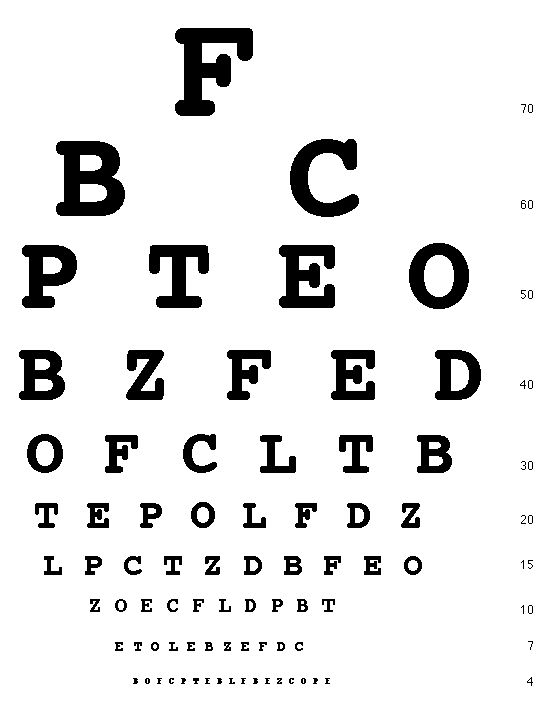 |
| Snellen Eye Chart |
Here's links to a bunch over at i-see.org
- ones you can use at the full on twenty feet. If you have an ipad, there's some free charts you can use at 8, but i'm not sure i'd want to use them solely. There's something to be said for having rays shining on paper and bouncing off. Could be wrong, just saying.
Tape measure
it's very good to know exactly where one's head is at that ten mark point.
Blutac or similar to stick up printed charts - and be able to move them around - up or down.
Wall or similar
Want to be able to stick up the charts nice and flat.
Space
depending on which chart used, you'll need to get to 8, 10 or 20 feet back to check yourself out. Me, i've started with a standard 20foot away chart but as the flat doesn't have a 20foot room, i'm sitting at 10feet away and just halfing the values. So if i get a line that says i'm at 20/20, i know it's really 20/40. But improvement is improvement. Alternately, and once i build up confidence, i can print the 20/20 chart at 50%. That's just mentally a hurdle cuz that's just SO SMALL right now for THAT FAR.
Bright Daylight or Simulacrum
Sunny days are better in my humble and limited experience than overcast. In the UK the former is rare: seize the opportunity. Morning light is grand. This may mean heading outside. As an alternative i've also used an LED ikea lamp, and a daylight type light on a chart bluetac'd up on the wall, but for me the best is a nice bright sunny morning.
Notebook/Pen - some kind of recording instrument
Have a log to take notes about the changes that will take place.
For those of us who work out and love to make ourselves go through all sorts of changes, we believe in logs, don't we? If we've been doing the change thing for awhile, we pull out a log because we believe that of course we'll change, and we want to know how to correlate what we do with what happens; the little science statisticians that we care and feed inside of us are all set to go. Same here: get out that log: believe that change is about to happen. If you're a geek (like me) you don't really take it seriously until the paper is out. There's going to be lots to measure here.
Set Up
Pretty simple set up: put up the chart at about eye level for the middle to start and back up so your eyes are X feet away from the chart (whatever your chart prescribes). Best: have lots of sun coming into the room.Instructions
Sit or stand - i started standing - and look at the chart.Base Line: Look at the Chart. What can you see? Even if you can't see any letters clearly, what's the shape? can you distinguish lines? how many distinctly? You may want to write this down or you may not believe what happens shortly. This is your personal base line.
For me i saw lines and could make out that there were letters, at least in the first couple, and could see a few if i squinted REALLY HARD. F! is it really that bad?? Even letters i could make out had a fuzzy aura. Like looking at the moon. Always a moon. And then some. You know? And if you have superior distance vision - well good for you. The rest of us are having a moment here.
Relax: Palming. Here's a big technique in the natural vision community to help relax between looking moments. Effectively, cup your hands, put them over your eyes such that no part of the hand is touching or squishing the eyes, but it's black in there when you open your eyes - now just stare into the blackness and wait for it to go black. Indeed, think about and remember what deep black is like. Count backwards from five if that helps. Just let your eyes relax in there. If the rest of you relaxes well that's really good too. Seeing is not efforting. It's un-efforting.
Relook at the chart. Move your hands away and staying super relaxed just let your eyes go to the chart - do not try to see anything and just notice what's different this time. Stay relaxed - no squinting; no straining. What's different? Sometimes, apparently it's common for folks to have a flash of something really clear and that's so surprising the view goes right back to fuzzy. Did that happen? If something like that happens, palm again; relax again; look again; rinse and repeat.
Notice what changes each time. And just BE with the chart. Seriously - the oddest thing to say is just rest your eyes on that chart. And let whatever happens happens.
But look; don't stare; don't squint; don't effort. Just look.
Rinse and repeat.
That's about it. A few notes on "it"ness below.
Waving not Drowning; Looking not Staring
A biggie for me in this process has been to get the difference between staring - trying to unsquint with my eyes wide open - wrong - and just looking. Letting the light come in, relaxing. Apparently the eye has to move to see things, so a fixed stare is not a good thing. It's efforting. Seeing is UnEfforting.The amazing thing: the first morning i tried this, mid workout (yes i keep the charts up where i work out so during recovery i can look at them as part of recovery. Very cool effect), i did freak out because after just kinda standing letters did seem to swim into view for a moment and then fuzz out again.
What a breakthrough position for me has been: eyes almost semi-closed it seems they're so frickin' relaxed, and then letting my head tilt back while staying looking at the chart, and opening my mouth. I don't know why about the head tilting back.
This breakthrough likely would not have happened without time to look and wait and see what happens. The other day i spent more or less the whole day engaged in this practicing looking (somewhat to my partner's chagrin "it's a little weird seeing you standing all day looking at the wall with your head back and your mouth hanging open").
Maybe so but in a day and a half, i got from the second line on the chart to the sixth. In this past day i'm on the 7th heading into the 8th. That's just bloody weird.
Time. The first four lines i can now consistently see pretty much right away. The next few lines, i need to wait, look and see. but i can do this sitting down, and without the head tilting as much now. I'm lucky with this: it's a long weekend and i'm caught up on work so rather than read a book (and get caught up on my reading) i reckon giving fixing up my vision a go would be time well spent. But that's the big deal, at least for me. If i'd only had ten or fifteen minutes a go, i don't know if i'd have made this kind of progress. Or even seen anything of note in that period.
It's been like a workshop where we spend a solid half day or day on a focused activity to get some real work done. And on that perspective, changes seem to be happening rapidly.
Slow Speed. It's still a slow process right now (still, ha! it's been three days - not even). I have to wait for the letters on the smaller lines to come into focus. I can't force them. And this is something i could kick optometrists about. Unlike that kind person at motor vehicles who suggested i just take it easy and try to get that letter again, optometrists will see me squirm and squint in a chair - the very opposite apparently of what is useful for our vision - and not say it's ok, breath, take your time. Let's see what emerges. Relax.
Have you ever had an eye doctor say Relax? Wait for It?I guess they don't have time: they have to get to that next appointment. Dang.
Whose Ideas are These, Anyway.
One name that comes up a lot in what i think may be called the Natural Vision area is William H. Bates who wrote Perfect Sight without Glasses.I didn't come to Bates directly, but rather via several other sources. I'm just going to list a couple that have made sense to me - and i don' t mean the science per se - just the approaches.
I started with something called Rebuild Your Vision without Glasses Contacts or Surgery by Orlin G. Sorensen (website for approach) that had a lot of vision drills in it that i had already learned from Z-Health that are themselves taken from behavioural optometry and sports vision work. These drills are most often used and taught for things like target acquisition, convergence, coordination and speed thereof, and being able to process visual information quickly enough in a cognitively demanding situation to perform better.
This is cool stuff, and very effective for a host of sensory-motor issues, but they are not about getting better distance vision, per se. And there were a lot of drills. The only new one was what turned out to be Bates's palming. But there was no applied context for the palming. So what. But i thought ok, when i get around to it, i'll give some of these exercises a more diligent go.
I'd seen other things on line that talked about exercises and i thought ya, when i get around to it.
Then i read a print out from Paul Anderson's site - Paul's Pathway to Normal Vision. The only exercise here was to relax one's eyes. That's it. Many many many suggestions for how to accomplish this feat of relaxation. Palming came back into the frame.
Just relax? that's all i have to do to see better? One of the things i really liked about Anderson's document was that he identified two things: coping strategies and common effects of eyes relaxing.
The main coping type? squinting (that's me). Side effects of relaxing vision - sometimes pain within the eyes; most often, tearing. Interesting. Made me think of trying to do a new skill and the muscles are all shakey. there are muscles in the eye, getting into a new pattern. That could smart. Ok. Interesting. Likewise that after relaxing one might have a flash of clear seeing. Wow, really? and then that's what happened.
And there was Bates again. So i got a copy of Bate's actual Perfect Vision Without Glasses and started reading it. What struck me there is how much of a deal he made of using a Snellen eye chart in classrooms, and what a big difference this made to students who not only started using it, but in a few cases, started using it on each other to help each other see better. That's the one that did it for me. Suffer the children?
I found a full 20 foot away Snellen chart with the big E on top going right down to the stuff that makes folks like me happy, a tiny print chart too, and started putting the Paul's relaxing stuff together with Bates's chart work. I also got a copy of an early Bates inspired person, W. Maccracken who wrote Normal Sight without Glasses in 1945, and got into more detail about the workings of the eye. Interesting again.
Now, Bates and his acolytes have other approaches than what i did, like sitting as close as ya need to to get a couple lines nicely in focus and then moving back a line at a time to build up focus. There are other eye exercises for imagination and recall that make much sense. I'm just telling you how i'm doing it:
I am standing or sitting 10 feet away (effectively half the standard distance away) from a full chart (explained) - something called the ETDRS which is supposed to be a better measure of acuity than Snellen (so what? it's less blurry standing here at this line than yesterday). It gets used in research a lot; i like it cuz it fits on a sheet.
When i get better than the 10ft line on that one (equivalent to the 20ft line if i were 20 feet away), i'll go to the 50% chart and keep my ten foot distance. I'm just about there but i'd like a more consistent lock on those letters in that line.
ETDRS visual acuity chart

Thoughts on Progress to Date
Ok i admit a horrible disappointment when i learned a sheet i thought must be for 10 feet away turned out to be one for 20 feet away. Oh no! what does that mean? Fail fail fail. Fail? Well, let's put that in perspective, shall we?If someone had said Wednesday that i'd be seeing a better than 20/20 line of text by Saturday i think i may have given them the Look of Dubiosity. I'm still absolutely skeptical and keep thinking this can't be real; after all i've read a LOT of posts by "professionals" saying that all this natural vision stuff is snake oil , and that astigmatisms and whatever else are fixed things, and vision is a fixed thing because of the shape of the eyeball etc etc eg this quotation:
Contrary to scientific fact, Bates taught that errors of refraction are due, not to the basic shape of the eyeball or the structure of the lens, but to a functional and therefore curable derangement in the action of the muscles on the outside of the eyeball. All defects in vision, he said, were caused by eyestrain and nervous tension; and perfect vision could be achieved by relaxing the eyes completely. Bates warned that eyeglasses cause the vision to deteriorate; he also deplored the use of sunglasses. Bates claimed his exercises could correct nearsightedness, farsightedness, astigmatism, and presbyopia (the inability of older people to focus their eyes on nearby objects). They could also cure such diseases as cataracts, eye infections, glaucoma, and macular degeneration. His exercises included palming (covering the eyes and attempting to see blackness) and shifting or swinging the gaze from object to object.
It should be obvious that these exercises cannot influence eyesight disorders as Bates claimed. Nearsightedness, farsightedness, astigmatism, and presbyopia result from inborn and acquired characteristics of the lens and the eyeball—which no exercise can change. [sic, and emphasis mine -mc] As for eye diseases, the only thing the exercises can do is delay proper medical or surgical treatment and result in permanent impairment of vision.Really? Like, really? I am for sure a vision can be improved skeptic - just because it's likely best protection against failure "see - i knew it wouldn't work; not cuz i didn't do it right but because, well, it's just because." But work in neurology amply teaches us we're plastic people and so adapt all the time, and that vision is cognitive. There's a lot happening and being coordinated between the moment light hits the lens and that light is perceived as something in the mind. A lot of opportunities to improve clarity.
When i look at these charts and just see a line get almost frighteningly black for a moment and then go grey - well something is happening. When over a couple hours or a night/day transition i am readily able to see lines i could not see before, what can i say? That's evidence of a sort is it not? I keep telling myself, well, those were just the easy lines, this next one, that's the killer; that's really gonna show you your limitations; you can't cross that one. Uh huh.
We are constantly reshaping ourselves and our bodies to adapt to what we do and how we do it. In z-health the SAID principle is revised from Specific Adaptation to Imposed Demand to the body is always adapting to exactly what we're doing. And so maybe the abnormal vision i've had is just the vision i've been practicing, and expecting.
For whatever reason i didn't see well at a distance, and no one was around to coach me on how to get that visual/cognitive connection to inform the muscular operations on the eye that let the muscles get light properly onto the retina that if i just slowed down, waited, and let the light in, vision could happen. I have never stopped to try to see if i could see better. Well that's not exactly true. I have squinted to beat the band to try to see something further away than i could get myself close enough to see better. And as anyone who's tried it knows, squinting is difficult to maintain full on for long.
Now i dunno about everybody's eyes out there, and anyone reading saying "ya but i have this kinda vision and that kinda affliction so this will never work for me" - Maybe - i don't know. But what do we have to lose? If one has seen the doctor and is preparing for either getting lenses or contacts or surgery, what does one have to lose in the interim by spending a few hours looking at a chart on a sunny day?
I would only encourage you to t a k e y o u r t i m e.
Let an hour pass. or more. Take a leap of faith. Relax
Application: Visually Doing Scales
Right now, this work of unEfforting Vision using these charts reminds me of practicing scales. Scales are exercises; they're not performances. They're used to help get the hands used to reaching for notes accurately if unmusically at various speeds and styles. That kind of technique work is then combined with practicing pieces - so applied technique to more real scenarios - until one is performing.Sadly this analogy sounds like work - like rather joyless efforting - rather than what practice at its best is: intent (discussion of intent on b2d here).
So far i've been doing scales: looking not staring with intent to experience visual accuity at different letter sizes at the same distance away. My closest real world practice has been to look out the window to a street sign that has been fuzzy only to find that on waiting for it - and head cocking and jaw slackening - that that sign has bloody numbers on the bottom of it, and i could at first make them out and then just see them, clearly. Each time i have to reacquire that clarity, but it's happening. That sounds pretty cognitive.
 |
| uk plates are in code |
I plan on staying this course for awhile longer. I haven't gotten to the bottom of the ETDRS chart (pdf) yet :) at either 10 feet or 20 feet, though i may be hitting S L O W L Y 20/20. And that has to be a measured first.
If you decide to give it a go, i'd be delighted to hear how you get on. i-see.org is a great site for charts, articles (like Bates in a nutshell) and related resources.
Related Posts:
- The Complete Athlete, Review
- Sensory motor performance: Training on the other side of the weight room
- What's a movement assessment
- Precognitve performance checks and balances
Subscribe to:
Comments (Atom)

 COACHING with dr. m.c.