Tuesday, January 18, 2011
Ottoman Pistol Part III: ankle bending
Follow @mcphoo
Tweet
In the previous two posts about the Ottoman Pistol we looked at the main muscles that are at play in this version of that assisted version of the one legged squat: the quads (pt 1) and the hamstrings and butt (pt 2).
 The Ankle. In this post we're looking at the last part of this series, and it's less about muscle work and more about movement. It's what happens at the ankles. Why bother to look at movement rather than muscle? It's the last key bendy bit of the move, if you will, and because we usually focus on the muscle side, we can kinda forget that the ankle joint is a key lever (with the knee and the hip) that lets that squat happen. Indeed in full pistols, you'll often hear folks talk about their ankles either a) supposedly not having enough flexibility or b) they cave into the side or c) can't stay down. Take a look at Franz Snideman's great video series on his revelations through the whole pistol for more.
So for today, it might be fun if not just interesting to take a look at what's going on around this wild joint.
Gastrocnemius and Soleus (S&G) First off, we're likely pretty familiar with the big muscles that work the ankle. They are the gastrocnemius (gastrocs for short) and soleus. They're what let us do calf raises, go on point, help control the foot kicking a football. These muscles are usually really strong in just about anyone. Indeed, if they actually test weak, it's likely sign of some other issue that problems with these the S&G.
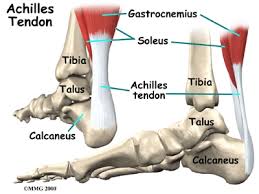 Two interesting things about the S&G (well i think so): they both connect into the one tendon in the body most of us know by its nick name: the achiles tendon (or tendo calcaneus, formally). It comes from the base of the muscles down the lower part of the lower leg and into the back of the back bone of the foot, that bone being the calcaneus. Contract those muscles, we pull up on that bone, we point our toes. That's the first interesting thing: the achiles tendon connection.
Different Origins. The second cool thing is that while they both connect to the same place at their insertions, the origin of each (the parts closest to the middle of the body) are very different - which kinda helps understand why we have both an S and a G rather than just one big muslce. The design also reflects how important this movement is (technically ankle plantar flexion, or bending towards the base of the foot).
The Soleus tucks in underneath the gastrocs and it connects along the upper shaft of the big bone of the lower leg, the tibia. We'll come back to that in a moment. The keen thing here is that the muscle is dedicated to *just* flexing the ankle down, and it's a biggie. The gastrocs on the other hand, kinda like the reins on a horse, goes around to the frontish of the femur. In other words, it crosses at the knee joint and so not only has an effect on the ankle, but also pulls on the knee to help bend/flex it.
Bottom line, there's a lot of muscle to help flex the foot, and flex the foot down while helping bend the knee.
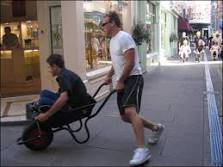 Super geeky aside: 2nd class lever. Plantar flexion of the foot when used to lift some or all of the body is one of the few examples in the body of what's know as a second class lever where the resistance (or load) is between the axis and the force. The usual example is a wheel barrow. The resistance is the load; the axis is at the wheel (ahead of the resistance) and the force is in the handles (behind the resistance).
If we look at the ankle - where to we see these three things? It's kinda clear that the pull or the force is at the achilles tendon on the calcaneus, right? So where's the axis or fulcrum? This only really comes into play when the foot is actually being used as a lever - as something to move something else (in physics the definition of work is the movement of an object). So, the ball of the foot (unless we're going on point perhaps) is the usual fulcrum of this lever (analogous to the wheelbarrow wheel). The resistance or load becomes effectively the stuff up through the tibia. The tibia, as we see is between the force and the axis/fulcrum. Jeeze that's cool.
Action in Pistol: More Eccentric Contraction. Just as we saw with the muscles of the knee and hip managing eccentric contraction to control lowering of the hip and of the knee (flexion), we're going to see the same eccentric contraction in the S&G for letting the lower leg roll forward at the ankle into dorsiflexion - the opposite of plantar flexion. Dorsiflexion has the angle between the top of the foot and the top of the shin decrease - which is exactly the motion that occurs as we squat down and the shin moves forward relative to the planted foot. The big soleus and gastrocs then pay themselves out under control to support the motion around the ankle. How cool is that?
Meanwhile, at the front of the leg, the tibialis anterior, peroneus tertius and related smaller extensor muscles are going to help by contracting at the front of the shin to help that forward action of dorsiflexon take place.
The ankle joint: wild bones wild bones. One of the amazing things about this joint we tend to take for granted is actually how sophisticated, articulated and mobile it is. When we think about a joint like the ankle we might think about something like a horseshoe with a bolt across the open bit and something like a block with a hole drilled through it hanging off the bolt. Ok, maybe that's just me.
The ankle joint is intriguingly more intrigued. The first bit of the ankle is that the bumpy bits that we feel and bang have names: malleoli. The malleoli are the bumpy bits at the base of the two bones that make up the shin: the bigger tibia that the femur rests upon for knee action with all that meniscus cartilege and acl/mcl joints, and the fibula, the smaller, thinner balance bone. The structure is similar to the lower arm's radius/ulnar double boning.
So ok, we have the malleoli that act as kind of connectors from the leg to the foot.
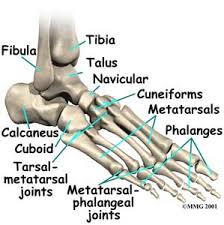 Talus/Calcaneus. Now it seems to me things get really impressively remarkable. The malleoli move atop a bone that sits atop a bone.
Let's go slowly (at least for me): the part of the foot that hits the ground at the back is the calcaneus. The bone that sits on top of this - doesn't touch the ground at all - is the talus. The malleoli articulate around the talus. The ankle joint therefore or what we think of as the ankle is actually four bones and three joints: bones are the tib and fib and the talus/calcaneus. The joints are the lateral malleoli with the talus, the medial malleoli with the talus and the taleo-calcaneal joint.
From all these connections, we might get a bit more clearly why the ankle may be vulnerable to sprain.
Just take a look at how intriguing the lacing is of the bones of this joint.
It Moves! It's ALIVE
An important thing to note, i think, to help conceptualize the ankle that goes beyond the first part of this post is that we're talking a complex mechanics here, not just a hinge joint.
When we say the achiles tendon conncects to the bone at the base back of the foot, pulls it, and the ankle bends, that sounds pretty simple. And it's a true statement, for a given granularity of truth. But those three joints in just the ankle - never mind the rest of the foot - suggest that the motion may be a little more suble. The achiles does pull on the calcaneus, but it's wrapped atop the talus, which is slotted between the malleoli - which as we see in the illustrations above is way forward of the tendon and also way above that pull point.
We're not even touching on the talus/calcaneus being the back stop for the little tarsals of the foot before getting to the bones that end up through multiple joints into the toes.
What's my point: with this many joints, that's a whole lot of movement going on.
Why have this much movement that we need three joints in the ankle alone?
The foot is how we usually first encounter the world. It lets us stand with the feet in full contact with the earth while we get our butt back and move our knees in, in our athletic ready stance. The foot can do this because its multiple joints support multiple angles of movement while still wrapping around some uneven surfaces and especially while distributing load from the rest of the body across some spingy shock absorbers. I could just go on and on about the miracle of the foot with 24 percent of the bones of our body in those two feet.
Since we're focusing on the ankle for the pistol, though, an important part to bear in mind is that the talus doesn't simply pivot like there's a bolt through one end of the malleoli to the other. There is give, movement as we move the joints in their capsules. For instane, As we bend the knee forward towards the foot on the floor, someone putting their fingers on our malleoli should feel the malleoli roll back - a wee bit - but back nonetheless. The two shin bones move back on the talus. IT's movement we can feel, especially as we practice ankle movements for mobility. Likewise, the lateral (side to side) movements of the ankle happen becuase of the shape of the bones, and also because of the flexibility of the tendons. Tendons are not always pulled up super tight. Muscles pull on them; different positions relax them and so on.
Take away: ankle movement is a complex interoperation of joints. To dorsiflex well in our ottoman pistol, we need to be sure our foot feels comfortable supporting dorsiflexion without collapsing (everting - the opposite direction to the movement shown in the image above).
One of the best ways to help the ankle is actually to work with all the joints: if there's an oddity in hip movement or knee movement or shoulder movement, that might show up in the ankle. The site of an issue isn't always the source.
That said, unless we have a movement practice, most of us don't do movement practice with our feet. Leaning in and out on the ankles from a tall spine - without having to involve the hips - is a potent practice. So is placing our foot behind us and resting on the top of the foot from multiple angles. Each of these motions helps lubricate the joints and tendons, but also practices the movements we need to control in our squat. Shoes that pass the twist test with mobile soles, and that let our ankles move more while walking are also great aids to better foot and gait practice.
SUMMARY
Muscularly, at the ankle in the pistol, the big players are the calf muslces, the soleus and gastrocs, as they eccentrically contract to help let the knee bend forward by braking that forward action by paying out the musculo/ligamentary line at the back of the leg/foot to let the shin come forward towards the ankle.
Joint Wise. The ankle is an interesting set of joints that are ligament to bone to musculo-tendonal levers. It acts like a hinge and like a ball in socket and like an inertial damper for load.
Improving that Base of Support. Sometimes just some simple movement work can improve the action of the joint *just* because they give the joint some practice in moving and practicing its range of motion - with and without load. Please note, we're not talking making the ankles either more stable or more mobile; we're talking simply about supporting whatever their movement needs are for the particular motion.
Recommendations. Please note: no one said that to improve dorsiflexion or ankle control, we need to stretch before squatting. No. We did not. A bit of a discussion around why not, here (threat and movement) and here (what's a warm up)
You're perhaps familiar with the approach i've found successful for myself and the folks i coach: i like z-health movement work for loaded and unloaded movement practice. THe movement template ensures that we get practice in a variety of positions/tensions/challenges. Doing this kind of joint prep work has been shown in some research to help reduce incidence of injury (see By Test Stronger section of this post). That's good. And decent control means better pistol.
Sometimes getting to that control may also mean some prelim practice work before going for the ottoman, both to reduce neuro-perceived threat and sometimes just plain old stress (tips for that one). If you'd like some help with dialing in what you need to succeed here, consider a coach - one who can do a movement assessment maybe even too. Master ZHealth Practitioners Ken Froese and Lou McGovern (remember his excellent tip for improving the press?) have pioneered using a movement with the sphenoid to help get people who haven't pistoled to pistol. We're just that complex and amazing.
Heres to enjoying our movement.
Pistol Resources:
- beast skills site
- Pavel Tsatsouline's The Naked Warrior
- Steve Cotter's Mastering the Pistol
Thanks for viewing this series. Hope it helps you enjoy your ottoman pistol practice even more
Related Ottoman Pistol Posts
So for today, it might be fun if not just interesting to take a look at what's going on around this wild joint.
Gastrocnemius and Soleus (S&G) First off, we're likely pretty familiar with the big muscles that work the ankle. They are the gastrocnemius (gastrocs for short) and soleus. They're what let us do calf raises, go on point, help control the foot kicking a football. These muscles are usually really strong in just about anyone. Indeed, if they actually test weak, it's likely sign of some other issue that problems with these the S&G.
Different Origins. The second cool thing is that while they both connect to the same place at their insertions, the origin of each (the parts closest to the middle of the body) are very different - which kinda helps understand why we have both an S and a G rather than just one big muslce. The design also reflects how important this movement is (technically ankle plantar flexion, or bending towards the base of the foot).
| different origins of the S (on the tibia) and G (on the femur) one crosses the knee (G); the other doesn't. |
Bottom line, there's a lot of muscle to help flex the foot, and flex the foot down while helping bend the knee.
If we look at the ankle - where to we see these three things? It's kinda clear that the pull or the force is at the achilles tendon on the calcaneus, right? So where's the axis or fulcrum? This only really comes into play when the foot is actually being used as a lever - as something to move something else (in physics the definition of work is the movement of an object). So, the ball of the foot (unless we're going on point perhaps) is the usual fulcrum of this lever (analogous to the wheelbarrow wheel). The resistance or load becomes effectively the stuff up through the tibia. The tibia, as we see is between the force and the axis/fulcrum. Jeeze that's cool.
| the bumpy bits of the ankle that we feel or see is really the bumpy bits at the bottom of the TWO bones of the shin: the tibia (big inside one) and the fibula (leaner outside one) |
The ankle joint: wild bones wild bones. One of the amazing things about this joint we tend to take for granted is actually how sophisticated, articulated and mobile it is. When we think about a joint like the ankle we might think about something like a horseshoe with a bolt across the open bit and something like a block with a hole drilled through it hanging off the bolt. Ok, maybe that's just me.
The ankle joint is intriguingly more intrigued. The first bit of the ankle is that the bumpy bits that we feel and bang have names: malleoli. The malleoli are the bumpy bits at the base of the two bones that make up the shin: the bigger tibia that the femur rests upon for knee action with all that meniscus cartilege and acl/mcl joints, and the fibula, the smaller, thinner balance bone. The structure is similar to the lower arm's radius/ulnar double boning.
So ok, we have the malleoli that act as kind of connectors from the leg to the foot.
Let's go slowly (at least for me): the part of the foot that hits the ground at the back is the calcaneus. The bone that sits on top of this - doesn't touch the ground at all - is the talus. The malleoli articulate around the talus. The ankle joint therefore or what we think of as the ankle is actually four bones and three joints: bones are the tib and fib and the talus/calcaneus. The joints are the lateral malleoli with the talus, the medial malleoli with the talus and the taleo-calcaneal joint.
From all these connections, we might get a bit more clearly why the ankle may be vulnerable to sprain.
Just take a look at how intriguing the lacing is of the bones of this joint.
It Moves! It's ALIVE
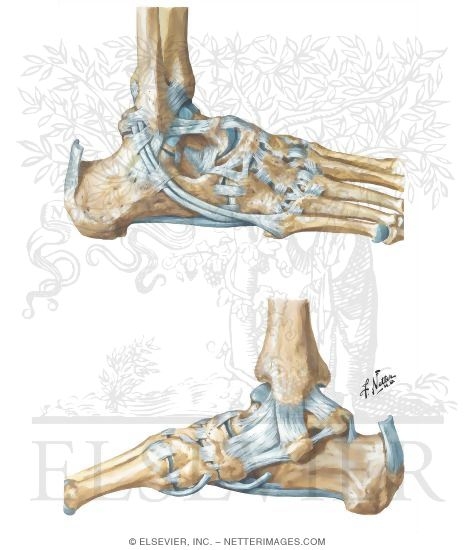 |
| the lacing of the malleoli with the taleo/calcaneal joint. |
When we say the achiles tendon conncects to the bone at the base back of the foot, pulls it, and the ankle bends, that sounds pretty simple. And it's a true statement, for a given granularity of truth. But those three joints in just the ankle - never mind the rest of the foot - suggest that the motion may be a little more suble. The achiles does pull on the calcaneus, but it's wrapped atop the talus, which is slotted between the malleoli - which as we see in the illustrations above is way forward of the tendon and also way above that pull point.
We're not even touching on the talus/calcaneus being the back stop for the little tarsals of the foot before getting to the bones that end up through multiple joints into the toes.
What's my point: with this many joints, that's a whole lot of movement going on.
Why have this much movement that we need three joints in the ankle alone?
The foot is how we usually first encounter the world. It lets us stand with the feet in full contact with the earth while we get our butt back and move our knees in, in our athletic ready stance. The foot can do this because its multiple joints support multiple angles of movement while still wrapping around some uneven surfaces and especially while distributing load from the rest of the body across some spingy shock absorbers. I could just go on and on about the miracle of the foot with 24 percent of the bones of our body in those two feet.
| multijoint action allows for sophisticated movement around the joint while staying vertical - when we don't practice these movements we can hurt the lacing that has no practice with the strain at end range of motion |
Take away: ankle movement is a complex interoperation of joints. To dorsiflex well in our ottoman pistol, we need to be sure our foot feels comfortable supporting dorsiflexion without collapsing (everting - the opposite direction to the movement shown in the image above).
One of the best ways to help the ankle is actually to work with all the joints: if there's an oddity in hip movement or knee movement or shoulder movement, that might show up in the ankle. The site of an issue isn't always the source.
That said, unless we have a movement practice, most of us don't do movement practice with our feet. Leaning in and out on the ankles from a tall spine - without having to involve the hips - is a potent practice. So is placing our foot behind us and resting on the top of the foot from multiple angles. Each of these motions helps lubricate the joints and tendons, but also practices the movements we need to control in our squat. Shoes that pass the twist test with mobile soles, and that let our ankles move more while walking are also great aids to better foot and gait practice.
SUMMARY
Muscularly, at the ankle in the pistol, the big players are the calf muslces, the soleus and gastrocs, as they eccentrically contract to help let the knee bend forward by braking that forward action by paying out the musculo/ligamentary line at the back of the leg/foot to let the shin come forward towards the ankle.
Joint Wise. The ankle is an interesting set of joints that are ligament to bone to musculo-tendonal levers. It acts like a hinge and like a ball in socket and like an inertial damper for load.
Improving that Base of Support. Sometimes just some simple movement work can improve the action of the joint *just* because they give the joint some practice in moving and practicing its range of motion - with and without load. Please note, we're not talking making the ankles either more stable or more mobile; we're talking simply about supporting whatever their movement needs are for the particular motion.
Recommendations. Please note: no one said that to improve dorsiflexion or ankle control, we need to stretch before squatting. No. We did not. A bit of a discussion around why not, here (threat and movement) and here (what's a warm up)
You're perhaps familiar with the approach i've found successful for myself and the folks i coach: i like z-health movement work for loaded and unloaded movement practice. THe movement template ensures that we get practice in a variety of positions/tensions/challenges. Doing this kind of joint prep work has been shown in some research to help reduce incidence of injury (see By Test Stronger section of this post). That's good. And decent control means better pistol.
Sometimes getting to that control may also mean some prelim practice work before going for the ottoman, both to reduce neuro-perceived threat and sometimes just plain old stress (tips for that one). If you'd like some help with dialing in what you need to succeed here, consider a coach - one who can do a movement assessment maybe even too. Master ZHealth Practitioners Ken Froese and Lou McGovern (remember his excellent tip for improving the press?) have pioneered using a movement with the sphenoid to help get people who haven't pistoled to pistol. We're just that complex and amazing.
 |
| yup, the sphenoid |
Heres to enjoying our movement.
Pistol Resources:
- beast skills site
- Pavel Tsatsouline's The Naked Warrior
- Steve Cotter's Mastering the Pistol
Thanks for viewing this series. Hope it helps you enjoy your ottoman pistol practice even more
Related Ottoman Pistol Posts
- Part 1: the quads
- Part 2 the hip and hamstrings

 PDF
PDF

Monday, January 10, 2011
Main Muscles in the Ottoman Pistol, Part 2: the butt
Follow @mcphoo
Tweet
In the previous post, we considered the quads' role in the ottoman pistol. This post we'll take a wee look at the butt and hamstrings. Remember the quads are largely knee extensors and hip flexors. The vastus group stabilizes the knee, and particularly helps us as we stand up - contracting the quads locks the knee cap for instance. The butt and hamstrings work the back of the leg and knee and hip to flex the knee and extend the hip, as in the runner's leg going back in the sprint.
SO let's take a look at how this muscle combo works in the pistol.
 The Butt - the Glutius Maximus
 We know that the knees HAVE to straighten for us to stand up in the pistol. But there's another big body part that changes, too, and that's the hip. The hip extends as we move from the squat position where the pelvis is flexed, to standing up, where it's extending. But the movement in the squat not only has the hip extending but the leg externally rotating (turning out) and moving away from midline, or abducting.
 The muscles that extend the hip include the biggest muscle in the body: the gluteus maximus. Hip extension (and external rotation of the leg, or the leg turning out) must take alot of work if it has such mass associated with it.
THis massive muscle is interesting in the way it connects to the body: it attaches to the back of the pelvis - that makes sense since it has to connect with the hip. It also connects along the sacrum - the lowest part of the back, if you will.
The muscle connects into the femur at the gluteal tuberosity and into the iliotibial tract (IT band). That tract connects into the top of the tibia - in other words the butt effectively connects over the hip and past the knee into the lower leg. So the butt also helps support the knee via the IT band when the knee is extended (when we're standing up.
The Hamstrings: Biceps Femoris, Semitendinous and Semimembranous Muscles
Along the back of the the leg run the hamstrings or biceps femorous, semimembranous and semitendinous muscles. .
Origins. The semimembranous and semitendenous muscles along with the long head of the biceps femoris all connect into the ishial tuberosity of the pelvis (into the sitting bones if you will). The short head of the biceps femoris however does not connect to the pelvis. Instead it connects into the femur.
Insertions. The Semis connect into the tibia or the medial side of the knee. The biceps femoris, to the lateral side of the tibia (top of lower leg).
With the hamstrings, then, we have a set of muscles that connects to the pelvis to pull it into extension (to straighten it), and likewise connects with the knee to pull it into flexion (to bend). In the case of the pistol, where the foot is on the floor and stays there, the main action of the hamstrings will be on the hip.
(Aside: It's in running and kicking for instance where the knee is working that we'd see the hamstrings come in more with the knee, but when the leg stays nailed to the floor, or the knee is immobile, the hammies will work the hip).
Working the Pistol
Going Down. As we saw, the quads help the knee, trunk and flexed hip on the way down into the bottom position of the pistol (eccentric contraction). In going down, the glute max and the hamstrings are also on, also eccentrically contracting, actively helping to let the hips flex. That's their main action in the descending leg: eccentric contraction to assist hip flexion.
Coming Back Up. Once down, the glute max will get active to extend the hip (concentric contraction) as we start to come up, and the hamstrings will contribute to pull the hip into extension (concentric contraction) as well.
A note on Eccentric Contraction:
Just to review the knee/hip part of this movement, the quad group (the thigh) on the way down is doing "eccentric contraction" (ec) - controlling the speed of the bend of the knee: it is contracting muscle fibers while the muscle still lengthens to allow the limbs to move. The butt is likewise doing eccentric contraction on the way down to help control the movement of the hip into flexion.
Imagine someone lowering something on a rope: to pay out the rope slowly, one is applying some tension somewhere to control the descent, else the rope will just slide through one's hands. If one is lowering a piano from a building, the important ropes - the ones taking the strain - are the lowering ropes; there may be folks on the ground gathering up rope on either side of the piano to guide it to make sure it doesn't hit a wall on the way down, but the heavy lifting as it were is in the lowering, the paying out of the rope.
Two other points about EC: we're also stronger in eccentric contraction than concentric contraction: it's easier to lower a piano to the ground than pick it up. And finally - a reminder that eccentric contraction kicks off DOMS more so than concentric contraction.
Wrap up of the Butt (really glute max) and Hamstrings
So the pistol is certainly working the legs and butt big time: a lot of eccentric conrtaction for controlling the movement of the hip into flexion on the way down and conversely a lot of concentric contraction to help the hip get back up to neutral.
Plainly this move does a LOT for the lower body - by using one leg, bodyweight becomes a significant challenge for that first rep or multiple reps. Many other stabiliser muscles come into play in these movements; there's also considerable vestibular challenge in this movement as we must add more balance control to succeed. But for now, let's get the biggies figured out.
Next time, in the last of this series, we'll look at the last major bit of the ottoman pistol, the ankles.
Pistol Resources:
- beast skills site
- Pavel Tsatsouline's The Naked Warrior
- Steve Cotter's Mastering the Pistol
Related Articles
SO let's take a look at how this muscle combo works in the pistol.
The Butt - the Glutius MaximusWe know that the knees HAVE to straighten for us to stand up in the pistol. But there's another big body part that changes, too, and that's the hip. The hip extends as we move from the squat position where the pelvis is flexed, to standing up, where it's extending. But the movement in the squat not only has the hip extending but the leg externally rotating (turning out) and moving away from midline, or abducting.The muscles that extend the hip include the biggest muscle in the body: the gluteus maximus. Hip extension (and external rotation of the leg, or the leg turning out) must take alot of work if it has such mass associated with it.THis massive muscle is interesting in the way it connects to the body: it attaches to the back of the pelvis - that makes sense since it has to connect with the hip. It also connects along the sacrum - the lowest part of the back, if you will.
The muscle connects into the femur at the gluteal tuberosity and into the iliotibial tract (IT band). That tract connects into the top of the tibia - in other words the butt effectively connects over the hip and past the knee into the lower leg. So the butt also helps support the knee via the IT band when the knee is extended (when we're standing up.
The Hamstrings: Biceps Femoris, Semitendinous and Semimembranous Muscles
 |
| great kinesiology resource |
Origins. The semimembranous and semitendenous muscles
along with the long head of the biceps femoris all connect into the ishial tuberosity of the pelvis (into the sitting bones if you will). The short head of the biceps femoris however does not connect to the pelvis. Instead it connects into the femur.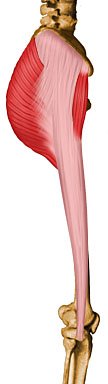 |
| glute max joining IT band into Tibia |
With the hamstrings, then, we have a set of muscles that connects to the pelvis to pull it into extension (to straighten it), and likewise connects with the knee to pull it into flexion (to bend). In the case of the pistol, where the foot is on the floor and stays there, the main action of the hamstrings will be on the hip.
(Aside: It's in running and kicking for instance where the knee is working that we'd see the hamstrings come in more with the knee, but when the leg stays nailed to the floor, or the knee is immobile, the hammies will work the hip).
Working the Pistol
Going Down. As we saw, the quads help the knee, trunk and flexed hip on the way down into the bottom position of the pistol (eccentric contraction). In going down, the glute max and the hamstrings are also on, also eccentrically contracting, actively helping to let the hips flex. That's their main action in the descending leg: eccentric contraction to assist hip flexion.
Coming Back Up. Once down, the glute max will get active to extend the hip (concentric contraction) as we start to come up, and the hamstrings will contribute to pull the hip into extension (concentric contraction) as well.
A note on Eccentric Contraction:
Just to review the knee/hip part of this movement, the quad group (the thigh) on the way down is doing "eccentric contraction" (ec) - controlling the speed of the bend of the knee: it is contracting muscle fibers while the muscle still lengthens to allow the limbs to move. The butt is likewise doing eccentric contraction on the way down to help control the movement of the hip into flexion.
Imagine someone lowering something on a rope: to pay out the rope slowly, one is applying some tension somewhere to control the descent, else the rope will just slide through one's hands. If one is lowering a piano from a building, the important ropes - the ones taking the strain - are the lowering ropes; there may be folks on the ground gathering up rope on either side of the piano to guide it to make sure it doesn't hit a wall on the way down, but the heavy lifting as it were is in the lowering, the paying out of the rope.
Two other points about EC: we're also stronger in eccentric contraction than concentric contraction: it's easier to lower a piano to the ground than pick it up. And finally - a reminder that eccentric contraction kicks off DOMS more so than concentric contraction.
Wrap up of the Butt (really glute max) and Hamstrings
So the pistol is certainly working the legs and butt big time: a lot of eccentric conrtaction for controlling the movement of the hip into flexion on the way down and conversely a lot of concentric contraction to help the hip get back up to neutral.
Plainly this move does a LOT for the lower body - by using one leg, bodyweight becomes a significant challenge for that first rep or multiple reps. Many other stabiliser muscles come into play in these movements; there's also considerable vestibular challenge in this movement as we must add more balance control to succeed. But for now, let's get the biggies figured out.
Next time, in the last of this series, we'll look at the last major bit of the ottoman pistol, the ankles.
Pistol Resources:
- beast skills site
- Pavel Tsatsouline's The Naked Warrior
- Steve Cotter's Mastering the Pistol
Related Articles
- All About Delayed Onset Muscle Soreness, Part 1 - causes
- All about DOMS part 2: aids at reduction of DOMS
- Somatosensory hierarchy: working the other side of the weight room
Sunday, January 2, 2011
Main Muscle Movement in the Ottoman Pistol - Part 1: the Quads
Follow @mcphoo
Tweet
The (let's call it) Ottoman Pistol described yesterday - works a potent combination of muscles. We know what these muscles are because we usually feel them if we haven't pistoled in awhile: quads (front of leg), glutes (butt), sometimes the adds (adductors - inside leg), and some of that core goodness too. In this first post we'll take a quick look at what's happening with the quads - what those muscles are, and especially, why they're firing up in the Ottoman Pistol.
The Quads
Often the most felt muscles in this abbreviated leg squat are those at the front of the leg, aka the quads The quad group has four big muscles: the vastus set of medialis, lateralis, intermedius and the big front and top muscle (lies atop the intermedius), the rectus femoris. All four of these muscles meet at the knee cap - the patella and from there, hook into the lower leg.
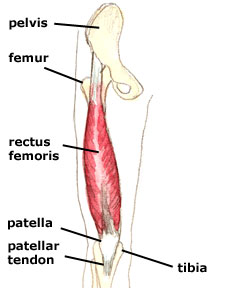 The Vastus Group vs the Rectus Femoris. While the full quad group has a lot in common, there's a big distinction between the rec fem and the vastus group. The vastus set cross the knee and connect along the top of the big honking top-of-the-leg femur bone. The rectus femoris on the other hand actually hooks onto the pelvis itself rather than the femur. Isn't that wild? These four muscles share common connections at the knee, and then diverge where they start: hip vs leg. In other words, the rec.fem. crosses two joints - in this case both the knee and the hip - while the vast group of vastus muscles only cross one joint, the knee.
The Quad Job This difference in hook ups influences the main job of the muscles that make up the quads.
The vastus set acts on the knee to extend it or straighten it out; the rectus femoris, while it also crosses the knee mainly acts to flex the hip or to bring the knee up towards the chest. In the bottom of the squat, the hip is pretty durn flexed.
Integrating the muscle movement with the Pistol. Since we feel the pistol the next day in the front of the legs, we know the quads are involved. We also know now that the quads give us two actions in particular: (1) flexing the hip and (2) extending the knee.
Where's hip flexion in the pistol? IT's in two parts of the movement: the leg controlling the decent (that's going into flexion), and the leg that is extended out. That leg is being held in hip flexion.
In the descending/bending leg, the rectus femoris is stretched. We can see from where it attaches up on the pelvis that as one goes down, and that muscle is activated, it's going to pull the pelvis forward - the pelvis rotates around the hip as the angle between the leg and the pelvis closes down from 180 to 45 degress or less. The RF is not the only muscle involved here, but it's the biggie.
In the extended leg case, a couple core muscles - the psoas and illiacus - are doing more of the work to hold out the extended leg than the rec fem to keep that 90 degree flexion. That's because the RF is at its shortest when the knee is extended and the leg flexed, so it's not getting as big an advantage on the hip.
The more the knee bends, the more the rec fem comes into gear for flexing the leg/hip.
Where's the knee extension in the pistol? When we go to stand back up, the knee extends. That's perhaps the biggest work load of the pistol. And boy do we know that that knee extension, aka standing up, is a challenge. Getting down takes a certain control, absolutely, but gravity guarentees that's the direction we'll move. Getting up is where the money is, and that means knee extension.
Summary: Why we feel the pistol in the Thigh.
There are two big actions in the pistol: hip flexion and knee extension. In other words, going into the squat and coming up from it.
Hip flexion comes in two places: in getting a leg out in front of us and in the descent into the squat position. In the quad group, hip flexion involves the rectus femoris in both of these positions, but in particular in the descent into the squat.
Knee extension comes in majorly as we stand up. The quads pull this off via the vastus muscles pulling over the knee cap by their connection at the top of the femur, the big leg bone. The rectus femoris pulls over the same part of the knee but gets reefed up by that muscle reefing up from the hip. Two big levers therefore pull up the knee into a straightened position.
Next Time
The other big player in the pistol is the butt, aka the glutes. Next time we'll look at how that group of muscles' actions of hip extension, external rotation and abduction contribute to those two big moves in the pistol: the squat and the standing up.
Happy New Year
Pistol Resources:
- beast skills site
- Pavel Tsatsouline's The Naked Warrior
- Steve Cotter's Mastering the Pistol
Related posts:
 |
| from the Beast Skills how to pistol tutorial: a light butt touch for the ottoman pistol |
Often the most felt muscles in this abbreviated leg squat are those at the front of the leg, aka the quads The quad group has four big muscles: the vastus set of medialis, lateralis, intermedius and the big front and top muscle (lies atop the intermedius), the rectus femoris. All four of these muscles meet at the knee cap - the patella and from there, hook into the lower leg.
 |
| From Grant's Dissector (ch6) the rec fem is reflected so we can see the vastus intermedius underneath and the lateralis and medialis to either side. |
The vastus set acts on the knee to extend it or straighten it out; the rectus femoris, while it also crosses the knee mainly acts to flex the hip or to bring the knee up towards the chest. In the bottom of the squat, the hip is pretty durn flexed.
In the descending/bending leg, the rectus femoris is stretched. We can see from where it attaches up on the pelvis that as one goes down, and that muscle is activated, it's going to pull the pelvis forward - the pelvis rotates around the hip as the angle between the leg and the pelvis closes down from 180 to 45 degress or less. The RF is not the only muscle involved here, but it's the biggie.
In the extended leg case, a couple core muscles - the psoas and illiacus - are doing more of the work to hold out the extended leg than the rec fem to keep that 90 degree flexion. That's because the RF is at its shortest when the knee is extended and the leg flexed, so it's not getting as big an advantage on the hip.
The more the knee bends, the more the rec fem comes into gear for flexing the leg/hip.
Where's the knee extension in the pistol? When we go to stand back up, the knee extends. That's perhaps the biggest work load of the pistol. And boy do we know that that knee extension, aka standing up, is a challenge. Getting down takes a certain control, absolutely, but gravity guarentees that's the direction we'll move. Getting up is where the money is, and that means knee extension.
Summary: Why we feel the pistol in the Thigh.
There are two big actions in the pistol: hip flexion and knee extension. In other words, going into the squat and coming up from it.
Hip flexion comes in two places: in getting a leg out in front of us and in the descent into the squat position. In the quad group, hip flexion involves the rectus femoris in both of these positions, but in particular in the descent into the squat.
Knee extension comes in majorly as we stand up. The quads pull this off via the vastus muscles pulling over the knee cap by their connection at the top of the femur, the big leg bone. The rectus femoris pulls over the same part of the knee but gets reefed up by that muscle reefing up from the hip. Two big levers therefore pull up the knee into a straightened position.
Next Time
The other big player in the pistol is the butt, aka the glutes. Next time we'll look at how that group of muscles' actions of hip extension, external rotation and abduction contribute to those two big moves in the pistol: the squat and the standing up.
Happy New Year
Pistol Resources:
- beast skills site
- Pavel Tsatsouline's The Naked Warrior
- Steve Cotter's Mastering the Pistol
Related posts:
- The magic shoulder part one: scapula rigging
- The magic shoulder part two: g/h joint
- overview of fat
- magnificent protein - not just about muscles
Friday, December 31, 2010
We Can Do It - The House Hold Objects of Health
Follow @mcphoo
Tweet
The best part of a hotel room for working out - at least my favorite item? The ottoman. Yes the humble foot rest. Why? Leg work; butt work and DOMS to go.
To be more particular, i'm talking the ottoman meets the single leg squat, aka the pistol. The pistol move is where one puts out one leg in front and - in the complete move - drops down to a full squat and stands back up again. This is an awesome move. But unless one is steve cotter, doing 50 of these may be a bit of a stretch.
Enter the ottoman. It makes pistols accessible, practicable and fun. Here's how. One can sit down with the leg extended, butt right to the middle of the ottoman and rest, and then stand up on the one leg. One can also just use the edge of the ottoman to touch down as lightly as possible - using it more as a safety stop than a rest - and come back up again.
 As for set styles, one can do right leg then left leg for say ten total in a set. Or five and five (or two and two). Rest and repeat.
A lovely Move. There are some really nice bits to this movement: knowing that the ottoman is there to limit the range of motion and to act as a catch enables one to practice control of the descent - we can work on going super slow or faster. We can go down with both feet on the ground. Sit, and come up on one leg.
Butt and Quads A very nice thing about this move is that the position works the butt and the quads in particular - but it also hits the all important core to keep oneself steady while moving down and then up.
Next couple posts we'll look at How the ottoman pistol works those muscle groups. In the meantime, to all those hotel warriors out there, happy new year's eve, and let me know if you give this move a go.
Follow up, Part 1: how the thighs (quads) work in the pistol.
Follow up, part 2: how the glutes (butt) work in the pistol
Follow up part 3: how the ankles work in the pistol
best for 2011.
-mc
if you'd like to learn more about the Pistol, lots of great places:
- beast skills site
- Pavel Tsatsouline's The Naked Warrior
- Steve Cotter's Mastering the Pistol Tweet Follow @begin2dig
 |
| pistol about mid way down |
Enter the ottoman. It makes pistols accessible, practicable and fun. Here's how. One can sit down with the leg extended, butt right to the middle of the ottoman and rest, and then stand up on the one leg. One can also just use the edge of the ottoman to touch down as lightly as possible - using it more as a safety stop than a rest - and come back up again.
 As for set styles, one can do right leg then left leg for say ten total in a set. Or five and five (or two and two). Rest and repeat.
 |
| Full butt on seat - but can go just to the edge, too |
Butt and Quads A very nice thing about this move is that the position works the butt and the quads in particular - but it also hits the all important core to keep oneself steady while moving down and then up.
Next couple posts we'll look at How the ottoman pistol works those muscle groups. In the meantime, to all those hotel warriors out there, happy new year's eve, and let me know if you give this move a go.
Follow up, Part 1: how the thighs (quads) work in the pistol.
Follow up, part 2: how the glutes (butt) work in the pistol
Follow up part 3: how the ankles work in the pistol
best for 2011.
-mc
if you'd like to learn more about the Pistol, lots of great places:
- beast skills site
- Pavel Tsatsouline's The Naked Warrior
- Steve Cotter's Mastering the Pistol Tweet Follow @begin2dig
Friday, December 24, 2010
When Free really means "trade ya; won't tell ya"
Follow @mcphoo
Tweet
At this festive season, we know marketing tries to hit new heights to entice sales. There's one technique that has begun to grate. It's the promise of "free" that doesn't really mean free. Has this happened to you? You're sent a link to something that sounds super helpful; it claims to be free, but then here's what happens:
first step: - an email address is requested Hmm. Why do i need to provide this email address? We are now moving out of the world of free and engaging in an exchange, are we not?
 Second step: confirmation. It turns out giving an any email address is not sufficient - i must confirm the email address by clicking a magic link in an email, and then a link to the promised free material will be provided.
Why not just give me the "free" link?
Ah! there's something tied to the email address - a desire to use it?
Third step: mailing list . finally becomes apparent when the link is sent that one is really subscribing to an email list to get more mailings and "offers" from this person.
Is this exchange actually as promised, free? Well, no, it's not: it's a trade. The currency is my email address and willingness to be on an email list before i get the goods.
Of course (presumably) i can "unsubscribe" from the list, but these terms aren't shared because we're not actually told that we're signing up for an email list. but have you tried to do this with any companies whose mailing lists you seem to be on? Some lists seem never to want to let go despite how much time one takes to go through the process.
But i stray from the point. What gals me is that FREE doesn't mean free. When i go to the store and am offered a "free" sample, it's given to me as an actually FREE sample - no strings attached. When i go to someone's web site, and i get information, that's FREE - no strings attached. That's free.
What most of these mailings are about is not free, but is about a trade: my email (and subscription) in exchange for the item. My time to conclude this exchange for the item.
What also bugs me is the lack of transparency in these exchanges: the page that claims FREE STUFF does not say " once i get your email, you can have this thing." That's only a state one infers many clicks in that one finds out what's going on, and sometimes not until the mail starts pouring in after the fact. And so how evaluate if this exchange (not free give away) is fair value? is worth the price?
There are alternatives. Why not simply make it clear that the vendors are keen to trade what they have on offer in exchange for a confirmed email address & free subscription to said vendor's mailing list? That seems both more honest and more engaging? The terms and conditions as it were?
Isn't this what reputable businesses do? I was fascinated recently by an "affiliate marketing" product (and yup this is an affiliate link) recently that went through long pages of detail about what's in the product, how it works and also went into human-readable detail about what this product would NOT do - so that if you still wanted to get the product after that - fair warning. That was amazing.
I go on and on about precision nutrition: it's 40 page overview book IS free: click the link. Ta da. download. Do they still sell product? Yes.
Now, i'm not going to blame these folks for bait and switch who use the term Free when they mean Trade. THere's a ton of marketing guidance that seems to suggest that this is exactly the way to sell stuff online. Promise FREE as a way to get a name on a mailing list, and build clients from there. It seems that's become so common, we may even no longer expect "free" to mean "free" - it's more like "free, wink wink nudge nudge"
Me, all i'm saying is that that's not what Free means, and i'm sick of it. And perhaps folks who think they do well with their fake free may even do better with real trade. And wouldn't that be a wonderful gift for the holiday season.
All the best,
mc
Related Links
first step: - an email address is requested Hmm. Why do i need to provide this email address? We are now moving out of the world of free and engaging in an exchange, are we not?
Why not just give me the "free" link?
Ah! there's something tied to the email address - a desire to use it?
Third step: mailing list . finally becomes apparent when the link is sent that one is really subscribing to an email list to get more mailings and "offers" from this person.
Is this exchange actually as promised, free? Well, no, it's not: it's a trade. The currency is my email address and willingness to be on an email list before i get the goods.
Of course (presumably) i can "unsubscribe" from the list, but these terms aren't shared because we're not actually told that we're signing up for an email list. but have you tried to do this with any companies whose mailing lists you seem to be on? Some lists seem never to want to let go despite how much time one takes to go through the process.
But i stray from the point. What gals me is that FREE doesn't mean free. When i go to the store and am offered a "free" sample, it's given to me as an actually FREE sample - no strings attached. When i go to someone's web site, and i get information, that's FREE - no strings attached. That's free.
What most of these mailings are about is not free, but is about a trade: my email (and subscription) in exchange for the item. My time to conclude this exchange for the item.
What also bugs me is the lack of transparency in these exchanges: the page that claims FREE STUFF does not say " once i get your email, you can have this thing." That's only a state one infers many clicks in that one finds out what's going on, and sometimes not until the mail starts pouring in after the fact. And so how evaluate if this exchange (not free give away) is fair value? is worth the price?
There are alternatives. Why not simply make it clear that the vendors are keen to trade what they have on offer in exchange for a confirmed email address & free subscription to said vendor's mailing list? That seems both more honest and more engaging? The terms and conditions as it were?
Isn't this what reputable businesses do? I was fascinated recently by an "affiliate marketing" product (and yup this is an affiliate link) recently that went through long pages of detail about what's in the product, how it works and also went into human-readable detail about what this product would NOT do - so that if you still wanted to get the product after that - fair warning. That was amazing.
Aside. Indeed, if you're interested in marketing at all - as a discipline and a demonstration of psychology and have some time, i'd encourage you just to move through this thing - it's Dan Brock's Super Deadbeat affiliate how to program/course thingOk, that's a for sale example. Another example of free stuff has got to be Brad Pilon's site on Eat Stop Eat - lots of value in the information posts about eating and working out. And yes, Pilon has stuff to sell, but you can get a ton from the web site. I'm happy to buy his stuff as a sign of gratitude for all the free stuff.
All i can tell you right now is that i've bought it; i'm fascinated by the material and presentation, and look forward to some time in the first quarter of the new year to have a go with it. It's not free BUT i got as said more than enough information from the overview to make a decision about spending 29 bucks on the potential to get a return on that investment and maybe a bit more.
I can also say that from a brief look through the actual course/material, just as the warnings for the product claim, while the couase makes the steps easy to follow, it does take some attention to detail to have a good go. One may only spend an hour in the office with this, but it's going ot be a *very focused hour*

I go on and on about precision nutrition: it's 40 page overview book IS free: click the link. Ta da. download. Do they still sell product? Yes.
Now, i'm not going to blame these folks for bait and switch who use the term Free when they mean Trade. THere's a ton of marketing guidance that seems to suggest that this is exactly the way to sell stuff online. Promise FREE as a way to get a name on a mailing list, and build clients from there. It seems that's become so common, we may even no longer expect "free" to mean "free" - it's more like "free, wink wink nudge nudge"
Me, all i'm saying is that that's not what Free means, and i'm sick of it. And perhaps folks who think they do well with their fake free may even do better with real trade. And wouldn't that be a wonderful gift for the holiday season.
All the best,
mc
Related Links
- Affiliate Links at b2d
- Fitness Geek Gifts
- and any of the links along the side of the blog - stuff i've tried, use, recommend
Thursday, December 9, 2010
The Drinkulator: fast liver risk test for alcohol consumption this festive season.
Follow @mcphoo
Tweet
Did you know that our solid organs don't have pain sensors? So our liver and kidneys in particular can't tell us they're in distress in the same way a strained shoulder can. No direct pain cry. This lack of direct pain signalling is part of why we often don't catch liver and kidney diseases at an effectively early stage, unless they're caught indirectly.
One of the indirect ways to check our liver function is related to drinking. How's your drinking level liver health? Turns out this correlates rather strongly to liver disease risk - a surprisingly high killer - the only one going up still year on year (at least in britain)
Whether it's an evening tipple or a weekend head banger, alcohol does different things to us at different times and at different ages (one advantage to aging apparently is alcohol tolerance changing. Yes, up).
 But there's also a lot of variables around what affects risks around alcohol consumption vs. tolerances. If we're not testing we're guessing. Would a liver check be a good idea? How would you know?
The great thing is, it's pretty straight ahead to check potential risk to see if you or a loved one may need to get a particular check.
Here's a fast and easy approach to a liver alcohol check colleagues over in Medicine developed that uses a simple traffic light evaluation: red get thee to your doctor; amber something to think about; green for good. It's called the Drinkulator. See where you're at. You may be happily surprised. It may also be another health link, too, to share with your pals this festive season.
Enjoy. Tweet Follow @begin2dig
One of the indirect ways to check our liver function is related to drinking. How's your drinking level liver health? Turns out this correlates rather strongly to liver disease risk - a surprisingly high killer - the only one going up still year on year (at least in britain)
Whether it's an evening tipple or a weekend head banger, alcohol does different things to us at different times and at different ages (one advantage to aging apparently is alcohol tolerance changing. Yes, up).
The great thing is, it's pretty straight ahead to check potential risk to see if you or a loved one may need to get a particular check.
Here's a fast and easy approach to a liver alcohol check colleagues over in Medicine developed that uses a simple traffic light evaluation: red get thee to your doctor; amber something to think about; green for good. It's called the Drinkulator. See where you're at. You may be happily surprised. It may also be another health link, too, to share with your pals this festive season.
Enjoy. Tweet Follow @begin2dig
Tuesday, December 7, 2010
Fat don't make us fat - surprise, eh?
Follow @mcphoo
Tweet
Do you see ads saying "fat free" or "fat reduced"? or read articles saying that fat is bad, especially if trying to lose weight? Me too. Thing is, such approaches are sort of a misleading. Main thing: eating fat doesn't make us fat; indeed fat is essential to our health. Indeed, a blend of different types of fats is critical. And, believe it or not, that blend of fats helps us burn our stored fat better. This post is meant as a quick overview of these points. Later we'll look at some strategies to make fat work better for us.
First things first: what's losing weight, anyway?
First up: when we talk about "losing weight" what most of us really want is to reduce the amount of stored fat - adipose tissue - we have. That's what it means to get lean: increase the ratio of lean tissue (muscle, bone - everything not fat) to fat.
 When ads for weight loss programs talk about losing four pounds or more in one week, they are NOT talking about fat loss. They are usually talking about water. If we go on a diet that suddenly cuts out all our bread and pasta and rice - stuff that holds water - we'll drop weight pretty fast by dropping that water. Not the same as burning fat. It's harder to burn off excess fat than it is to drop water weight. So let's stick with burning fat.
We'll look at why we call it "burning" another time, but it's about oxidizing, converting to fuel in the prescence of oxygen - as opposed to without oxygen, aerobic vs anaerobic.
Second, to lose weight, we have to take in less fuel than we use. Most of us get that food is fuel for the body. Everything we do - even thinking - takes energy. Energy requires fuel. We're designed to convert food into fuel for various processes, from, like said, thinking (electrical impulses in the brain), to digestion, to creating new tissue, to pumping our hearts, to moving our bodies.
IF we don't get enough fuel from food to run these processes, the body starts to cannibalise itself to get that energy. Generally speaking, it takes that fuel from stored fat (good), but under various conditions it will take it from muscle and other tissue like bone - even in the presence of fat - and that's not good.
Third, and this one relates to eating fat doesn't make us fat: we can really eat anything we want and lose weight. We could eat only butter and sugar and as long as we were in caloric deficit, we'd lose weight. We might feel like crap, because we wouldn't be getting the stuff we need like vitamins minerals protein etc from just eating butter and sugar, but we could do that as long as we're in caloric deficit.
What's caloric deficit? The energy it takes to burn food is measured in calories. We usually see these measures as kcals (a thousand calories). When we talk about dieting to lose weight, we are really saying that calories in must be fewer than calories out. This is one of the laws of thermodynamics.
When we are in caloric deficit, that means that we are not providing enough calories from our food to fuel our energy requirements that day.
Effect of Caloric Deficit. When we don't take in enough calories to meet our energy requirements, the body starts that self-cannibalisation process. If the caloric deficit is not too great (above 60% of its requirements), the body will usually take that fuel from stored fat.
A The main thing to think of in losing weight is that we want to be in caloric deficit. Caloric deficit is achieved by nutrition/diet first and foremost and is assisted by exercise.
The main take away here, though, is that caloric deficit is not the same thing as saying "kill fat" from our diet. That would be bad. That's the next point.
Second, Fat is ESSENTIAL to every part of us. Fat is fantastic. Fat is fabulous. We need it to live. It's essential. It's everywhere in our bodies and it's wonderful. Love and respect the fat, as i've said here before. It is an AWESOMELY wonderful insulator, source of energy, protector of our cells. Our body can when needed fabricate fat into a variety of forms of fuel that different parts of our body need for energy that we usually get from different food stuffs. It's super versatile. This versatility is a big part of b2d friend Mike T Nelson's PhD work, and is properly described as "metabolic flexibility."
Types of Fat in Food. So now that we know fat is a good, important and essential thing, the other really really important thing about fat in food is that there are different types of fat, and these different types of fat are critical for different processes in the body.
We've all likely heard now about Omega 3's and Omega 6's. Well, turns out that we need a balance of these types of fats. They are *essential* - meaning we need them and the body can't synthesize them (unlike omega 9's which it can - from 3's and 6's).
Why essential? Fat types are really critical (i'm using really alot aren't i? that's because of how important stuff is) for inflammation. When we get hurt, we really really want our body to send Good Stuff to the injury to help protect it and to help it heal. That's a big job with Omega 6's - stuff we get from the main types of fats in meats. But also, we want inflammation to clear out effectively when its job is done, not keep going "eek, danger will robinson" - that's where Omega 3's come in as discussed in detail with RD Georgie Fear here at b2d. Main thing where we see omega 3's is they help reduce inflammation.
Balance 2:1 of the essentials.
With essential fats - the omega 3's and 6's - what we're striving to achieve in our diet is a 2:1 ratio of omega 6's to omega 3's. Western diets are anywhere typically from 6:1 to 20:1. In other words, the goal is to significantly up the amount of 3's and cut the 6's. Getting to this ratio usually means two things: (1) reducing meat intake down from a couple times a day to a couple times a week (2) increasing veggies (especially greens like spinach and brocoli) and legumes to more like each meal, and supplementing with something like algae oil or fish oil.

Fat as Fat Burner There is even work to show that the ingestion of certain kinds of fats - like omega 3's in fish oil or fats like CLA's found in beef - actually help mobilize our stored (adipose) fat so they can be burned off more readily.
Fat as Replacement Fuel Likewise there are entire diet approaches - known alterternately as either protein sparing or ketogenic - that get the body to burn fat for what the body usually requires from carbohydrates. Now that's not a lot, really, but it's something. And when already in caloric deficit, it can be a *short term* kick start for fat burning in a decent diet. Not great necessarily forever, since we do prefer different nutrients for different jobs our bod does, for instance, like preferring carbs for exercise. We'll go into why another time.
So given this wonderfulness, why does fat have this bad rap as the nutrient to kill? Why does the government and the various process food producers get that fat free is a big diet win? Perhaps the former is ill informed and the latter is evil? Let's take a quick look, and you decide.
Some Food Energy Facts - Many diet approaches are focused initially on counting calories. Or more properly, trying to count calories, since calories assigned to foods are notoriously inaccurate. It also forgets about the roles of this nutrient. When folks focus exclusively on calories and they want to cut calories, though, fat looks like an awesome candidate to cull: fat has "more calories" than anything else. Anything else what?
We're pretty familiar with the notion that there are three big groups of foods: carbohydrates, proteins and fats. Of these, yes, fat, has the highest caloric density of any other food nutrient. What does that mean? If we put the same weight of these types of material on a scale - if we could get just pure fat, pure carbs, and pure protein, for that same weight, fat would produce more energy. In fact pretty much double the other nutrients
Well, yes and no, really. And mostly no. Remember that caloric deficit is the big win for fat loss. Similarly, if we are in the opposite state, caloric surplus, we gain weight. Any material we ingest that doesn't get used for tissue building or related, or wasted as not usable once the useful stuff is removed - that stuff gets repackaged into fat storage.
Too Much of a Good Thing - or Anything
In other words ANY excess nutrient will be converted into fat as our potential energy store, whether that nutrient is carb, protein or fat.
And really, in our diets the biggest thing most of us do to excess is not fat, but processed foods like breads, pasta, pizza, stuff with sugar in it. These kinds of foods are nutrient light and calorically dense - high cal; low nutrient value. I did a piece awhile ago about how important protein is, for instance, because while fat is the wrapper for most of the squishy stuff in our body, protein is often what that fat is covering. There's no protein in coke. There's also no fat. But one can get quite fat from od'ing on coke-a-cola. Calorically dense; nutritionally light. Bad combo.
So to sum up:
And All the best on this holiday feasting season. Love the fat.
Related Link
First things first: what's losing weight, anyway?
First up: when we talk about "losing weight" what most of us really want is to reduce the amount of stored fat - adipose tissue - we have. That's what it means to get lean: increase the ratio of lean tissue (muscle, bone - everything not fat) to fat.
We'll look at why we call it "burning" another time, but it's about oxidizing, converting to fuel in the prescence of oxygen - as opposed to without oxygen, aerobic vs anaerobic.
Second, to lose weight, we have to take in less fuel than we use. Most of us get that food is fuel for the body. Everything we do - even thinking - takes energy. Energy requires fuel. We're designed to convert food into fuel for various processes, from, like said, thinking (electrical impulses in the brain), to digestion, to creating new tissue, to pumping our hearts, to moving our bodies.
IF we don't get enough fuel from food to run these processes, the body starts to cannibalise itself to get that energy. Generally speaking, it takes that fuel from stored fat (good), but under various conditions it will take it from muscle and other tissue like bone - even in the presence of fat - and that's not good.
Third, and this one relates to eating fat doesn't make us fat: we can really eat anything we want and lose weight. We could eat only butter and sugar and as long as we were in caloric deficit, we'd lose weight. We might feel like crap, because we wouldn't be getting the stuff we need like vitamins minerals protein etc from just eating butter and sugar, but we could do that as long as we're in caloric deficit.
What's caloric deficit? The energy it takes to burn food is measured in calories. We usually see these measures as kcals (a thousand calories). When we talk about dieting to lose weight, we are really saying that calories in must be fewer than calories out. This is one of the laws of thermodynamics.
When we are in caloric deficit, that means that we are not providing enough calories from our food to fuel our energy requirements that day.
Effect of Caloric Deficit. When we don't take in enough calories to meet our energy requirements, the body starts that self-cannibalisation process. If the caloric deficit is not too great (above 60% of its requirements), the body will usually take that fuel from stored fat.
A The main thing to think of in losing weight is that we want to be in caloric deficit. Caloric deficit is achieved by nutrition/diet first and foremost and is assisted by exercise.
The main take away here, though, is that caloric deficit is not the same thing as saying "kill fat" from our diet. That would be bad. That's the next point.
Second, Fat is ESSENTIAL to every part of us. Fat is fantastic. Fat is fabulous. We need it to live. It's essential. It's everywhere in our bodies and it's wonderful. Love and respect the fat, as i've said here before. It is an AWESOMELY wonderful insulator, source of energy, protector of our cells. Our body can when needed fabricate fat into a variety of forms of fuel that different parts of our body need for energy that we usually get from different food stuffs. It's super versatile. This versatility is a big part of b2d friend Mike T Nelson's PhD work, and is properly described as "metabolic flexibility."
Types of Fat in Food. So now that we know fat is a good, important and essential thing, the other really really important thing about fat in food is that there are different types of fat, and these different types of fat are critical for different processes in the body.
We've all likely heard now about Omega 3's and Omega 6's. Well, turns out that we need a balance of these types of fats. They are *essential* - meaning we need them and the body can't synthesize them (unlike omega 9's which it can - from 3's and 6's).
Why essential? Fat types are really critical (i'm using really alot aren't i? that's because of how important stuff is) for inflammation. When we get hurt, we really really want our body to send Good Stuff to the injury to help protect it and to help it heal. That's a big job with Omega 6's - stuff we get from the main types of fats in meats. But also, we want inflammation to clear out effectively when its job is done, not keep going "eek, danger will robinson" - that's where Omega 3's come in as discussed in detail with RD Georgie Fear here at b2d. Main thing where we see omega 3's is they help reduce inflammation.
Balance 2:1 of the essentials.
With essential fats - the omega 3's and 6's - what we're striving to achieve in our diet is a 2:1 ratio of omega 6's to omega 3's. Western diets are anywhere typically from 6:1 to 20:1. In other words, the goal is to significantly up the amount of 3's and cut the 6's. Getting to this ratio usually means two things: (1) reducing meat intake down from a couple times a day to a couple times a week (2) increasing veggies (especially greens like spinach and brocoli) and legumes to more like each meal, and supplementing with something like algae oil or fish oil.

Aside: Other ways to describe fats: saturated or unsaturated fats
A popular way to describe fats is also weirdly chemical: saturated, mono unsaturated, polyunsaturated and trans fats. Such descriptions have to do with the state of hydrogen present or not to go along with their mainly carbon structures. So what? one might say. Indeed. Two quick notes on how to id these types of fats: naturally saturated fats go solid, like butter and animal fat (lard). Unsaturated fats stay liquid (more here at wisegeek). The fear of too much saturated fat in the diet is that it happily clomps up with itself, and doing this in the blood stream is not a good idea. Unsaturated fats have less tendency this way. Unsaturated fats for example are veggie oils.
The so called evil trans fats are where plant oils have hydrogen forced into them to make them solidify. So they have the effect of a saturated fat while being as cheap as plant oils. If you're thinking er, does that mean margarine is a transfat? you'd be right. It's a really cruddy transfat too because unless stated otherwise, the source of the original oil can be pretty poor.
The important thing about a mix of fat types - saturated and unsaturated - is sorta close to omega types: it's not about cutting them out (though trans fats are rather evil because they're often not real foods but largely crap); it's getting the ratio right. We could get into a whole conversation about cholesterol and HDL and LDL (why most folks pillory saturated fats)- there, too, it's about ratios - not that LDL is bad and HDL is good. Again, as with omega's, the guidance is kinda the same: eat less meat/dairy; up the plants and fish or algae. Please note i have not said saturated fats are evil. Best evidence seems to suggest best path is about ratios. About - surprise surprise - balance.
Update on transfats: talking with an expert clinician in obesity about transfats today, he made the point that the UK really doesn't technically have transfats having worked with industry and govn't to keep them out. We still have hydrogenated fats - like margarine - but the molecules are not technically what constitute a trans fat. I'm still not sure i grok the difference, and it may be a fairly nice distinction. I asked, but whatever, at best, that still creates these hydrogen-forced fats to behave like saturated fats, yes? The answer was yes. So, again, we want to reduce these in our diet in order to get the omega ratios into 2:1 harmony. He also said that in the view of himself and many colleagues that most dietary fat should come from monounsaturated sources once omega 3 ratios to 6's were fixed. Monounsaturated fats are nuts and seeds and plant oils and avacados. So again, less meat/dairy; more plants.Fat as Fuel On the plus side as well, fat is our main fuel source. Just to breath - every breath we take - we're using up fat. When we're sleeping, we're burning fat. When we're working up to a pretty high heart rate, in other words when exercising, we're burning fat. When we're typing, we're mainly burning fat. Without fat to burn, and in the absence of food, we'd be burning up stuff we don't want to burn - like muscle and bone.
Fat as Fat Burner There is even work to show that the ingestion of certain kinds of fats - like omega 3's in fish oil or fats like CLA's found in beef - actually help mobilize our stored (adipose) fat so they can be burned off more readily.
Fat as Replacement Fuel Likewise there are entire diet approaches - known alterternately as either protein sparing or ketogenic - that get the body to burn fat for what the body usually requires from carbohydrates. Now that's not a lot, really, but it's something. And when already in caloric deficit, it can be a *short term* kick start for fat burning in a decent diet. Not great necessarily forever, since we do prefer different nutrients for different jobs our bod does, for instance, like preferring carbs for exercise. We'll go into why another time.
So given this wonderfulness, why does fat have this bad rap as the nutrient to kill? Why does the government and the various process food producers get that fat free is a big diet win? Perhaps the former is ill informed and the latter is evil? Let's take a quick look, and you decide.
Some Food Energy Facts - Many diet approaches are focused initially on counting calories. Or more properly, trying to count calories, since calories assigned to foods are notoriously inaccurate. It also forgets about the roles of this nutrient. When folks focus exclusively on calories and they want to cut calories, though, fat looks like an awesome candidate to cull: fat has "more calories" than anything else. Anything else what?
We're pretty familiar with the notion that there are three big groups of foods: carbohydrates, proteins and fats. Of these, yes, fat, has the highest caloric density of any other food nutrient. What does that mean? If we put the same weight of these types of material on a scale - if we could get just pure fat, pure carbs, and pure protein, for that same weight, fat would produce more energy. In fact pretty much double the other nutrients
- In one gram of carbs, 4kcals;
- one gram of protein, 4kclas,
- one gram of alcohol, 5kcals and
- one gram of fat, 9kcals.
Well, yes and no, really. And mostly no. Remember that caloric deficit is the big win for fat loss. Similarly, if we are in the opposite state, caloric surplus, we gain weight. Any material we ingest that doesn't get used for tissue building or related, or wasted as not usable once the useful stuff is removed - that stuff gets repackaged into fat storage.
Too Much of a Good Thing - or Anything
In other words ANY excess nutrient will be converted into fat as our potential energy store, whether that nutrient is carb, protein or fat.
 |
| From a real transformation post |
So to sum up:
- fat doesn't make us fat; caloric surplus makes us fat
- fat is essential for our survival
- no whole food based real fat is evil; it's the ratios of fat types that are important (eat less meat more plants and algae oil/fish oil)
- transfat is an abomination - or at least a horrible adulteration of real nutrient rich fats
- eat less of everything, but mostly reduce meats up plants.
A note on complexity. Others argue differently than the suggested less meat/more plants and algae/fish oils as i've put it above. Some folks do suggest why not just up your saturated fats? And that's ok to explore for sure - but here's the thing - as some of you know who read b2d, i'm not a single factor person. I've said over and over we're complex systems, and complex systems require responses that are sensitive to complexity. This post is introductory; not definitive, and the evidence on how to support complexity is getting better and more subtle all the time.
In this space, i've become a fan of late of TEST OURSELVES - and so have ordered a HUGE blood/chemistry workup from Bioletics so i can check what's working for me - or what needs tuning, including my essential fatty acids. I'll come back to that in the new year. The goal here, tho, is to expose what's know about simple facts of fat as per the breakdown above, and hope you can put that information to good use - even if that means using is just as a stepping off point to ask more questions. Best on your journey.
And All the best on this holiday feasting season. Love the fat.
Related Link
- great approach to nutrition with which to love the fat: precision nutrition overview
- mc's balsamic diet
- Georgie Fear's great "Dig In" recipe book - tasty and easy peasy. festive even.
- respect the fat
- Magnificent Protein- not just about muscles
- Green Tea - good for more than what ails ya
- Caffeine makes us crazy
- Coffee replacement drink?
Wednesday, December 1, 2010
Improving the Squat: Reduce the threat (squat position part 2)
Follow @mcphoo
Tweet
Yesterday i just asked about how folks were doing with their squat position - just getting into and achieving a squat. The posts at facebook and here suggested that most folks of a healthy bent kinda think of the squat as the Big Squat - going up and down - rather than just sitting in a squat position. That's ok. The same principles apply. But right now, just being happy in a bodyweight squat position is a first start especially for folks just approaching health and fitness anew. So in this post we're gonna look at one of the higher order ways to approach a better squat: reduce the threat.
And please, once again, let me invite comments from readers to speak about your own squatting-as-sitting experience (or related squat efforts) to help shape this mini series.
Reduce Threat; enable movement
 The story goes that the reason a lot of us are challenged with our squat is that we spend too much time sitting and this does all sorts of things to our tendons from tightening them to shortening them to weakening them.
Any of that may be true. But then again, maybe not. Hard to say, really *why* something happens in the body, as in really, is a muscle physiologically shorter than it needs to be to achieve this position? Or is it fine, it's just tense? or weak? or something else?
One of the things we talk about in nervous system work in z-health in particular is that the nervous system is designed to respond to one state: threat/no threat. If there's threat, we get survival mode responses which means performance for anything not related to survival gets shut down. Less threat; better performance.
Let's think about this for a sec with respect to the squat if it's a challenge.
Strength: The squat requires a certain amount of strength to let us get down under control and back up under control. If our nervous system is wired for our survival, and it has some doubt about our capacity to get back up from being down, why would it let us get into a self-compromised position?
Mobility: the squat requires a certain amount of flexibility around the joints: the ankles, knees, hips, pelvis all have to be able to move in a rather coordinated way. Note i said mobility, not stability and not flexibility - more on these distinctions here.
Balance: when a bunch of joints are moving together that requires some balance work to be involved. Balance, maintaining it, is a constant dance between proprioception (where we are in space and how fast a limb is moving), vestibular information - that inner ear organ set that's telling the body if it's upright and how to correct to stay upright - and vision. Vision is our biggest input to the nervous system to keep us oriented against gravity. There are a ton of reflexes just in the back of the neck related to the eyes to keep us upright (wild, isn't it?). So the eyes and the inner ear are working together like mad all the time, along with info from nerves around the muscles and joints to coordinate where we are. Balance is a big deal
 Familiarity: The squat may be a natural movement, but if we haven't been doing it since we were little, then, it's a lot to expect that it's going to still feel natural - as opposed to uncomfortable. We're plastic people - every part of us from our skin to our brains adapts to what we do regularly. And if squatting isn't part of our movement, then that adaptation will not be a big deal for our brains. It needs to be reintroduced as a skill - just like any other skill.
And just like any other skill, if we try to do it and we don't feel super comfortable, that action itself can induce stress - which again privileges survival not performance; protection not openness. If we start breathing more shallowly as we descend into the squat, that's not a great thing for telling our bod we feel safe and happy doing this movement.
Challenge anywhere affects everywhere: arthrokinetic reflex
We've seen this before at b2d - how a joint jammed somewhere can affect performance elsewhere - we saw how cranking the head back so the neck joints were squished resulted in a weaker hamstring test, and as soon as the neck went to a neutral position, the hamstrings tested stronger again. There a physiological challenge at one point in the body which compromises performance affected performance elsewhere in the body.
Given the above list of just four issues that feed into a large movement like the squat, i hope it's possible to see how a challenged squat may have more than any one single factor feeding into it.
In other words, if there's a bit of a challenge in our ankles or pelvis mobility, if there's a bit of weakness in our thighs, or if we haven't been doing squats in a long time, or if perhaps we may have even a slight vision or balance issue, maybe that big drop down to the ground is going to be perceived by our nervous system as a threat - and for our own protection we're just not going to go there.
Dialing in Threat Reduction - one system at a time
The job of a movement assessment is to check in on these factors - have actual tests for them - and be able provide ways to deal with these factors quickly. That's an option i like cuz it's personal, fast and efficient. (Why i'm having a holiday sale for online assessments, too: see link upper right corner of page)
But since we're not looking at each other face to face right now, let's take this one step at a time.
Preflight Check: how's your squat right now?
Proprioceptive Assist:
Whether you need to do this next one or not, please try it to have the comparison.
That's a really itty bitty bunch of stuff to try, isn't it? The thing is, if our bods are perceiving threat, sometimes that's all it takes: a little thing to us can be a big thing to the nervous system to help it move out of survival "must protect" mode, and letting us take the breaks off.
If any of the above helped a bit, or better than a bit, that's great. You might also find that one thing helped and another thing may have seemingly made the squat worse - that's all valuable information.
None of the above is getting into strength or flexibility particularly - it's getting into opening up some nervous system channels to help reduce threat perception to the body. This experience of getting further or feeling smoother, or for that matter something feeling worse, i hope, shows that there's a lot going on perceptually within us, and that we respond very quickly to information shifts in that system.
This rapid response to shifting stimulus also shows us why we need to test something right away so see what affect it's having because the effect IS so immediate.
If none of these drills seemed to help, that's information too, and i'd like to hear from you about what you noticed or didn't notice after either any of these drills individually or putting them together. That suggests that there's something else we haven't hit on yet that may be keeping your body from feeling safe to take the next step.
 Complex Systems. To state the obvious, the variety of responses to these protocols also shows that we're really individual. What flips the switch for one person - even someone who seems so similar to another person - may be entirely different for that other person. We are COMPLEX systems - tons and tons of things are intertwining. It's this complexity that keeps me from saying "if you can't squat you just need to do X and you'll be fine" - if i hear someone say "just stretch" one more time, well, i'll get over it. Never mind me.
Ok, that's it for today.
I hope to hear from you - or your questions - so in the next couple days we can move towards a path for YOU that will help your squat. Love yourself today as you practice.
best
mc
Related Links
And please, once again, let me invite comments from readers to speak about your own squatting-as-sitting experience (or related squat efforts) to help shape this mini series.
Reduce Threat; enable movement
The story goes that the reason a lot of us are challenged with our squat is that we spend too much time sitting and this does all sorts of things to our tendons from tightening them to shortening them to weakening them.Any of that may be true. But then again, maybe not. Hard to say, really *why* something happens in the body, as in really, is a muscle physiologically shorter than it needs to be to achieve this position? Or is it fine, it's just tense? or weak? or something else?
One of the things we talk about in nervous system work in z-health in particular is that the nervous system is designed to respond to one state: threat/no threat. If there's threat, we get survival mode responses which means performance for anything not related to survival gets shut down. Less threat; better performance.
Let's think about this for a sec with respect to the squat if it's a challenge.
Strength: The squat requires a certain amount of strength to let us get down under control and back up under control. If our nervous system is wired for our survival, and it has some doubt about our capacity to get back up from being down, why would it let us get into a self-compromised position?
Mobility: the squat requires a certain amount of flexibility around the joints: the ankles, knees, hips, pelvis all have to be able to move in a rather coordinated way. Note i said mobility, not stability and not flexibility - more on these distinctions here.
Balance: when a bunch of joints are moving together that requires some balance work to be involved. Balance, maintaining it, is a constant dance between proprioception (where we are in space and how fast a limb is moving), vestibular information - that inner ear organ set that's telling the body if it's upright and how to correct to stay upright - and vision. Vision is our biggest input to the nervous system to keep us oriented against gravity. There are a ton of reflexes just in the back of the neck related to the eyes to keep us upright (wild, isn't it?). So the eyes and the inner ear are working together like mad all the time, along with info from nerves around the muscles and joints to coordinate where we are. Balance is a big deal
 Familiarity: The squat may be a natural movement, but if we haven't been doing it since we were little, then, it's a lot to expect that it's going to still feel natural - as opposed to uncomfortable. We're plastic people - every part of us from our skin to our brains adapts to what we do regularly. And if squatting isn't part of our movement, then that adaptation will not be a big deal for our brains. It needs to be reintroduced as a skill - just like any other skill.
And just like any other skill, if we try to do it and we don't feel super comfortable, that action itself can induce stress - which again privileges survival not performance; protection not openness. If we start breathing more shallowly as we descend into the squat, that's not a great thing for telling our bod we feel safe and happy doing this movement.
Challenge anywhere affects everywhere: arthrokinetic reflex
We've seen this before at b2d - how a joint jammed somewhere can affect performance elsewhere - we saw how cranking the head back so the neck joints were squished resulted in a weaker hamstring test, and as soon as the neck went to a neutral position, the hamstrings tested stronger again. There a physiological challenge at one point in the body which compromises performance affected performance elsewhere in the body.
Given the above list of just four issues that feed into a large movement like the squat, i hope it's possible to see how a challenged squat may have more than any one single factor feeding into it.
In other words, if there's a bit of a challenge in our ankles or pelvis mobility, if there's a bit of weakness in our thighs, or if we haven't been doing squats in a long time, or if perhaps we may have even a slight vision or balance issue, maybe that big drop down to the ground is going to be perceived by our nervous system as a threat - and for our own protection we're just not going to go there.
Dialing in Threat Reduction - one system at a time
The job of a movement assessment is to check in on these factors - have actual tests for them - and be able provide ways to deal with these factors quickly. That's an option i like cuz it's personal, fast and efficient. (Why i'm having a holiday sale for online assessments, too: see link upper right corner of page)
But since we're not looking at each other face to face right now, let's take this one step at a time.
Preflight Check: how's your squat right now?
- By all means, check how far you can go down to sitting into a squat.
Proprioceptive Assist:
- if you have shoes and socks on, if you can take them off, by all means, do.
- rock back and forth on your bare feet. bounce on the heels a bit. roll up to the toes if that feels safe. do this a few times.
- bend over on your ankle - stay standing up straight while you do this - grab a table or chair if that helps you feel more upright - little movements is all you're looking for here while keeping your body nice and tall and relaxed.
- breath in, pause, breath out for longer than you breathed in - go for twice as long out if you can staying relaxed.
- now, try your squat again and see if either you got deeper or it felt smoother
- let me know in the comments
Whether you need to do this next one or not, please try it to have the comparison.
- After doing the above drills and re-test of your squat,
- find a door way with edges you can hang onto or a pole you can hang onto or a bannister and now letting your body feel that you're taking some of the load with your arms (that's important),
- breath in, pause, breath out slowly
- let yourself down into the squat, and come back up.
- only go to where you feel comfy going - this is all to be stress free.
- did you get any deeper? did that feel any easier?
- let me know, please, here in the comments.

Vision is a mental process. It's cognitive. We have to take in info from a lens in our eye and blend it with info from the other eye, flip it so it's upside right and then interpret what the heck it means. That's work. Practicing vision, and so reducing the load, can often open up performance.
Near Far Jumps. Here's a quicky exercise i've written about before with a zhealth video called near far jumps, of focusing close then switching focus to look far - so the eyes have to work at re-focusing and doing that as fast as possible.
Eye Position. Another one? look down while going down; up while going up. Eye position triggers those postural reflexes that helps movement.
Try that, and retry your squat. Let me knowResults? Individual
That's a really itty bitty bunch of stuff to try, isn't it? The thing is, if our bods are perceiving threat, sometimes that's all it takes: a little thing to us can be a big thing to the nervous system to help it move out of survival "must protect" mode, and letting us take the breaks off.
If any of the above helped a bit, or better than a bit, that's great. You might also find that one thing helped and another thing may have seemingly made the squat worse - that's all valuable information.
None of the above is getting into strength or flexibility particularly - it's getting into opening up some nervous system channels to help reduce threat perception to the body. This experience of getting further or feeling smoother, or for that matter something feeling worse, i hope, shows that there's a lot going on perceptually within us, and that we respond very quickly to information shifts in that system.
This rapid response to shifting stimulus also shows us why we need to test something right away so see what affect it's having because the effect IS so immediate.
If none of these drills seemed to help, that's information too, and i'd like to hear from you about what you noticed or didn't notice after either any of these drills individually or putting them together. That suggests that there's something else we haven't hit on yet that may be keeping your body from feeling safe to take the next step.

Ok, that's it for today.
I hope to hear from you - or your questions - so in the next couple days we can move towards a path for YOU that will help your squat. Love yourself today as you practice.
best
mc
Related Links
- The other side of the weight room: somato-sensory hierarchy
- bendy bits and full range of motion
- Eye position to increase strength
- Complexity is not evil
Tuesday, November 30, 2010
Can you Squat? - that may be worth fixing - part 1
Follow @mcphoo
Tweet
Yesterday we looked at how one can start "working out" simply by putting in some quality cycles on breathing, with particular attention to breathing from the belly rathe than the chest, breathing through the nose, not the mouth, and getting exhalations from time to time to be double the time for inhalation - working up to breathing out for 50-60 seconds.
Today the question is: how's your squat? What i mean by squat is the "squat position" just sitting comfortably in with one's feet on the floor and one's butt down to the ground. Is it possible to squat down like this without falling back on le butt?
This position is well known globally as how quite a lot of the population supposedly sits - for just about anything requiring sitting. The position is lauded as better than a chair because of the way it affects nerves and in particular our guts so they can do what they're designed to do without be squished up by us hunching up in a chair.
Indeed, the squat has been given pride of place in various movement systems. Paul Chek lists is as one of the 6 "primal patterns." Gray Cook uses the overhead squat as the first movement and greatest validation of progress in the functional movement screen.
 The squat has also been pretty reified in "real gyms" as part of the powerlifting and strength scene and as a beautiful all-round strength move as illustrated here in Mark Rippetoe's excellent Starting Strength.
Intriguingly an awful lot of the men i work with in particular have a hard time with the squat, with getting their butt down and staying stable.
There can be many many things going on to make the humble squat a challenge. And there are lots of ways to help make it easier to access.
The main question in this wee post is - how's your squat right now?
Here's another quick question: if you're someone who's having a hard time getting down into the above illustrated squat position you might want to try this simple check: if you can grab onto a doorway or a banister or post - or something solid - can you let yourself down to the ground while hanging on?
Why not check this out today and post some comments below about what's hard or easy in your own squat and - and tomorrow when i'm off this 10 hour flight - we'll get back together again about how to help make this core super fine movment part of a gift to yourself for this holiday season.
best
mc
Part 2: reduce threat; improve movement in the squat is here
related
 |
| you basic squat |
This position is well known globally as how quite a lot of the population supposedly sits - for just about anything requiring sitting. The position is lauded as better than a chair because of the way it affects nerves and in particular our guts so they can do what they're designed to do without be squished up by us hunching up in a chair.
Indeed, the squat has been given pride of place in various movement systems. Paul Chek lists is as one of the 6 "primal patterns." Gray Cook uses the overhead squat as the first movement and greatest validation of progress in the functional movement screen.
The squat has also been pretty reified in "real gyms" as part of the powerlifting and strength scene and as a beautiful all-round strength move as illustrated here in Mark Rippetoe's excellent Starting Strength.Intriguingly an awful lot of the men i work with in particular have a hard time with the squat, with getting their butt down and staying stable.
There can be many many things going on to make the humble squat a challenge. And there are lots of ways to help make it easier to access.
The main question in this wee post is - how's your squat right now?
Here's another quick question: if you're someone who's having a hard time getting down into the above illustrated squat position you might want to try this simple check: if you can grab onto a doorway or a banister or post - or something solid - can you let yourself down to the ground while hanging on?
Why not check this out today and post some comments below about what's hard or easy in your own squat and - and tomorrow when i'm off this 10 hour flight - we'll get back together again about how to help make this core super fine movment part of a gift to yourself for this holiday season.
best
mc
Part 2: reduce threat; improve movement in the squat is here
related
- coming back to the kettlebell frontsquat: movement efficiency
- what's a movement assessment anyway?
- indian clubs with brett jones
- enhancing the viking push press with bone rythym
Monday, November 29, 2010
Are you breathing comfortably? fast tip for immediate performance improvement
Follow @mcphoo
Tweet
This post is about a fast simple cheap way to improve health and well being pretty much, yup, right this minute. Literally. Simply by tuning what we have to do and are doing right now. Yup it's breathing, every breath we take, where amazingly, less can be more, especially the right less. So when you hear your pals say they don't have time to workout - why not offer them these few tips? They will actually be improving a key marker in health and for that matter athletic performance.
 What this post proposes is a quick series of exercises that we can do any time of day, pretty much anywhere. Once or twice a day, no more than a few minutes a go (and that's remarkably few breaths) research/practice shows, such deliberate breathing is a fabulous stress buster, may help reduce asthma symptoms, balance blood pressure, enhance sleep, digestion, energy - all this before. By deliberate breathing we mean we pay attention to it.
So let's take a look.
How's your breathing right now?
Fast check - when you inhale right now, is your chest moving our your belly? Here's another fast check: is your mouth ever partially opened or closed? This next one needs a timing device - how many in and out breath sets do you have in a minute when sitting still?
Now, why should you care about any of these questions?
Quick facts: how we breath has a tremendous effect, especially, on whether the body thinks we're stressed or not. We literally perform better when we breath better. This isn't hard to imagine: if we can't breath we die; if we have strange breathing - like hyperventilating (too much breathing) that's a pretty good way to say that our system is in distress, and is going to be concerned about survival rather than performance.
Better breathing - fewer, slower, deeper - helps redress not only hormonal levels that signal stress (or not) that get triggered by stress breathing (hyperventilating again) but also manages our pH balance which can also signal stress and is hugely important for cuing up the state of the body - too acidic; too alkaline. Indeed, any of us who have gotten nauseous when overdoing exercise are experiencing the effects of imbalanced pH levels.
Without going into the gnarly bits of what's going on, here's a few things we can do at any point in the day that will help us feel better, sleep better, digest better - well almost anything better.
If we're answering yes to any combination of chest moving, open mouth or greater than 20 sets a minute, we're ready for some practice.
A Low Tech Breathing Practice Progression
Moving Chest Breathing to Belly breathing: goal - regular breathing from the belly
if you breath up in the chest, consciously think about breathing from the belly instead - simple practice - do it for five breaths, and then go back to your life. Any time you think about your breathing, just check: chest or belly? do a few belly breaths. As that become more frequently part of personal awareness, the more we'll be belly breathing
Moving Mouth Breathing to Nasal Breathing
Nasal breathing is just breathing in and out through one's nose. Sounds simple, but when combining nasal breathing with belly breathing it's is a powerful technique to help with stress, hyperventilation, and respiratory distress
 So as in the last exercise, getting to nasal breathing from mouth breathing is to do the work when you think about it: if you become aware of breathing through your mouth, practice a few breaths with a very deliberate focus "i'm breathing in through my nose i'm breathing out through my nose"
Nasal breathing helps keep our co2/o2 levels balanced, and physically using the nose as designed for breathing means that we're filtering particulates out of the air that ain't going into us, the air also gets warmed which is less stressful for us to for performance.
Nasal Breathing ++ (pursed lips exhalation)
When the top two techniques feel more comfortable, try this on a daily basis and especially when feeling stressed. It's this: inhale normally, pause before exhalation, and then see how long you can breath out through pursed lips. A healthy person will get to 50-60secs of pursed lips exhalation.
Now here's a cool thing: if you give yourself five minutes to focus on just this task, you will likely find that your exhalations go up significantly each exhalation.
This latter practice in particular is a big big win: it will help reset the CO2 balance in the body. Doing this reduced breathing also is very relaxing and helps reset our hormonal/stress balance.
Noting the Difference
Tracking:
So it's very cool to put breathing awareness into our daily practice and watch how it affects sense of wellbeing in terms of sleep, rest, energy, digestion. One of the practices colleagues and i have looked at it NOT to practice anything for a week and note how we feel about sleep, digestion, energy, and then give this practice a go for two weeks and track the difference - it's nice to see something's really having an effect.
It's Cheap It's Easy It has a Fast Effect.
One of the best things about breathing is that we have to do it all the time anyway, so it's awesome that doing so little in terms of deliberate practice (pay attention to how we breath a couple times a day and practice particular types of breathing a few minutes twice a day), we get such a big bang for the buck.
Invitation: how's deliberate breathing going?
Please give this a go, and as you do, please come back here and post your experiences over the coming weeks.
Related Posts
So let's take a look.
How's your breathing right now?
Fast check - when you inhale right now, is your chest moving our your belly? Here's another fast check: is your mouth ever partially opened or closed? This next one needs a timing device - how many in and out breath sets do you have in a minute when sitting still?
Now, why should you care about any of these questions?
Quick facts: how we breath has a tremendous effect, especially, on whether the body thinks we're stressed or not. We literally perform better when we breath better. This isn't hard to imagine: if we can't breath we die; if we have strange breathing - like hyperventilating (too much breathing) that's a pretty good way to say that our system is in distress, and is going to be concerned about survival rather than performance.
Better breathing - fewer, slower, deeper - helps redress not only hormonal levels that signal stress (or not) that get triggered by stress breathing (hyperventilating again) but also manages our pH balance which can also signal stress and is hugely important for cuing up the state of the body - too acidic; too alkaline. Indeed, any of us who have gotten nauseous when overdoing exercise are experiencing the effects of imbalanced pH levels.
Without going into the gnarly bits of what's going on, here's a few things we can do at any point in the day that will help us feel better, sleep better, digest better - well almost anything better.
If we're answering yes to any combination of chest moving, open mouth or greater than 20 sets a minute, we're ready for some practice.
A Low Tech Breathing Practice Progression
Moving Chest Breathing to Belly breathing: goal - regular breathing from the belly
if you breath up in the chest, consciously think about breathing from the belly instead - simple practice - do it for five breaths, and then go back to your life. Any time you think about your breathing, just check: chest or belly? do a few belly breaths. As that become more frequently part of personal awareness, the more we'll be belly breathing
Moving Mouth Breathing to Nasal Breathing
Nasal breathing is just breathing in and out through one's nose. Sounds simple, but when combining nasal breathing with belly breathing it's is a powerful technique to help with stress, hyperventilation, and respiratory distress
Nasal breathing helps keep our co2/o2 levels balanced, and physically using the nose as designed for breathing means that we're filtering particulates out of the air that ain't going into us, the air also gets warmed which is less stressful for us to for performance.
Nasal Breathing ++ (pursed lips exhalation)
When the top two techniques feel more comfortable, try this on a daily basis and especially when feeling stressed. It's this: inhale normally, pause before exhalation, and then see how long you can breath out through pursed lips. A healthy person will get to 50-60secs of pursed lips exhalation.
Now here's a cool thing: if you give yourself five minutes to focus on just this task, you will likely find that your exhalations go up significantly each exhalation.
This latter practice in particular is a big big win: it will help reset the CO2 balance in the body. Doing this reduced breathing also is very relaxing and helps reset our hormonal/stress balance.
Noting the Difference
Tracking:
So it's very cool to put breathing awareness into our daily practice and watch how it affects sense of wellbeing in terms of sleep, rest, energy, digestion. One of the practices colleagues and i have looked at it NOT to practice anything for a week and note how we feel about sleep, digestion, energy, and then give this practice a go for two weeks and track the difference - it's nice to see something's really having an effect.
It's Cheap It's Easy It has a Fast Effect.
One of the best things about breathing is that we have to do it all the time anyway, so it's awesome that doing so little in terms of deliberate practice (pay attention to how we breath a couple times a day and practice particular types of breathing a few minutes twice a day), we get such a big bang for the buck.
Invitation: how's deliberate breathing going?
Please give this a go, and as you do, please come back here and post your experiences over the coming weeks.
Related Posts
- Run longer: breath in through your nose
- Eye Position to help performance
- Eye movements for better vision
- Eye position in rowing?
- Squish your eyes to relax
- Increasing Sensory Motor Perception for Performance
- Fatigue Testing
- What's a movement assessment (and how do i get one - or give one for a gift?)
Sunday, November 28, 2010
unhealthy interest addenda: it's not about the gold standard; it's first about interest
Follow @mcphoo
Tweet
Yesterday i wrote up a wee post about what i'd learned about the creation of money as always being the creation of debt in our monetary system. This fact isn't something promoted when we visit the Bank of England and go heft the gold bar (made in germany) that's on display. That fact is that money in our current international monetary system is always already debt. That the creation of a dollar is at first the creation of a debt. As such, the goal of ever paying off debt with money that is always debt first, is impossible.
In the wee bit of notes i've seen about this post, several folks have argued our problems all come from being off the gold standard. If we could only create as much money as we have some resource to back it, then money would be limited to actual SOMETHING, right? and so we couldn't spiral into unending debt, right?
Let's look at that.
it's not about the Gold Standard - it's about interest (of debt)
A few things seem to be missing in this argument - about the race that will always be on to keep plundering the earth of more gold; that value can be in other things that have real worth (unlike gold that's just shiny) - such as infrastructure from education to roads; that a fractional reserve system is questionable and that pulling the plug on interest that can just be used to create more interest rather than spent (or just killing interest) could pretty much solve this mess.
To review a couple of these points, in a fractional reserve system even with gold, something can still been made out of nothing. Fractional reserve: i am allowed to make something of nothing; as long as i have One Bit in reserve, i can ACT as if i have Ten Bits, let's say (see money marketing mechanics pdf, in resources, below).
Likewise, i'm making loans at interest on this fictional money, too. The debt of interest accrues against that fictional gold, too, and so debt, like cancer, grows much much faster than the healthy organism and will inevitably consume it. See the graph above. The curve of debt is taking an exponential hike against the more linear (and limited) growth of people and goods.
It hasn't always been this way; it doesn't have to be this way. Check out tally sticks in Henry I's England and Greenbacks in Lincoln's America. See The Secret of Oz (or its 14 year precursor, the masters of money) as putting the boots to the so called value of the myth of the Gold Standard; it will make you ill. The benefit of the Gold Standard, when the gold is held by the private banks, is no benefit or change. It's all still debt and fractional reserve banking and private banks deciding to contract the money supply. So please, time to recheck the illusion that it's all because we went off gold that we have these problems. Gold backing historically has been the root control of central banks in the world's economy, and especially in the US.
Exponentially Impossible - that's just the inescapable math.
Fundamentally it seems to me that it really really doesn't matter whether a standard is backed by gold or not, if the most fundamental concept, regardless of standard, is that to create a dollar, that dollar is toujour deja, always already, attached to interest, that dollar + something - that is, it's always attached to debt, and that the interest of that debt does not have to be 100% recycled.
On a system-wide level, it becomes impossible - as we see all around us - to pay off the debt because, in this system, the payment of one debt OF NECESSITY creates MORE DEBT. Because loans are always attached to interest with a goal of creating never ending growth of interest which means more debt, and all the interest (that is 100% of it) does not circulate back into the money supply. It's not recyled; it's ponzi'd. Which gets back to money in our monetary system as debt.
In the monetary system as a whole, of which we are a part, it's impossible with the current laws around interest and its use for 100% of the debt ever to be paid. Look at what's happening with Europe right now for instance, exemplified in this video's question "and where does the money come to pay off that debt?" "exactly; next question..." "but what's the answer?" "you're wasting valuable time"
Alas, the bailout - the creation of more debt as some perverse kind of rescue - of COURSE sees banks becoming wealthy again, at the cost of everyone else because it's just more of the same, except accelerated. Loans when they can only ever be repaid as loans are perhaps the definition of insanity: doing the same thing and expecting a different result. And the economic divides get wider and the process accelerates.
As said, this process can start to get a little intrigued - but it doesn't need to be. We just have to start with the monetary system creates money as money + interest. Where's the money coming from to pay off that interest? It's a deliberately exponentially viscous spiral. If you want to go down the more intrigued path, here's a route via a very interesting discussion by Paul Grignon that still comes out to the same conclusion. Here's a lovely 7min animation if you prefer that to text. Really really worth reading/watching.
Once we know that fundamentally money = debt, there's no surprise - there's no question. What we see now of nations always responding to debt, and using debt as an excuse for everything, what is happening now is EXACTLY, PREDICTABLY what's going to happen. That we're surprised is the horrible sign of our own well fostered ignorance, and resistance to the desire that anyone could be doing this.
 No Spoon. The crime is that we have been educated to think money has to be this way. But it has not always been this way. It does not have to be this way. There is no frickin' spoon, dam it.
Kill interest; kill off any of the problems we see right now. Well ok, either get rid of interest or have very different rules governing how interest can be used (eg, it must be spent in its entirety), and problems iron out. No wonder all major religions of the world said usury was a sin.
The idea of monetary reform is not crazy nut nut conspiracy based. Take a look at the section about monetary reform that talks about "govn't issued debt free money"(just scroll down the page). Quite sensible people talk about it. And if we were more sensible more of us would be demanding politicians to stop dicking around with debt and telling us to tighten our belts, and would be worrying about fundamental causes. Sheesh, since they're sadly around anyway, here's something a Monarch or Pope who doesn't have to worry about being elected could actually do something about meaningfully. Never mind the dam architecture Charles. Get one with Money as Debt.
Legal Tender. The most amazing heist that the private banks of the world have pulled off is to have govn'ts sign up to allowing banks to say "we'll handle the money supply" and that when a govn't needs money, they get it as A LOAN with INTEREST from a BANK, a private corporation.
One might argue (and others have) that US independence was to get away from just such monetary policy rooted in England/Europe. Or for that matter, in the forced return in the UK to - Guess what? - the Gold Standard (see the currency act of 1763). So the US went to WAR to get away from this control. That break lasted only till 1913. Who's doomed to repeat history?
Cui Bono?
We like to make things more complicated than they are or actually better than they are (as this argument against the claims of Money as Debt II shows) because we have a hard time accepting that a) something could be this simple and b) this corrupt and yet c) this legal. That we have empowered govn'ts to indenture us to banks in an impossible cycle doomed to collapse and suffering. This isn't a conspiracy; it's just the law.
When, please, are the aliens coming?
Thanks to the amazing work featured here by Paul Grignon off the coast of Vancouver Island, Canada.
Addenda to the addenda
There are historical precedents for alternatives. I'd encourage you to watch the Secret of Oz, especially the last 45 mins if you're interested in previous and even recent precedents. It's not more debt (duh?). It's community banks, savings banks, state banks with debt-free money being created and spent into circulation for the "common wealth."
The story of Iceland's pre-privatised banking prosperity and catastrophe of what happened when it privatised away from savings banks is amazing. Go Iceland in recovering your banking. The US has done it six times historically. Do it again.
Some monetary reform related resources
In the wee bit of notes i've seen about this post, several folks have argued our problems all come from being off the gold standard. If we could only create as much money as we have some resource to back it, then money would be limited to actual SOMETHING, right? and so we couldn't spiral into unending debt, right?
Let's look at that.
it's not about the Gold Standard - it's about interest (of debt)
A few things seem to be missing in this argument - about the race that will always be on to keep plundering the earth of more gold; that value can be in other things that have real worth (unlike gold that's just shiny) - such as infrastructure from education to roads; that a fractional reserve system is questionable and that pulling the plug on interest that can just be used to create more interest rather than spent (or just killing interest) could pretty much solve this mess.
 |
| actual goods growth (green) cannot keep up with the exponential curve of debt (red) |
Likewise, i'm making loans at interest on this fictional money, too. The debt of interest accrues against that fictional gold, too, and so debt, like cancer, grows much much faster than the healthy organism and will inevitably consume it. See the graph above. The curve of debt is taking an exponential hike against the more linear (and limited) growth of people and goods.
It hasn't always been this way; it doesn't have to be this way. Check out tally sticks in Henry I's England and Greenbacks in Lincoln's America. See The Secret of Oz (or its 14 year precursor, the masters of money) as putting the boots to the so called value of the myth of the Gold Standard; it will make you ill. The benefit of the Gold Standard, when the gold is held by the private banks, is no benefit or change. It's all still debt and fractional reserve banking and private banks deciding to contract the money supply. So please, time to recheck the illusion that it's all because we went off gold that we have these problems. Gold backing historically has been the root control of central banks in the world's economy, and especially in the US.
[W]e shall answer their demands for a gold standard by saying to them, you shall not press down upon the brow of labor this crown of thorns. You shall not crucify mankind upon a cross of gold.
William Jennings Bryan on July 9, 1896, at the Democratic National Convention in Chicago
Exponentially Impossible - that's just the inescapable math.
Fundamentally it seems to me that it really really doesn't matter whether a standard is backed by gold or not, if the most fundamental concept, regardless of standard, is that to create a dollar, that dollar is toujour deja, always already, attached to interest, that dollar + something - that is, it's always attached to debt, and that the interest of that debt does not have to be 100% recycled.
On a system-wide level, it becomes impossible - as we see all around us - to pay off the debt because, in this system, the payment of one debt OF NECESSITY creates MORE DEBT. Because loans are always attached to interest with a goal of creating never ending growth of interest which means more debt, and all the interest (that is 100% of it) does not circulate back into the money supply. It's not recyled; it's ponzi'd. Which gets back to money in our monetary system as debt.
In the monetary system as a whole, of which we are a part, it's impossible with the current laws around interest and its use for 100% of the debt ever to be paid. Look at what's happening with Europe right now for instance, exemplified in this video's question "and where does the money come to pay off that debt?" "exactly; next question..." "but what's the answer?" "you're wasting valuable time"
Alas, the bailout - the creation of more debt as some perverse kind of rescue - of COURSE sees banks becoming wealthy again, at the cost of everyone else because it's just more of the same, except accelerated. Loans when they can only ever be repaid as loans are perhaps the definition of insanity: doing the same thing and expecting a different result. And the economic divides get wider and the process accelerates.
As said, this process can start to get a little intrigued - but it doesn't need to be. We just have to start with the monetary system creates money as money + interest. Where's the money coming from to pay off that interest? It's a deliberately exponentially viscous spiral. If you want to go down the more intrigued path, here's a route via a very interesting discussion by Paul Grignon that still comes out to the same conclusion. Here's a lovely 7min animation if you prefer that to text. Really really worth reading/watching.
Once we know that fundamentally money = debt, there's no surprise - there's no question. What we see now of nations always responding to debt, and using debt as an excuse for everything, what is happening now is EXACTLY, PREDICTABLY what's going to happen. That we're surprised is the horrible sign of our own well fostered ignorance, and resistance to the desire that anyone could be doing this.
"It is well enough that people of the nation do not understand our banking and monetary system, for if they did, I believe there would be a revolution before tomorrow morning." ~Henry Ford
Kill interest; kill off any of the problems we see right now. Well ok, either get rid of interest or have very different rules governing how interest can be used (eg, it must be spent in its entirety), and problems iron out. No wonder all major religions of the world said usury was a sin.
The idea of monetary reform is not crazy nut nut conspiracy based. Take a look at the section about monetary reform that talks about "govn't issued debt free money"(just scroll down the page). Quite sensible people talk about it. And if we were more sensible more of us would be demanding politicians to stop dicking around with debt and telling us to tighten our belts, and would be worrying about fundamental causes. Sheesh, since they're sadly around anyway, here's something a Monarch or Pope who doesn't have to worry about being elected could actually do something about meaningfully. Never mind the dam architecture Charles. Get one with Money as Debt.
Legal Tender. The most amazing heist that the private banks of the world have pulled off is to have govn'ts sign up to allowing banks to say "we'll handle the money supply" and that when a govn't needs money, they get it as A LOAN with INTEREST from a BANK, a private corporation.
One might argue (and others have) that US independence was to get away from just such monetary policy rooted in England/Europe. Or for that matter, in the forced return in the UK to - Guess what? - the Gold Standard (see the currency act of 1763). So the US went to WAR to get away from this control. That break lasted only till 1913. Who's doomed to repeat history?
(money as debt II: the discussion of the gold standard - about 4mins in)
Cui Bono?
We like to make things more complicated than they are or actually better than they are (as this argument against the claims of Money as Debt II shows) because we have a hard time accepting that a) something could be this simple and b) this corrupt and yet c) this legal. That we have empowered govn'ts to indenture us to banks in an impossible cycle doomed to collapse and suffering. This isn't a conspiracy; it's just the law.
When, please, are the aliens coming?
Thanks to the amazing work featured here by Paul Grignon off the coast of Vancouver Island, Canada.
Addenda to the addenda
There are historical precedents for alternatives. I'd encourage you to watch the Secret of Oz, especially the last 45 mins if you're interested in previous and even recent precedents. It's not more debt (duh?). It's community banks, savings banks, state banks with debt-free money being created and spent into circulation for the "common wealth."
The story of Iceland's pre-privatised banking prosperity and catastrophe of what happened when it privatised away from savings banks is amazing. Go Iceland in recovering your banking. The US has done it six times historically. Do it again.
Some monetary reform related resources
- my fave: Terry Pratchett's prescient Making Money
- Monetary Reform Links
- eg Sovereignty
- Money as Debt
- the Politics of Money
- Digital Coin dot Info
- why interest is such the big issue - more from Paul Grignon (money as debt author)
- money market mechanics (pdf) - the blue print for fractional reserve banking to create the money supply
- another intriguing documentary: The Secrets of Oz (youtube).


Subscribe to:
Posts (Atom)

 COACHING with dr. m.c.