Tuesday, December 7, 2010
Fat don't make us fat - surprise, eh?
Follow @mcphoo
Tweet
Do you see ads saying "fat free" or "fat reduced"? or read articles saying that fat is bad, especially if trying to lose weight? Me too. Thing is, such approaches are sort of a misleading. Main thing: eating fat doesn't make us fat; indeed fat is essential to our health. Indeed, a blend of different types of fats is critical. And, believe it or not, that blend of fats helps us burn our stored fat better. This post is meant as a quick overview of these points. Later we'll look at some strategies to make fat work better for us.
First things first: what's losing weight, anyway?
First up: when we talk about "losing weight" what most of us really want is to reduce the amount of stored fat - adipose tissue - we have. That's what it means to get lean: increase the ratio of lean tissue (muscle, bone - everything not fat) to fat.
 When ads for weight loss programs talk about losing four pounds or more in one week, they are NOT talking about fat loss. They are usually talking about water. If we go on a diet that suddenly cuts out all our bread and pasta and rice - stuff that holds water - we'll drop weight pretty fast by dropping that water. Not the same as burning fat. It's harder to burn off excess fat than it is to drop water weight. So let's stick with burning fat.
We'll look at why we call it "burning" another time, but it's about oxidizing, converting to fuel in the prescence of oxygen - as opposed to without oxygen, aerobic vs anaerobic.
Second, to lose weight, we have to take in less fuel than we use. Most of us get that food is fuel for the body. Everything we do - even thinking - takes energy. Energy requires fuel. We're designed to convert food into fuel for various processes, from, like said, thinking (electrical impulses in the brain), to digestion, to creating new tissue, to pumping our hearts, to moving our bodies.
IF we don't get enough fuel from food to run these processes, the body starts to cannibalise itself to get that energy. Generally speaking, it takes that fuel from stored fat (good), but under various conditions it will take it from muscle and other tissue like bone - even in the presence of fat - and that's not good.
Third, and this one relates to eating fat doesn't make us fat: we can really eat anything we want and lose weight. We could eat only butter and sugar and as long as we were in caloric deficit, we'd lose weight. We might feel like crap, because we wouldn't be getting the stuff we need like vitamins minerals protein etc from just eating butter and sugar, but we could do that as long as we're in caloric deficit.
What's caloric deficit? The energy it takes to burn food is measured in calories. We usually see these measures as kcals (a thousand calories). When we talk about dieting to lose weight, we are really saying that calories in must be fewer than calories out. This is one of the laws of thermodynamics.
When we are in caloric deficit, that means that we are not providing enough calories from our food to fuel our energy requirements that day.
Effect of Caloric Deficit. When we don't take in enough calories to meet our energy requirements, the body starts that self-cannibalisation process. If the caloric deficit is not too great (above 60% of its requirements), the body will usually take that fuel from stored fat.
A The main thing to think of in losing weight is that we want to be in caloric deficit. Caloric deficit is achieved by nutrition/diet first and foremost and is assisted by exercise.
The main take away here, though, is that caloric deficit is not the same thing as saying "kill fat" from our diet. That would be bad. That's the next point.
Second, Fat is ESSENTIAL to every part of us. Fat is fantastic. Fat is fabulous. We need it to live. It's essential. It's everywhere in our bodies and it's wonderful. Love and respect the fat, as i've said here before. It is an AWESOMELY wonderful insulator, source of energy, protector of our cells. Our body can when needed fabricate fat into a variety of forms of fuel that different parts of our body need for energy that we usually get from different food stuffs. It's super versatile. This versatility is a big part of b2d friend Mike T Nelson's PhD work, and is properly described as "metabolic flexibility."
Types of Fat in Food. So now that we know fat is a good, important and essential thing, the other really really important thing about fat in food is that there are different types of fat, and these different types of fat are critical for different processes in the body.
We've all likely heard now about Omega 3's and Omega 6's. Well, turns out that we need a balance of these types of fats. They are *essential* - meaning we need them and the body can't synthesize them (unlike omega 9's which it can - from 3's and 6's).
Why essential? Fat types are really critical (i'm using really alot aren't i? that's because of how important stuff is) for inflammation. When we get hurt, we really really want our body to send Good Stuff to the injury to help protect it and to help it heal. That's a big job with Omega 6's - stuff we get from the main types of fats in meats. But also, we want inflammation to clear out effectively when its job is done, not keep going "eek, danger will robinson" - that's where Omega 3's come in as discussed in detail with RD Georgie Fear here at b2d. Main thing where we see omega 3's is they help reduce inflammation.
Balance 2:1 of the essentials.
With essential fats - the omega 3's and 6's - what we're striving to achieve in our diet is a 2:1 ratio of omega 6's to omega 3's. Western diets are anywhere typically from 6:1 to 20:1. In other words, the goal is to significantly up the amount of 3's and cut the 6's. Getting to this ratio usually means two things: (1) reducing meat intake down from a couple times a day to a couple times a week (2) increasing veggies (especially greens like spinach and brocoli) and legumes to more like each meal, and supplementing with something like algae oil or fish oil.

Fat as Fat Burner There is even work to show that the ingestion of certain kinds of fats - like omega 3's in fish oil or fats like CLA's found in beef - actually help mobilize our stored (adipose) fat so they can be burned off more readily.
Fat as Replacement Fuel Likewise there are entire diet approaches - known alterternately as either protein sparing or ketogenic - that get the body to burn fat for what the body usually requires from carbohydrates. Now that's not a lot, really, but it's something. And when already in caloric deficit, it can be a *short term* kick start for fat burning in a decent diet. Not great necessarily forever, since we do prefer different nutrients for different jobs our bod does, for instance, like preferring carbs for exercise. We'll go into why another time.
So given this wonderfulness, why does fat have this bad rap as the nutrient to kill? Why does the government and the various process food producers get that fat free is a big diet win? Perhaps the former is ill informed and the latter is evil? Let's take a quick look, and you decide.
Some Food Energy Facts - Many diet approaches are focused initially on counting calories. Or more properly, trying to count calories, since calories assigned to foods are notoriously inaccurate. It also forgets about the roles of this nutrient. When folks focus exclusively on calories and they want to cut calories, though, fat looks like an awesome candidate to cull: fat has "more calories" than anything else. Anything else what?
We're pretty familiar with the notion that there are three big groups of foods: carbohydrates, proteins and fats. Of these, yes, fat, has the highest caloric density of any other food nutrient. What does that mean? If we put the same weight of these types of material on a scale - if we could get just pure fat, pure carbs, and pure protein, for that same weight, fat would produce more energy. In fact pretty much double the other nutrients
Well, yes and no, really. And mostly no. Remember that caloric deficit is the big win for fat loss. Similarly, if we are in the opposite state, caloric surplus, we gain weight. Any material we ingest that doesn't get used for tissue building or related, or wasted as not usable once the useful stuff is removed - that stuff gets repackaged into fat storage.
Too Much of a Good Thing - or Anything
In other words ANY excess nutrient will be converted into fat as our potential energy store, whether that nutrient is carb, protein or fat.
And really, in our diets the biggest thing most of us do to excess is not fat, but processed foods like breads, pasta, pizza, stuff with sugar in it. These kinds of foods are nutrient light and calorically dense - high cal; low nutrient value. I did a piece awhile ago about how important protein is, for instance, because while fat is the wrapper for most of the squishy stuff in our body, protein is often what that fat is covering. There's no protein in coke. There's also no fat. But one can get quite fat from od'ing on coke-a-cola. Calorically dense; nutritionally light. Bad combo.
So to sum up:
And All the best on this holiday feasting season. Love the fat.
Related Link
First things first: what's losing weight, anyway?
First up: when we talk about "losing weight" what most of us really want is to reduce the amount of stored fat - adipose tissue - we have. That's what it means to get lean: increase the ratio of lean tissue (muscle, bone - everything not fat) to fat.
We'll look at why we call it "burning" another time, but it's about oxidizing, converting to fuel in the prescence of oxygen - as opposed to without oxygen, aerobic vs anaerobic.
Second, to lose weight, we have to take in less fuel than we use. Most of us get that food is fuel for the body. Everything we do - even thinking - takes energy. Energy requires fuel. We're designed to convert food into fuel for various processes, from, like said, thinking (electrical impulses in the brain), to digestion, to creating new tissue, to pumping our hearts, to moving our bodies.
IF we don't get enough fuel from food to run these processes, the body starts to cannibalise itself to get that energy. Generally speaking, it takes that fuel from stored fat (good), but under various conditions it will take it from muscle and other tissue like bone - even in the presence of fat - and that's not good.
Third, and this one relates to eating fat doesn't make us fat: we can really eat anything we want and lose weight. We could eat only butter and sugar and as long as we were in caloric deficit, we'd lose weight. We might feel like crap, because we wouldn't be getting the stuff we need like vitamins minerals protein etc from just eating butter and sugar, but we could do that as long as we're in caloric deficit.
What's caloric deficit? The energy it takes to burn food is measured in calories. We usually see these measures as kcals (a thousand calories). When we talk about dieting to lose weight, we are really saying that calories in must be fewer than calories out. This is one of the laws of thermodynamics.
When we are in caloric deficit, that means that we are not providing enough calories from our food to fuel our energy requirements that day.
Effect of Caloric Deficit. When we don't take in enough calories to meet our energy requirements, the body starts that self-cannibalisation process. If the caloric deficit is not too great (above 60% of its requirements), the body will usually take that fuel from stored fat.
A The main thing to think of in losing weight is that we want to be in caloric deficit. Caloric deficit is achieved by nutrition/diet first and foremost and is assisted by exercise.
The main take away here, though, is that caloric deficit is not the same thing as saying "kill fat" from our diet. That would be bad. That's the next point.
Second, Fat is ESSENTIAL to every part of us. Fat is fantastic. Fat is fabulous. We need it to live. It's essential. It's everywhere in our bodies and it's wonderful. Love and respect the fat, as i've said here before. It is an AWESOMELY wonderful insulator, source of energy, protector of our cells. Our body can when needed fabricate fat into a variety of forms of fuel that different parts of our body need for energy that we usually get from different food stuffs. It's super versatile. This versatility is a big part of b2d friend Mike T Nelson's PhD work, and is properly described as "metabolic flexibility."
Types of Fat in Food. So now that we know fat is a good, important and essential thing, the other really really important thing about fat in food is that there are different types of fat, and these different types of fat are critical for different processes in the body.
We've all likely heard now about Omega 3's and Omega 6's. Well, turns out that we need a balance of these types of fats. They are *essential* - meaning we need them and the body can't synthesize them (unlike omega 9's which it can - from 3's and 6's).
Why essential? Fat types are really critical (i'm using really alot aren't i? that's because of how important stuff is) for inflammation. When we get hurt, we really really want our body to send Good Stuff to the injury to help protect it and to help it heal. That's a big job with Omega 6's - stuff we get from the main types of fats in meats. But also, we want inflammation to clear out effectively when its job is done, not keep going "eek, danger will robinson" - that's where Omega 3's come in as discussed in detail with RD Georgie Fear here at b2d. Main thing where we see omega 3's is they help reduce inflammation.
Balance 2:1 of the essentials.
With essential fats - the omega 3's and 6's - what we're striving to achieve in our diet is a 2:1 ratio of omega 6's to omega 3's. Western diets are anywhere typically from 6:1 to 20:1. In other words, the goal is to significantly up the amount of 3's and cut the 6's. Getting to this ratio usually means two things: (1) reducing meat intake down from a couple times a day to a couple times a week (2) increasing veggies (especially greens like spinach and brocoli) and legumes to more like each meal, and supplementing with something like algae oil or fish oil.

Aside: Other ways to describe fats: saturated or unsaturated fats
A popular way to describe fats is also weirdly chemical: saturated, mono unsaturated, polyunsaturated and trans fats. Such descriptions have to do with the state of hydrogen present or not to go along with their mainly carbon structures. So what? one might say. Indeed. Two quick notes on how to id these types of fats: naturally saturated fats go solid, like butter and animal fat (lard). Unsaturated fats stay liquid (more here at wisegeek). The fear of too much saturated fat in the diet is that it happily clomps up with itself, and doing this in the blood stream is not a good idea. Unsaturated fats have less tendency this way. Unsaturated fats for example are veggie oils.
The so called evil trans fats are where plant oils have hydrogen forced into them to make them solidify. So they have the effect of a saturated fat while being as cheap as plant oils. If you're thinking er, does that mean margarine is a transfat? you'd be right. It's a really cruddy transfat too because unless stated otherwise, the source of the original oil can be pretty poor.
The important thing about a mix of fat types - saturated and unsaturated - is sorta close to omega types: it's not about cutting them out (though trans fats are rather evil because they're often not real foods but largely crap); it's getting the ratio right. We could get into a whole conversation about cholesterol and HDL and LDL (why most folks pillory saturated fats)- there, too, it's about ratios - not that LDL is bad and HDL is good. Again, as with omega's, the guidance is kinda the same: eat less meat/dairy; up the plants and fish or algae. Please note i have not said saturated fats are evil. Best evidence seems to suggest best path is about ratios. About - surprise surprise - balance.
Update on transfats: talking with an expert clinician in obesity about transfats today, he made the point that the UK really doesn't technically have transfats having worked with industry and govn't to keep them out. We still have hydrogenated fats - like margarine - but the molecules are not technically what constitute a trans fat. I'm still not sure i grok the difference, and it may be a fairly nice distinction. I asked, but whatever, at best, that still creates these hydrogen-forced fats to behave like saturated fats, yes? The answer was yes. So, again, we want to reduce these in our diet in order to get the omega ratios into 2:1 harmony. He also said that in the view of himself and many colleagues that most dietary fat should come from monounsaturated sources once omega 3 ratios to 6's were fixed. Monounsaturated fats are nuts and seeds and plant oils and avacados. So again, less meat/dairy; more plants.Fat as Fuel On the plus side as well, fat is our main fuel source. Just to breath - every breath we take - we're using up fat. When we're sleeping, we're burning fat. When we're working up to a pretty high heart rate, in other words when exercising, we're burning fat. When we're typing, we're mainly burning fat. Without fat to burn, and in the absence of food, we'd be burning up stuff we don't want to burn - like muscle and bone.
Fat as Fat Burner There is even work to show that the ingestion of certain kinds of fats - like omega 3's in fish oil or fats like CLA's found in beef - actually help mobilize our stored (adipose) fat so they can be burned off more readily.
Fat as Replacement Fuel Likewise there are entire diet approaches - known alterternately as either protein sparing or ketogenic - that get the body to burn fat for what the body usually requires from carbohydrates. Now that's not a lot, really, but it's something. And when already in caloric deficit, it can be a *short term* kick start for fat burning in a decent diet. Not great necessarily forever, since we do prefer different nutrients for different jobs our bod does, for instance, like preferring carbs for exercise. We'll go into why another time.
So given this wonderfulness, why does fat have this bad rap as the nutrient to kill? Why does the government and the various process food producers get that fat free is a big diet win? Perhaps the former is ill informed and the latter is evil? Let's take a quick look, and you decide.
Some Food Energy Facts - Many diet approaches are focused initially on counting calories. Or more properly, trying to count calories, since calories assigned to foods are notoriously inaccurate. It also forgets about the roles of this nutrient. When folks focus exclusively on calories and they want to cut calories, though, fat looks like an awesome candidate to cull: fat has "more calories" than anything else. Anything else what?
We're pretty familiar with the notion that there are three big groups of foods: carbohydrates, proteins and fats. Of these, yes, fat, has the highest caloric density of any other food nutrient. What does that mean? If we put the same weight of these types of material on a scale - if we could get just pure fat, pure carbs, and pure protein, for that same weight, fat would produce more energy. In fact pretty much double the other nutrients
- In one gram of carbs, 4kcals;
- one gram of protein, 4kclas,
- one gram of alcohol, 5kcals and
- one gram of fat, 9kcals.
Well, yes and no, really. And mostly no. Remember that caloric deficit is the big win for fat loss. Similarly, if we are in the opposite state, caloric surplus, we gain weight. Any material we ingest that doesn't get used for tissue building or related, or wasted as not usable once the useful stuff is removed - that stuff gets repackaged into fat storage.
Too Much of a Good Thing - or Anything
In other words ANY excess nutrient will be converted into fat as our potential energy store, whether that nutrient is carb, protein or fat.
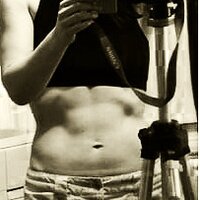
 |
| From a real transformation post |
So to sum up:
- fat doesn't make us fat; caloric surplus makes us fat
- fat is essential for our survival
- no whole food based real fat is evil; it's the ratios of fat types that are important (eat less meat more plants and algae oil/fish oil)
- transfat is an abomination - or at least a horrible adulteration of real nutrient rich fats
- eat less of everything, but mostly reduce meats up plants.
A note on complexity. Others argue differently than the suggested less meat/more plants and algae/fish oils as i've put it above. Some folks do suggest why not just up your saturated fats? And that's ok to explore for sure - but here's the thing - as some of you know who read b2d, i'm not a single factor person. I've said over and over we're complex systems, and complex systems require responses that are sensitive to complexity. This post is introductory; not definitive, and the evidence on how to support complexity is getting better and more subtle all the time.
In this space, i've become a fan of late of TEST OURSELVES - and so have ordered a HUGE blood/chemistry workup from Bioletics so i can check what's working for me - or what needs tuning, including my essential fatty acids. I'll come back to that in the new year. The goal here, tho, is to expose what's know about simple facts of fat as per the breakdown above, and hope you can put that information to good use - even if that means using is just as a stepping off point to ask more questions. Best on your journey.
And All the best on this holiday feasting season. Love the fat.
Related Link
- great approach to nutrition with which to love the fat: precision nutrition overview
- mc's balsamic diet
- Georgie Fear's great "Dig In" recipe book - tasty and easy peasy. festive even.
- respect the fat
- Magnificent Protein- not just about muscles
- Green Tea - good for more than what ails ya
- Caffeine makes us crazy
- Coffee replacement drink?

 PDF
PDFIf you enjoy these posts by all means you should


Subscribe to:
Post Comments (Atom)

 COACHING with dr. m.c.



5 comments:
No need to give up meat. The amount of omega 6 in meats is trivial compared to commercial salad dressings, vegetable oils or processed foods.
Three tablespoons of soybean salad dressing contains 13,000 milligrams of omega 6.
6 oz hamburger contains 600 milligrams of omega 6.
I eat meat every day and my omega 6/omega 3 ratio is 2.9.
Jake,
thanks for your interest in stopping by
the council was not that giving up meat was required, but reducing it was important.
As to the particulars, i'm not sure of your sources to state that your ratio is 2.9 to 1 overall. good for you.
However, let's look at beef:
grass fed beef does have a ratio of 2.7 to 1. But apparently grain fed is 17.2 to 1.
as for soybean oil, well why soybean oil? flaxseed oil is
omega 3 -20.3 omega 6 -4.9.
Olive oil is much better and often recommended, and also in lower quantities than three tablespoons. goodness that seems a lot.
(info from http://wunderflax.wordpress.com/2008/03/03/whats-the-ratio-of-omega-6-to-omega-3-in-the-food-i-eat/ and from http://weightoftheevidence.blogspot.com/2006/10/omega-3-and-omega-6-food-sources.html)
Also was recommended to pump up algae oils /fish oils for their very good high ratios, also listed above to help balance out lows in other foods.
hope those references help
mc
Hi, very nice post. I am just curious that why canola oil gets mentioned so little on the whole fat discussion. On paper it looks perfect: it has only 9% saturated fat, the omega6/omega3 ratio is exactly 2/1 and it tastes the same as vegetable oil. Is there a catch here or canola oil is just neglected?
Ke, i dunno, but there are a variety of sources that say neither it nor rape seed are great for human consumption, not because it doesn't have great 6/3 ratio, but because of the OTHER type of fat in it.
eg
http://www.hbci.com/~wenonah/new/canola.htm
i'd be inclined to look into it further, though.
best
mc
Hi mc,
Thanks for the info. I have read a little more and find it a fascinating topic. I thought I'd share what I found, in case your readers are interested.
1. The main reason for people to hate rapeseed oil and canola oil is that rapeseed contains erucic acid which has a bad smell. Canola is a special breed with much lower concentration of erucic acid. They also say that erucic acid is toxic.
2. Rapeseed oil is the main cooking oil of a large part of China (including where I was from). It is common knowledge that it needs to be heated to a very high temperature to be usable (which breaks down the erucic acid, apparently). I doubt it is very toxic, as myself and lots of people grew up on it. It may still be harmful, though.
3. Canola oil seems to be also treated with heat to remove the remaining erucic acid. Does the heating process break down other nutrients and create harmful chemicals? I don't know.
Conclusion: A lot of it is based on irrational fear of unfamiliar things. Like I pointed out, rapeseed oil is common where I grew up, so I do not share the fear of this "rancid" oil. On the other hand, with obvious big corporate interests, accurate information is hard to come by. I guess I will leave it like this.
Post a Comment