Sunday, June 20, 2010
the amazing engineering that is the shoulder, part 1: scapula and shoulder girdle
Follow @mcphoo
Tweet
How does the shoulder really work? What is it, anyway? When we think of working the shoulder, most of us likely think of the delts, maybe the traps (shoulder shrugs and all). When we think about shoulder injuries, the term "rotator cuff" enters the vocabulary and we worry about how to prehab/rehap these little stabilizer muscles. But really, the shoulder, or more particularly the shoulder joint and shoulder girdle is an amazing feat of evolutionary engineering, so much so that most of what we tend to think of as uppert body work is really shoulder work.
 Consider that we usually think of the lats, traps, rhomboids all as back muscles, and the pecs and seratus anterior as chest muscles. Yes, ok, that's more about where those muscles are located, but they're all, really really, shoulder muscles. Even the triceps and biceps are involved as shoulder muscles - and require the shoulder as their anchoring points.
Understanding a little bit more about how the shoulder works in terms of where the muscles attach to what and how they act on the shoulder may help enhance our lifting, prevent injury, and help us understand what we're doing - or not - when we think about working out.
So the goal of this set of posts on the shoulder is to offer a wee tour through the shoulder, and provide further resources if you get fired up to look further.
Part 1: the Scapula and Shoulder Girdle
In structural kinesiology - the study of movement in terms of nerves, bones and muscles and joints - there are two main ways to look at the shoulder: the shoulder girdle and the shoulder joint. Both of these views considers one of the weirdest and coolest bones in the body, the shoulder blade or scapula.
In this first of two parts looking at the shoulder, we'll first take a quick look at the multifacetted structure of the scapula and also look at the muscles associated with the shoulder girdle - or the muscles primarily involved with moving the scapula itself.
In part two, we'll look at the muscles acting on the main shoulder joint, the glenohumeral joint (gh), from the rotator cuff muscles to the lats and pec major.
The Scapula: It's a wild wild bone.
 This figure above shows three views of the scapula: the front side that faces the back of the ribs, the back side that we can feel or palpate, especially along that honking big spine, and where the magic focuses, the side on view that features the glenoid cavity - the aras where the arm - in particular the humerous fits into the shoulder.
Take a look at the ridges and bumps: every bit of an indentation or edge has a purpose in the muscular rigging that is the shoulder joint and shoulder girdle.
Overview: Let's take a quick look at the shoulder girdle muscles to get a sense of the specialness of the shoulder girdle design and what i mean by this rigging - and possibly why this approach in our design (is so cool).
The scapula first and foremost is situated behind and at the top of the rib cage. It has muscles attached to both sides of it: there are muscles along it's back; and muscles along its front. The ones we're looking at here are the ones that primarily move the scapula, and help keep it in position along the back of the rib cage.
 As said, each bump, dip and pointy part of the scapula has a mechanical design purpose. By way of example, the image to the left shows the back view of the scapula. In red, the levator scapula is attached to the superior border of the scapula. This shoulder muscle, while attached up at the top four vertebrae in the neck is not a neck muscle per se, but exists to help pull the scapula up (and a bit towards the spine, elevation and adduction)
If we look back at the image of the scapula bone, we see the medial border on the back/posterior side of the scap. Follow along to the medial border (left side of spine in the image with the levator scap shown) and the minor and major rhomboids are attached there and plug into the bottom of the cervical spine, and top half of the thoracic spine. If we just follow the line of the muscles, which go up diagonally, we can see that when they contract they'll pull the scapula towards the spine and up in elevation, but actually in doing so, can also rotate the shoulder socket down. We'll come back to why this rotation is important.
On the other side of the spine we see another rich and amazing attachment, the trapezius which is considered in three parts. The upper fibers attach along the far end of the clavicle or collar bone and the scapula's acromial process, and also along the start of the big spine on the back of the scapula. Again shoulder elevation helped here as well as adduction. Then the middle fibers which attach a little along the scapula spine, but also this time, rotate the socket up. The lower fibers of this massive muscle which connect on the scapula spine under side-ish area. These also contribute to pulling the shoulder socket up, but also bringing the shoulder down blade down.
To take a quick look at the front-ish part of the scapula, there's the pec minor and the seratus anterior.


The pec minor attaches to the scapula at the coricoid process (the biceps at one point do, too, among others) and then into the ribs. Again, if we follow the line of the muscles, we can see that when contracted, these muscles will pull the scapula, well, rather over the shoulder, rotating the socket downwards. The scapula also gets pulled away from the spine (abducted), and likewise dowward (depression).
The serratus anterior is an amazing set of muscles that connects all along the medial border on the inside/front of the scapula, on the opposite side from the rhomboids.
Where the rhomboids pulls the scap up and towards the spine, the seratus anterior pulls the scapula away from the spine and the scapula up at the same time via the attachment upwards along the sides of the ribs. The joint tension of the rhomboids and the serratus anterior both help keep the scapula down against the ribs in movements like the push up.
Why all this Scapular Movement? RANGE EXTENSION. I dunno about you, but while i've heard about shoulder depression and elevation and rotation, it hasn't meant a whole lot to me until i got to see what the bones actually do relative to what's getting rotated: the arm in the shoulder joint.
 An image may help. Take a look at the relative positions of the scapulae in the picture to the right here (in red the supraspinatus is highlighted, but that ain't important right now). If we look at the left arm, we'll note that the glenoid fossa - where the humerous fits into the shoulder) is in neutral. With the right arm elevated, like in an overhead press, we see that the whole scapula is titled away from the spine and that the glenoid fossa - where the arm connects - is pointed more UP.
Bottom wonderful line is that, by rigging up the scapula so that it's got all these guy wired muscles holding the scapulae as a kind of floating anchor point, we get far greater range of motion with our arms than if we had a more or less fixed ball and socket joint.
That is, if the scapula, which is largely designed to act as an attachment for the upper limbs, were fixed to the spine as a bone such that the socket for the humerus was fixed ( unable to rotate up, down, back and forward), the arm would have far more restricted motion. We'd be unable to press up, cross our arms, do push ups, waltz. Awful to contemplate.
So let's not. Let's sum up where we're at today.
Summing up part 1
In this first article on the shoulder girdle & scapula, we've had a quick look at the muscles that support the movement of the scapula and concurrently the resulting rotation of the glenohumeral joint that allows for the all important rich range of motion of the arm at the shoulder.
Next, we'll look at the muscles acting on the glenohumeral joint, like the giant lats, pec major, teres major, and including those pixie trouble makers, the rotator cuff muscles. Guarenteed once we go over how they work and where they are in the scapula, remembering the names of the four will be simple.
But heck, isn't that scapula an amazing bone or what, eh?
Resources
Some great books to help get into structural kinesiology are

 Manual of Structural Kinesiology
 really really good source for getting at the complete details on joints, muscles, actions, planes of motion, nerves. THere are great exercises and quizes with the book as well for self-testing

Anatomy of Movement (Revised Edition)
A very personable look at anatomy in the context of not only athletic but every day movements.
 And for getting into the actual feel of where these muscles are and how they operate live, there is the very popular Trail Guide to the Body Book

And heck if you've ever tried to figure out whether that groin pull is an adductor magus or gracialis, this is the one for you.
More books that include seeing the real tissue (making the case for illustrations) next time.
Related posts:
 Consider that we usually think of the lats, traps, rhomboids all as back muscles, and the pecs and seratus anterior as chest muscles. Yes, ok, that's more about where those muscles are located, but they're all, really really, shoulder muscles. Even the triceps and biceps are involved as shoulder muscles - and require the shoulder as their anchoring points.
Understanding a little bit more about how the shoulder works in terms of where the muscles attach to what and how they act on the shoulder may help enhance our lifting, prevent injury, and help us understand what we're doing - or not - when we think about working out.
So the goal of this set of posts on the shoulder is to offer a wee tour through the shoulder, and provide further resources if you get fired up to look further.
Part 1: the Scapula and Shoulder Girdle
In structural kinesiology - the study of movement in terms of nerves, bones and muscles and joints - there are two main ways to look at the shoulder: the shoulder girdle and the shoulder joint. Both of these views considers one of the weirdest and coolest bones in the body, the shoulder blade or scapula.
In this first of two parts looking at the shoulder, we'll first take a quick look at the multifacetted structure of the scapula and also look at the muscles associated with the shoulder girdle - or the muscles primarily involved with moving the scapula itself.
In part two, we'll look at the muscles acting on the main shoulder joint, the glenohumeral joint (gh), from the rotator cuff muscles to the lats and pec major.
The Scapula: It's a wild wild bone.

Take a look at the ridges and bumps: every bit of an indentation or edge has a purpose in the muscular rigging that is the shoulder joint and shoulder girdle.
Overview: Let's take a quick look at the shoulder girdle muscles to get a sense of the specialness of the shoulder girdle design and what i mean by this rigging - and possibly why this approach in our design (is so cool).
The scapula first and foremost is situated behind and at the top of the rib cage. It has muscles attached to both sides of it: there are muscles along it's back; and muscles along its front. The ones we're looking at here are the ones that primarily move the scapula, and help keep it in position along the back of the rib cage.

If we look back at the image of the scapula bone, we see the medial border on the back/posterior side of the scap. Follow along to the medial border (left side of spine in the image with the levator scap shown) and the minor and major rhomboids are attached there and plug into the bottom of the cervical spine, and top half of the thoracic spine. If we just follow the line of the muscles, which go up diagonally, we can see that when they contract they'll pull the scapula towards the spine and up in elevation, but actually in doing so, can also rotate the shoulder socket down. We'll come back to why this rotation is important.
On the other side of the spine we see another rich and amazing attachment, the trapezius which is considered in three parts. The upper fibers attach along the far end of the clavicle or collar bone and the scapula's acromial process, and also along the start of the big spine on the back of the scapula. Again shoulder elevation helped here as well as adduction. Then the middle fibers which attach a little along the scapula spine, but also this time, rotate the socket up. The lower fibers of this massive muscle which connect on the scapula spine under side-ish area. These also contribute to pulling the shoulder socket up, but also bringing the shoulder down blade down.
To take a quick look at the front-ish part of the scapula, there's the pec minor and the seratus anterior.


The pec minor attaches to the scapula at the coricoid process (the biceps at one point do, too, among others) and then into the ribs. Again, if we follow the line of the muscles, we can see that when contracted, these muscles will pull the scapula, well, rather over the shoulder, rotating the socket downwards. The scapula also gets pulled away from the spine (abducted), and likewise dowward (depression).
The serratus anterior is an amazing set of muscles that connects all along the medial border on the inside/front of the scapula, on the opposite side from the rhomboids.
Where the rhomboids pulls the scap up and towards the spine, the seratus anterior pulls the scapula away from the spine and the scapula up at the same time via the attachment upwards along the sides of the ribs. The joint tension of the rhomboids and the serratus anterior both help keep the scapula down against the ribs in movements like the push up.
Why all this Scapular Movement? RANGE EXTENSION. I dunno about you, but while i've heard about shoulder depression and elevation and rotation, it hasn't meant a whole lot to me until i got to see what the bones actually do relative to what's getting rotated: the arm in the shoulder joint.
 An image may help. Take a look at the relative positions of the scapulae in the picture to the right here (in red the supraspinatus is highlighted, but that ain't important right now). If we look at the left arm, we'll note that the glenoid fossa - where the humerous fits into the shoulder) is in neutral. With the right arm elevated, like in an overhead press, we see that the whole scapula is titled away from the spine and that the glenoid fossa - where the arm connects - is pointed more UP.
Bottom wonderful line is that, by rigging up the scapula so that it's got all these guy wired muscles holding the scapulae as a kind of floating anchor point, we get far greater range of motion with our arms than if we had a more or less fixed ball and socket joint.
That is, if the scapula, which is largely designed to act as an attachment for the upper limbs, were fixed to the spine as a bone such that the socket for the humerus was fixed ( unable to rotate up, down, back and forward), the arm would have far more restricted motion. We'd be unable to press up, cross our arms, do push ups, waltz. Awful to contemplate.
So let's not. Let's sum up where we're at today.
Summing up part 1
In this first article on the shoulder girdle & scapula, we've had a quick look at the muscles that support the movement of the scapula and concurrently the resulting rotation of the glenohumeral joint that allows for the all important rich range of motion of the arm at the shoulder.
Next, we'll look at the muscles acting on the glenohumeral joint, like the giant lats, pec major, teres major, and including those pixie trouble makers, the rotator cuff muscles. Guarenteed once we go over how they work and where they are in the scapula, remembering the names of the four will be simple.
But heck, isn't that scapula an amazing bone or what, eh?
Resources
Some great books to help get into structural kinesiology are
Manual of Structural Kinesiologyreally really good source for getting at the complete details on joints, muscles, actions, planes of motion, nerves. THere are great exercises and quizes with the book as well for self-testingAnatomy of Movement (Revised Edition)
A very personable look at anatomy in the context of not only athletic but every day movements.
And for getting into the actual feel of where these muscles are and how they operate live, there is the very popular Trail Guide to the Body Book And heck if you've ever tried to figure out whether that groin pull is an adductor magus or gracialis, this is the one for you.
More books that include seeing the real tissue (making the case for illustrations) next time.
Related posts:
- part 2 of the amazing shoulder: glenohumeral joint, rotator cuff and big movers.
- eccentric exercises - approaches for tendonopathy
- kettlebell swing - why we fire the lats (whether we want to or not)
- volume in press to go heavy: threat reduction; practice prep for heavy
- windmill/press 100s - not just working the shoulder, but the obliques

 PDF
PDF

Tuesday, June 8, 2010
Vacance - short break at b2d
Follow @mcphoo
Tweet
just fyi, there'll be a wee hiatus at begin2dig till after June 18.
Time for a wee break from all things plugged in - a Health Act, as it were.
Hope to see y'all again in a couple weeks, and that your practice continues great in the intervening period.
best to you,
mc
 Tweet
Follow @begin2dig
Tweet
Follow @begin2dig
Time for a wee break from all things plugged in - a Health Act, as it were.
Hope to see y'all again in a couple weeks, and that your practice continues great in the intervening period.
best to you,
mc
Friday, June 4, 2010
One less Rep - It's ok NOT to finish a set. Really. Less is hard but can be more
Follow @mcphoo
Tweet
Workouts are about work, about sufficient challenge for adapatation, about getting more perfect in each step of our practice. So why so many overuse injuries? Why so many of us getting jacked up? I wonder if it's at least in part from the reluctance to quit when we need to quit? So let me all fellow workout heads ask this quesiton:
 when you workout, if you have 10 reps of a set to do, or 5 sets to do, you WILL DO those reps; you will DO those sets. Even if you don't feel perfectly happy with yourself, entirely, especially if there's only three more reps, you're gonna do those reps. Or one more set, you're gonna do that set. Well are you, punk? your inner voice inquires?
Fave example: you're doing viking warrior conditioning - you have your 8 reps per 15 secs to do - ok wait, that's me, let's just own it: i'm doing VWC, these are my reps and sets, the timer is ticking, i have 3 more sets to do, the blister is forming on my hand - i can feel it - but will i quit? NO, because i HAVE TO FINISH MY SETS.
What's the Value of Having to get That Last Rep? Um, question to self: Why? Is this a competition? does someone have a gun to my head? What do i get out of a big fat crap-technique-showing blister except nearly a week off snatch practice? All i get is wow, i finished my sets. great. So what? i'm now looking at a several day hit to my training?
You know, saying this i'm thinking, this is just so obvious, isn't it? Hand starting to blister: stop. Duh. But the Duh has not been there, at least for me in the set, while the set is happening.
 At the RKC II cert in Feb, Pavel Tsatsouline, frech off the research for his Power to the People Professional, gave a related lecture on old time strong man training. A big part of that was strong men staying away from 1RM work; staying fresh. This theme is nothing new to Tsatousline's training approach. Stay fresh, gas in the tank, perfect form.
And yet...
Even when i believe i'm focusing on Pavel Tsatsouline's guidance to "stay fresh" - always end the set feeling fresh rather than ever going to failure, see i'm thinking i'm not - or haven't been. Why? Because i have been recovering from what has been called an "overuse injury" - tendinopathy in the shoulder. Painful arc syndrome. What ever.
There are lots of reasons for overuse injuries: lots of reps being one of them, but usually that's lots of use that is beyond the capacity of that tendon. And what wears into overuse? Form issues? And what happens to form on the weaker side when going with the stronger side? Fatigue? And with fatigue comes injury. We know this. This is basic.
Pain is the Last Warning for Change, not the First. The ugly side of overuse injuries is that they don't show up as pain until there's been some damage. Imagine pain being like an oil gage that only tells you when there's a teaspoon of oil left in the engine: there's no funky needle showing you the oil steadily leaking out of the system. And by the time that needle is in the red, well ya know something has likely been hurt in the engine, too.

Another analogy - this time with the human body, but same "if you feel it, it's gone too far" effect is like thirst. Waiting to hydrate till we're thirsty - especially on a hot day out in the sun - is too late. By the time we're thirsty symptoms of sun stroke/dehydration have hit our systems.
Pain is really our LAST warning. And as i've written about before, from the pain literature, pain is a warning (or signal) to change. Figuring out what to change can sometimes be an issue, but in working out with weight
And in working out, it seems we need to get better at developing our early warning system. What is that early warning system? Learning to trust ourselves. How might we do that? Let me offer an example.
Test It. The other day i had a write up to do 10 sets of X for my particular routine that day. By set five i was feeling a bit fatigued. So i thought wow this is too early to quit, surely, but let me test it. So i did a fatigue test (described here) - waited my normal recovery time - and retested. Nope. Not ready. Wait, retest. Good to go. Did the next three sets, and when going to do set 9, i had to own i felt not quite fresh. Like i'd be pushing it. So i didn't push.
What's the difference between 9 sets or 10? Let's see. That's 90% of the workout instead of 100%. 10% less volume. Let's put this in context: 10 fewer reps out of 100. Once in a week. What's the performance difference? My recovering shoulder was not saying the next day "don't do that again," so i was able to go ahead with my next day's plan. Great.
For folks not doing rehab/recovery for an injury, you may be wondering what does this have to do with me? I'm going to push hard. Bien sur. No one is saying don't work hard. We have to work hard for an adaptation. Work smart and hard.
After all, has my body lost anything by those 10 fewer reps in one workout session all week? In terms of absolute total volume, sure, but in terms of adaptation, i *don't* know. My guess is, not likely. Indeed, maybe for me i just optimised my load, doing the best for me at that moment by doing a few less today than what was an arbitrary number on a piece of paper. Ranges are better than absolutes, perhaps; intensional rather than extensional.
Pain is the Last Signal, not the ONLY signal. Every workout since then i've been trying to *listen* to my body to hear the signals that are there before pain happens. Rather than ignoring them as "nothing" i've been asking "what if?" - what if this tiny tiny bit of lost form, or this teeny weeny bit of fatigue may actual be more than i want to give it credit as being?
 The cool thing is (and it took me a long time to put together this simple 2+2 is 4) i have a suite of self-assessments i can use to self-test whether or not this is an "ok, just pause the set here - not even quit; just pause, do some recovery and then continue" kind of issue or a "bag it" one.
Now personally i do not test every set, every exercise, and perhaps i'll learn that that is less than optimal. Right now, what i'm testing is simply that set of question marks i would simply have ignored before and carried on to GET MY NUMBERS complete my workout.
Practicing Less(ness) - towards overuse prevention. What's interesting for me at least is that part of this practice is practicing a different perspective: letting go of the last rep. I have been consciously trying even if i feel fine going for X planned reps, just once in a while - usually at the end of the workout - to do X-1. Or one set in the block (if this is a volume day) to do a set that's half or two-thirds the no. of reps for that set.
Why? because i'm thinking it's kinda stupid to be so obsessed with getting in numbers - i'm pretty sure my "overuse shoulder injury" is not practicing a true focus on perfect quality rather than arbitrary numbers.
I may have thought oh ya i'm still fresh my form is still dandy, but my shoulder has told me something else, like "you blew it." I don't want that to happen anywhere else. So gonna listen - and lessen.
Less is Hard. Right now, i have to say, doing a set of 5 rather than 10 (in ten sets), finishing a set of 100's instead as 99's still causes a twinge in my brain. I still kinda clench my teeth, like somehow that means what? my whole workout is toast? i'm not as great as if i'd done the full count? That somehow without that weary adherence to numbers i'm a loser? can't cut it? oh dear. What would i say to someone i was coaching who was expressing such concern?
I guess i just decided i don't want to be that person anymore - who "has to do it" when there's no good reason why to do so and a potential raft of better reasons not to do so, or at least be flexible.
I'm not there yet - i'm not at a place where that less than planned sits well, but i'm working on it.
Take Aways Pain from overuse injuries shows up after the injury has happened. It may help therefore to learn to listen for other signs in the body to help suggest when actions that may contribute to overuse are happening.
There are ways to help hone this awareness - self-tests that we can leanr and practice when wanting to reality check how we're doing - lots of them in the essentials of elite performance dvd. BUT in order to hear something at all to trigger a test, speaking at least for myself, comes a willingness to do LESS than was scheduled for a day. And like any other performance skill, less needs to be practiced.
On the plus side, i'm finding that actually practicing less, learning less, has let me do more and in this recovery phase where doing anything has been a bonus, my better self is pleased with that progress.
How you doing with less is hard, but less can be more?
Related Resources
when you workout, if you have 10 reps of a set to do, or 5 sets to do, you WILL DO those reps; you will DO those sets. Even if you don't feel perfectly happy with yourself, entirely, especially if there's only three more reps, you're gonna do those reps. Or one more set, you're gonna do that set. Well are you, punk? your inner voice inquires?Fave example: you're doing viking warrior conditioning - you have your 8 reps per 15 secs to do - ok wait, that's me, let's just own it: i'm doing VWC, these are my reps and sets, the timer is ticking, i have 3 more sets to do, the blister is forming on my hand - i can feel it - but will i quit? NO, because i HAVE TO FINISH MY SETS.
What's the Value of Having to get That Last Rep? Um, question to self: Why? Is this a competition? does someone have a gun to my head? What do i get out of a big fat crap-technique-showing blister except nearly a week off snatch practice? All i get is wow, i finished my sets. great. So what? i'm now looking at a several day hit to my training?
You know, saying this i'm thinking, this is just so obvious, isn't it? Hand starting to blister: stop. Duh. But the Duh has not been there, at least for me in the set, while the set is happening.
At the RKC II cert in Feb, Pavel Tsatsouline, frech off the research for his Power to the People Professional, gave a related lecture on old time strong man training. A big part of that was strong men staying away from 1RM work; staying fresh. This theme is nothing new to Tsatousline's training approach. Stay fresh, gas in the tank, perfect form.And yet...
Even when i believe i'm focusing on Pavel Tsatsouline's guidance to "stay fresh" - always end the set feeling fresh rather than ever going to failure, see i'm thinking i'm not - or haven't been. Why? Because i have been recovering from what has been called an "overuse injury" - tendinopathy in the shoulder. Painful arc syndrome. What ever.
There are lots of reasons for overuse injuries: lots of reps being one of them, but usually that's lots of use that is beyond the capacity of that tendon. And what wears into overuse? Form issues? And what happens to form on the weaker side when going with the stronger side? Fatigue? And with fatigue comes injury. We know this. This is basic.
Pain is the Last Warning for Change, not the First. The ugly side of overuse injuries is that they don't show up as pain until there's been some damage. Imagine pain being like an oil gage that only tells you when there's a teaspoon of oil left in the engine: there's no funky needle showing you the oil steadily leaking out of the system. And by the time that needle is in the red, well ya know something has likely been hurt in the engine, too.
Another analogy - this time with the human body, but same "if you feel it, it's gone too far" effect is like thirst. Waiting to hydrate till we're thirsty - especially on a hot day out in the sun - is too late. By the time we're thirsty symptoms of sun stroke/dehydration have hit our systems.
Pain is really our LAST warning. And as i've written about before, from the pain literature, pain is a warning (or signal) to change. Figuring out what to change can sometimes be an issue, but in working out with weight
And in working out, it seems we need to get better at developing our early warning system. What is that early warning system? Learning to trust ourselves. How might we do that? Let me offer an example.
Test It. The other day i had a write up to do 10 sets of X for my particular routine that day. By set five i was feeling a bit fatigued. So i thought wow this is too early to quit, surely, but let me test it. So i did a fatigue test (described here) - waited my normal recovery time - and retested. Nope. Not ready. Wait, retest. Good to go. Did the next three sets, and when going to do set 9, i had to own i felt not quite fresh. Like i'd be pushing it. So i didn't push.
What's the difference between 9 sets or 10? Let's see. That's 90% of the workout instead of 100%. 10% less volume. Let's put this in context: 10 fewer reps out of 100. Once in a week. What's the performance difference? My recovering shoulder was not saying the next day "don't do that again," so i was able to go ahead with my next day's plan. Great.
For folks not doing rehab/recovery for an injury, you may be wondering what does this have to do with me? I'm going to push hard. Bien sur. No one is saying don't work hard. We have to work hard for an adaptation. Work smart and hard.
After all, has my body lost anything by those 10 fewer reps in one workout session all week? In terms of absolute total volume, sure, but in terms of adaptation, i *don't* know. My guess is, not likely. Indeed, maybe for me i just optimised my load, doing the best for me at that moment by doing a few less today than what was an arbitrary number on a piece of paper. Ranges are better than absolutes, perhaps; intensional rather than extensional.
Pain is the Last Signal, not the ONLY signal. Every workout since then i've been trying to *listen* to my body to hear the signals that are there before pain happens. Rather than ignoring them as "nothing" i've been asking "what if?" - what if this tiny tiny bit of lost form, or this teeny weeny bit of fatigue may actual be more than i want to give it credit as being?

Now personally i do not test every set, every exercise, and perhaps i'll learn that that is less than optimal. Right now, what i'm testing is simply that set of question marks i would simply have ignored before and carried on to GET MY NUMBERS complete my workout.
Practicing Less(ness) - towards overuse prevention. What's interesting for me at least is that part of this practice is practicing a different perspective: letting go of the last rep. I have been consciously trying even if i feel fine going for X planned reps, just once in a while - usually at the end of the workout - to do X-1. Or one set in the block (if this is a volume day) to do a set that's half or two-thirds the no. of reps for that set.
Why? because i'm thinking it's kinda stupid to be so obsessed with getting in numbers - i'm pretty sure my "overuse shoulder injury" is not practicing a true focus on perfect quality rather than arbitrary numbers.
I may have thought oh ya i'm still fresh my form is still dandy, but my shoulder has told me something else, like "you blew it." I don't want that to happen anywhere else. So gonna listen - and lessen.
Less is Hard. Right now, i have to say, doing a set of 5 rather than 10 (in ten sets), finishing a set of 100's instead as 99's still causes a twinge in my brain. I still kinda clench my teeth, like somehow that means what? my whole workout is toast? i'm not as great as if i'd done the full count? That somehow without that weary adherence to numbers i'm a loser? can't cut it? oh dear. What would i say to someone i was coaching who was expressing such concern?
I guess i just decided i don't want to be that person anymore - who "has to do it" when there's no good reason why to do so and a potential raft of better reasons not to do so, or at least be flexible.
I'm not there yet - i'm not at a place where that less than planned sits well, but i'm working on it.
Take Aways Pain from overuse injuries shows up after the injury has happened. It may help therefore to learn to listen for other signs in the body to help suggest when actions that may contribute to overuse are happening.
There are ways to help hone this awareness - self-tests that we can leanr and practice when wanting to reality check how we're doing - lots of them in the essentials of elite performance dvd. BUT in order to hear something at all to trigger a test, speaking at least for myself, comes a willingness to do LESS than was scheduled for a day. And like any other performance skill, less needs to be practiced.
On the plus side, i'm finding that actually practicing less, learning less, has let me do more and in this recovery phase where doing anything has been a bonus, my better self is pleased with that progress.
How you doing with less is hard, but less can be more?
Related Resources
- The Perfect Rep: revisiting the kettlebell front squat
- The perfect rep quest series
- Why not move through pain?
- What's going on with chronic low back pain - and possible approaches.
- Rannoch's 100
- Should i do this next set?
Thursday, June 3, 2010
660 seconds (11 mins) of minimal resistance training = a HUGE difference for fat burning
Follow @mcphoo
Tweet
 We know pretty unequivocally that the biggest part of a fat loss program is nutrition. That's first. BUT we also know that exercise can really help with keeping that program going. If we look at work on obesity and the role of exercise, we're looking at 5 hours of exercise a week (along with diet and expert support).
5 hours may be a good and healthy norm, but do you know any geeks who will say ya you bet i can get that 270-300 mins a week in. You bet. Not.

So a question might be, what's the minimal amount someone - especially someone at risk of being obese - can do in terms of working out to achieve a metabolic difference - where that metabilic change is to a boost start burning more calories in a day, and in particular burning more fat calories.
Researchers in 2009 took a look at just this question. The answer is - we're not entirely sure, but here's something that looks really promising:
 Just to be clear about what the program included:
 So not what anyone would call a super arduous program or one that folks without mobility/pain issues could perform as these moves are all done on machines. Some of us might have chosen different moves - like only compound moves without machines - but let's leave that aside. These have the advantage of also being seated, which for an inactive overweight population may be a good thing.
 Main Pluses. The main thing is that after 6 months, the folks doing this very simple, every-other-day program had significantly greater fat free mass (FFM) - or lean mass (eg, muscle) than the Control group. That's nice. But what is associated with this in terms of potential fat loss support? An upped metabolism, as measured by various metabolic resting rate measures. Faster metabolism is a known associated outcome with exercise; that means more fuel will get used more quickly. For example, 24hr energy expenditure went up from 13091 kJ's a day to 13618. That's a big deal.

And one more finding - the RQ measure - checking expiration gasses - showed that the (resistiance training) RT group seemed to have an upped "fat oxidation" level - that is, burning more fat for fuel, as opposed to carbs. That's what we want from exercise: more fat burning.
Reality Check. Working out alone doesn't cut it for fat loss. In the results, both groups over six months had their weight go up and their BMI go up. That's not good. BUT the fat mass increase in the RT was "non-significant" at 3.3% but definitely significant in the C group at 8.8%. Note, there was no specified dietary intervention in the study; the only mandated change was the exercise program:
Take Aways. So what are the possible take aways from this study? One the authors suggest is that 11 mins. of resitance trainging might pose an interesting alternative to cardio/aerobics. As the authors state "the positive influence of even a small amount of RT on fat oxidation suggests an important role of RT on body mass management."
So imagine the benefit of combining a minimum 11mins of resistance training with some simple non-calorie-counting nutrition habits (like those found in precision nutrition) and who knows how the world might change?
Simple Program for fat loss? workout: 11mins of resistance, 3 days a week + nurtition: Change one thing a month with say the PN habits (download), and suddenly persistence of simplicity carries the day.
If you try this approach or know someone who will, pleaes let me know how it goes.
Citations
We know pretty unequivocally that the biggest part of a fat loss program is nutrition. That's first. BUT we also know that exercise can really help with keeping that program going. If we look at work on obesity and the role of exercise, we're looking at 5 hours of exercise a week (along with diet and expert support).5 hours may be a good and healthy norm, but do you know any geeks who will say ya you bet i can get that 270-300 mins a week in. You bet. Not.

So a question might be, what's the minimal amount someone - especially someone at risk of being obese - can do in terms of working out to achieve a metabolic difference - where that metabilic change is to a boost start burning more calories in a day, and in particular burning more fat calories.
Researchers in 2009 took a look at just this question. The answer is - we're not entirely sure, but here's something that looks really promising:
Long-term resistance training (RT) may result in a chronic increase in 24-h energy expenditure (EE) and fat oxidation to a level sufficient to assist in maintaining energy balance and preventing weight gain. However, the impact of a minimal RT program on these parameters in an overweight college-aged population, a group at high risk for developing obesity, is unknown. PURPOSE: We aimed to evaluate the effect of 6 months of supervised minimal RT in previously sedentary, overweight (mean +/- SEM, BMI = 27.7 +/- 0.5 kg x m(-2)) young adults (21.0 +/- 0.5 yr) on 24-h EE, resting metabolic rate (RMR), sleep metabolic rate (SMR), and substrate oxidation using whole-room indirect calorimetry 72 h after the last RT session. METHODS: Participants were randomized to RT (one set, 3 d x wk(-1), three to six repetition maximums, nine exercises; N = 22) or control (C, N = 17) groups and completed all assessments at baseline and at 6 months. RESULTS: There was a significant (P < 0.05) increase in 24-h EE in the RT (527 +/- 220 kJ x d(-1)) and C (270 +/- 168 kJ x d(-1)) groups; however, the difference between groups was not significant (P = 0.30). Twenty-four hours of fat oxidation (g x d(-1)) was not altered after RT; however, reductions in RT assessed during both rest (P < 0.05) and sleep (P < 0.05) suggested increased fat oxidation in RT compared with C during these periods. SMR (8.4 +/- 8.6%) and RMR (7.4 +/- 8.7%) increased significantly in RT (P < 0.001) but not in C, resulting in significant (P < 0.001) between-group differences for SMR with a trend for significant (P = 0.07) between-group differences for RMR. CONCLUSION: A minimal RT program that required little time to complete (11min per session) resulted in a chronic increase in energy expenditure. This adaptation in energy expenditure may have a favorable impact on energy balance and fat oxidation sufficient to assist with the prevention of obesity in sedentary, overweight young adults, a group at high risk for developing obesity.
Just to be clear about what the program included:Participants performed 1 set of 9 exercises designed to train all major muscle groups (chest press, back extension, lat pull down, triceps extension, shoulder press, leg press, calf raise, leg curl, and abdominal crunch) using a resistance of 3–6 1RM, approximately equal to 85–90% of 1RM.
So not what anyone would call a super arduous program or one that folks without mobility/pain issues could perform as these moves are all done on machines. Some of us might have chosen different moves - like only compound moves without machines - but let's leave that aside. These have the advantage of also being seated, which for an inactive overweight population may be a good thing. Main Pluses. The main thing is that after 6 months, the folks doing this very simple, every-other-day program had significantly greater fat free mass (FFM) - or lean mass (eg, muscle) than the Control group. That's nice. But what is associated with this in terms of potential fat loss support? An upped metabolism, as measured by various metabolic resting rate measures. Faster metabolism is a known associated outcome with exercise; that means more fuel will get used more quickly. For example, 24hr energy expenditure went up from 13091 kJ's a day to 13618. That's a big deal.
And one more finding - the RQ measure - checking expiration gasses - showed that the (resistiance training) RT group seemed to have an upped "fat oxidation" level - that is, burning more fat for fuel, as opposed to carbs. That's what we want from exercise: more fat burning.
Reality Check. Working out alone doesn't cut it for fat loss. In the results, both groups over six months had their weight go up and their BMI go up. That's not good. BUT the fat mass increase in the RT was "non-significant" at 3.3% but definitely significant in the C group at 8.8%. Note, there was no specified dietary intervention in the study; the only mandated change was the exercise program:
Differences in reported dietary intake (total energy, carbohydrate, fat, protein) were not significant between the baseline and intervention periods for either RT or C, or between the 2 groups during the intervention. The mean intakes for total energy, and percent of dietary carbohydrate, fat and protein were 9538 kJ/day, 50%, 34%, and 16%, respectively. There was no difference for either group at baseline and 6 months between energy and macronutrient intake during the three days of standardized food prior to or during the calorimeter stay.In other words, eating habits didn't change BUT over six months, these folks gained lean mass, had there metabolic rates go up, and instead of losing fat free mass as in control, had their fat free mass go up.
Take Aways. So what are the possible take aways from this study? One the authors suggest is that 11 mins. of resitance trainging might pose an interesting alternative to cardio/aerobics. As the authors state "the positive influence of even a small amount of RT on fat oxidation suggests an important role of RT on body mass management."
So imagine the benefit of combining a minimum 11mins of resistance training with some simple non-calorie-counting nutrition habits (like those found in precision nutrition) and who knows how the world might change?
Simple Program for fat loss? workout: 11mins of resistance, 3 days a week + nurtition: Change one thing a month with say the PN habits (download), and suddenly persistence of simplicity carries the day.
If you try this approach or know someone who will, pleaes let me know how it goes.
Citations
KIRK, E., DONNELLY, J., SMITH, B., HONAS, J., LeCHEMINANT, J., BAILEY, B., JACOBSEN, D., & WASHBURN, R. (2009). Minimal Resistance Training Improves Daily Energy Expenditure and Fat Oxidation Medicine & Science in Sports & Exercise, 41 (5), 1122-1129 DOI: 10.1249/MSS.0b013e318193c64eTweet Follow @begin2dig
Miller, W., Koceja, D., & Hamilton, E. (1997). A meta-analysis of the past 25 years of weight loss research using diet, exercise or diet plus exercise intervention International Journal of Obesity, 21 (10), 941-947 DOI: 10.1038/sj.ijo.0800499
Wednesday, June 2, 2010
Why wait after eating to work out? empathetic to the parasympathetic?
Follow @mcphoo
Tweet
SO, here's a thought.
You know how your folks say don't go for a swim till an hour after eating? ever wondered why?
Here's a thought: turns out that eating triggers our peripheral nervous system, in particular, the parasympathetic nervous system aka "rest and digest" - so blood is going to digestion (the GI tract is pretty long. that's a lot of blood flow).
That means the energy going to the digestive system is not going to be as available for the rest of the peripheral nervous system actions (sympathetic), like moving muscles. So when we try to workout while we're digesting, something's gotta give - our bodies aren't optimized to do both things happily at once. Parasympathetic trying to say relax, lie down, digest. WHen working out, the sympathetic is going "fight or flight" - as you can imagine it's not a happy thing. Conflicting chemicals everywhere.
Now some folks say they have no problem working out right after eating. Anything is possible. But generally speaking, what i'm starting to think is "give my body a frickin' break" - rather than try to force it to split its energy across two demands - digest on the one hand; workout on the other - why not give it a chance to rest and digest before switching gears?
 What i've also been experimenting with is, while i support my rest and digest, and since digestion starts in the mouth (especially with carbs), i'm also trying something learned at the Sustenance course last summer, and that's focus on tasting the food. For me, that means no working while eating. It also means not trying to talk and eat concurrently.
The idea is that chewing food, while it does help break down food for digestion and thus improve the likelihood of getting more nutrients/less getting processed into waste, also helps improve the taste experience which means usually eating less at one sitting - satiation is related to a taste experience. Part of my hypothesis as to why good quality chococalte means less is more because of flavour.
So how does this chewing and attention relate to digestion? Potentially longer time spent in pre-gut processing of food - which means less time needs for the gut, means less effort by the gut, means easier job for the gut, means getting to a workout sooner?
And you know what? Well i'll tell you - it's actually nice to take a bit of a break after the meal to chit chat or gaze out the window or sit for a minute - if i need an excuse i have the excuse of "i need a few minutes to digest my food - i'm going to sit for a minute" - but it's quite zen or delightful. I like delight.
I find generally speaking i can have breakie (some sprouts, veggies, oil and vinegar - being sure to get protein/greens/fats in) and comfortably be doing good cardio (rowing say) within 20 mins of eating. Not an hour. Perhaps because of the attention on chewing? And really less food does seem like more: when less is on the plate - even if it's spinach leaves - i'm going to linger over the leaf as it were.
So all we are saying is, give the parasympathetic nervous system a chance: provide opportunities to enjoy food. When we're trying to lose weight, chewing, tasting longer; using flavourings like balsamic or seasoning, indulge the flavour, all good. and the workout can be well energised. Tweet Follow @begin2dig
You know how your folks say don't go for a swim till an hour after eating? ever wondered why?
Here's a thought: turns out that eating triggers our peripheral nervous system, in particular, the parasympathetic nervous system aka "rest and digest" - so blood is going to digestion (the GI tract is pretty long. that's a lot of blood flow).
That means the energy going to the digestive system is not going to be as available for the rest of the peripheral nervous system actions (sympathetic), like moving muscles. So when we try to workout while we're digesting, something's gotta give - our bodies aren't optimized to do both things happily at once. Parasympathetic trying to say relax, lie down, digest. WHen working out, the sympathetic is going "fight or flight" - as you can imagine it's not a happy thing. Conflicting chemicals everywhere.
Now some folks say they have no problem working out right after eating. Anything is possible. But generally speaking, what i'm starting to think is "give my body a frickin' break" - rather than try to force it to split its energy across two demands - digest on the one hand; workout on the other - why not give it a chance to rest and digest before switching gears?
The idea is that chewing food, while it does help break down food for digestion and thus improve the likelihood of getting more nutrients/less getting processed into waste, also helps improve the taste experience which means usually eating less at one sitting - satiation is related to a taste experience. Part of my hypothesis as to why good quality chococalte means less is more because of flavour.
So how does this chewing and attention relate to digestion? Potentially longer time spent in pre-gut processing of food - which means less time needs for the gut, means less effort by the gut, means easier job for the gut, means getting to a workout sooner?
And you know what? Well i'll tell you - it's actually nice to take a bit of a break after the meal to chit chat or gaze out the window or sit for a minute - if i need an excuse i have the excuse of "i need a few minutes to digest my food - i'm going to sit for a minute" - but it's quite zen or delightful. I like delight.
I find generally speaking i can have breakie (some sprouts, veggies, oil and vinegar - being sure to get protein/greens/fats in) and comfortably be doing good cardio (rowing say) within 20 mins of eating. Not an hour. Perhaps because of the attention on chewing? And really less food does seem like more: when less is on the plate - even if it's spinach leaves - i'm going to linger over the leaf as it were.
So all we are saying is, give the parasympathetic nervous system a chance: provide opportunities to enjoy food. When we're trying to lose weight, chewing, tasting longer; using flavourings like balsamic or seasoning, indulge the flavour, all good. and the workout can be well energised. Tweet Follow @begin2dig
Sunday, May 30, 2010
Rope Climbing, how to climb a rope efficiently (if you can find a rope...)
Follow @mcphoo
Tweet
Ever climbed a rope? I haven't yet. But it *seems* like such the complete athletic movement - like a pull up that keeps on going, no? So this is a post to help folks prep for your own rope climbing ascent.
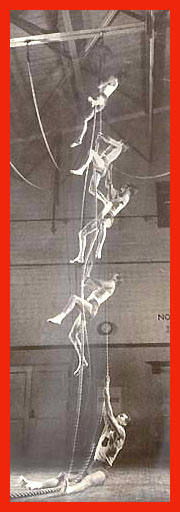 Partial History. It turns out that once upon a time - from between the 1860's to 1932 rope climbing was an olympic event. It persisted as a college competition sport into the 1960's.
John Gill put together a wonderful overview of both the history and the specs of the competition. Please visit these pages - the content and images are lovely, and its fabulous to read the descriptions from various periods of the respect and pleasure experienced by authors who obviously enjoyed practicing this movement. Citing from there, Gill quotes a wonderful text on gymnastics from the 50's that describes climbing this way:
Modern Practice. Apparently in 1993, it started a resurgence in the Czech republic that is still going strong, as demonstrated in this 2007 vid below:
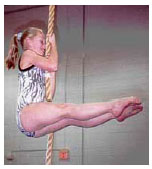 Kids Resurgence. Perhaps more excitingly, rope climbing is apparently also making a come back in kids gymnastics classes as part of the National Elite Physical Abilites testing (pdf), at least in the states. And the cool thing is, form here - of keeping the legs in pike position - is part of the practice - so no leg help; all upper body and core.
Very cool to see girls do this so well - don't stop!
Getting Practical. Here's some awesome rope climbing teaching tips for starting with kids (how well do these translate to adults?)
Adult Tips One place where rope climbing is used more as a physical readiness test than as a competition is in the French Foreign Legion, where climbing a rope multiple times with 24kg of gear is not unknown. So here's a french foreign legion rope climbing tip.
I can confirm that this approach has been tested out by experience rope climbers who found that it made a climb "ridiculously easy"with the added tip to "stay close to the rope" and "look down a bit"
I'm keen to try rope climbing. i imagine sitting down legs out, and rather staying down. Actually, part of the challenge for me is just finding a place with a rope. Our uni gym doesn't have one (does yours?). I've run trails where there are pull up bar stations at points on the trail, but not rope climbing ones - perhaps it's a health and safety fear? Work was not happy about a rope slung down between an open area between two floors. Perhaps if it had had decorative ivy?
Climbing Simulation: Update 2011 - crosscore War Machine -
Ok since i wrote this post, i've found a way to practice rope climbing without a rope. It's called (ahem) the "war machine" made in the US by some awesome guys. Really. Awesome. If you scroll in to 55secs, the vid below shows the climbing simulation (but the whole vid is so good, you just might want to watch the whole thing.
The cool thing is that with the WM we're able to practice the techniques for climbing recommended above. Wicked. Starting with feet on a box or ball or jammed into the wall is also great. If you're interested in the WM in the US avail right from cross core; in the UK avail from Balance Performance. In either case, tell 'em dr mc sent you and they'll be happy happy.
General Queries: Do you climb a rope? if so, do you keep your legs piked out? where do you practice? would you agree it's technique?
Look forward to hearing from you.
Related Posts - in strength as practice
Partial History. It turns out that once upon a time - from between the 1860's to 1932 rope climbing was an olympic event. It persisted as a college competition sport into the 1960's.John Gill put together a wonderful overview of both the history and the specs of the competition. Please visit these pages - the content and images are lovely, and its fabulous to read the descriptions from various periods of the respect and pleasure experienced by authors who obviously enjoyed practicing this movement. Citing from there, Gill quotes a wonderful text on gymnastics from the 50's that describes climbing this way:
Competitive rope climbing is truly an art and a skill by itself. It does not involve all the intricacies or maneuvers of apparatus work yet the art of climbing can be detailed and exacting in nature. A great deal of practice is involved to produce a champion rope climber. Since the record for climbing a rope 20' high with the hands alone is under 3 seconds it is easily understood why considerable practice is necessary for top performances. (sited as from Newt Loken & Robert Willoughby in the Complete Book of Gymnastics, 1959.)That's a pretty compelling description of a skill-based rather than just strength based practice.
Modern Practice. Apparently in 1993, it started a resurgence in the Czech republic that is still going strong, as demonstrated in this 2007 vid below:
Kids Resurgence. Perhaps more excitingly, rope climbing is apparently also making a come back in kids gymnastics classes as part of the National Elite Physical Abilites testing (pdf), at least in the states. And the cool thing is, form here - of keeping the legs in pike position - is part of the practice - so no leg help; all upper body and core.Very cool to see girls do this so well - don't stop!
Getting Practical. Here's some awesome rope climbing teaching tips for starting with kids (how well do these translate to adults?)
Adult Tips One place where rope climbing is used more as a physical readiness test than as a competition is in the French Foreign Legion, where climbing a rope multiple times with 24kg of gear is not unknown. So here's a french foreign legion rope climbing tip.
I will now reveal the secret to the dreaded rope climb. RaiderDingo was the closest to the technique. It is very simple, and has little to do with upper-body strength. It is 90% technique. I did miss several meals (we had to climb it every day before midday meal) before I studied the guys who scooted right up the damn thing. When I saw how they did it, I almost laughed at myself. I truly believe that EVs should have to figure it out for themselves, like we anciens did. But, with all of the "upper-body strength" answers, I feel that I must give this out to the wannabes--I seldom reveal Legion secrets, as my brother anciens should know by now, so take this as Primo Info from one who knows.

Everyone makes the same mistake--they reach up as high as they can, and start to pull themselves up--this is wrong and will wear you out before you get 1 meter. The correct way is to start with both hands directly in front of your nose--elbows at 45% at all times--take short steps with your hands, keeping them directly in front of your nose at all times--NEVER, I repeat NEVER straighten your arms. Some of the testing requires that you climb it twice, without ever touching the ground between the two climbs, we had to go up once, come back down, and without setting either foot on the ground, go right back up. If you use this technique, you will have no trouble going up and down several times. I am 6 feet and 1 inch tall, slim, with ZERO upper-body strength--I could barely do 3 pull-ups, but once I got the TECHNIQUE, I never had any problem with the rope. In fact, during the testing, I started up the rope for the 3rd time without touching ground, and the Sgt. had to stop me. I think he was afraid that I was giving the secret away.
It is my OPINION, that they are not testing upper-body strength, as much as MENTAL CAPACITY. So, les gars, there you have it. If you doubt the simplicity of this, just try it at your local gym--believe me, you will be amazed. This is the only secret I will ever give away, so take it to heart and savor your victory when you astonish the cadre by scooting right up the damned dreaded rope the very first time. I do expect expensive cadeaux from all EVs who trust me and use the technique. I hope this will be the end of the "rope" questions. Tex __________________
Les hommes comme vous, je ne refuser rien.
I can confirm that this approach has been tested out by experience rope climbers who found that it made a climb "ridiculously easy"with the added tip to "stay close to the rope" and "look down a bit"
I'm keen to try rope climbing. i imagine sitting down legs out, and rather staying down. Actually, part of the challenge for me is just finding a place with a rope. Our uni gym doesn't have one (does yours?). I've run trails where there are pull up bar stations at points on the trail, but not rope climbing ones - perhaps it's a health and safety fear? Work was not happy about a rope slung down between an open area between two floors. Perhaps if it had had decorative ivy?
Climbing Simulation: Update 2011 - crosscore War Machine -
Ok since i wrote this post, i've found a way to practice rope climbing without a rope. It's called (ahem) the "war machine" made in the US by some awesome guys. Really. Awesome. If you scroll in to 55secs, the vid below shows the climbing simulation (but the whole vid is so good, you just might want to watch the whole thing.
The cool thing is that with the WM we're able to practice the techniques for climbing recommended above. Wicked. Starting with feet on a box or ball or jammed into the wall is also great. If you're interested in the WM in the US avail right from cross core; in the UK avail from Balance Performance. In either case, tell 'em dr mc sent you and they'll be happy happy.
General Queries: Do you climb a rope? if so, do you keep your legs piked out? where do you practice? would you agree it's technique?
Look forward to hearing from you.
Related Posts - in strength as practice
- asha wagner - pistoling, pull up'ing and pressing a 24kg kb
- michael castriovanni interview - tossing kettlebells with a partner
- hanging leg raise: technique first then strength?
- Pull ups 101 - how to, in many ways
- War Machine in Training - with Rannoch Donald
Saturday, May 29, 2010
How to Get outsdide and Move better fast: right water, safe barefeet and sun cover, rather than sun screen
Follow @mcphoo
Tweet
Now that we've seen and felt the sun in the UK/EU for a few days, one turns there thoughts to summer. And summer means sweat, and sweat means hydration, so a few notes about hydration, sun screen and barefooting.
Why these three?
we'd like to stay out side for fresh air - and not burn like a crispy critter OR be outside and NOT get the vitamin D we need; we'd likely like to move better and hydration actually helps our bodies move better. really. and while our muscles, skin and fascia move better with some H2O, we move better when we let our joints (in parts like our feet) move as designed. Sounds right, right?
So a few thoughts/tips on water, feet and sun (screen).

a quick note about hydration: amount
here's a few pointers about how much water to drink - it may be less than we usually think:
Water is a biggie for lots of reasons, but one is that it lets muscles and fascia (our connective tissue) actually move better. A hydrated body is a happy body.
Too much of a good thing? And if you've been chugging gallons for awhile, any extreme can be a problem - with too much water consumption (rare) it's called hyponatremia:
About Sun Screen
Well what can i say? time to think different, as it were.
Likewise those spray on tans (and tanning beds) aren't necessarily helping. Seems we need to relearn our relationship to the sun, sanely.
About running about barefoot or near barefoot. Nothing like splish splashing barefoot; or feeling the grass (or mud) between one's toes. And it's great to do with minimal shodness - yes i'm thinking vibram fivefingers (and i keep hearing great things about the bikilia's too - will report when i get a chance to try them, too). Here's a few starters.

 In rare rare cases, pain (like in a toe or heal) may be something else showing up that's been in train for awhile. There's stuff called freiburgs syndrome and heal spurs. Pain is a signal to change something; sometimes we need help to figure out how to make that change. If you have sharp pain in your foot at any point, see your doc.
Cramps? Shin SplinAnd if you are all gung ho in your new not suede shoes, and find yourself getting cramps, here's a few notes on what may be happening, and suggestions on how to deal with that. Remember: stretching is for dealing with the cramp; dun't work in avoiding 'em.
But on the up side
Reasonable hydration, reasonable sun exposure/sun cover, and reasonable movement towards moving as we're designed to move, greater happiness is ours. really. Water helps us move better; better foot mobility helps us move better. Moving helps us feel better.
Amen!
Related Notes:
Why these three?
we'd like to stay out side for fresh air - and not burn like a crispy critter OR be outside and NOT get the vitamin D we need; we'd likely like to move better and hydration actually helps our bodies move better. really. and while our muscles, skin and fascia move better with some H2O, we move better when we let our joints (in parts like our feet) move as designed. Sounds right, right?
So a few thoughts/tips on water, feet and sun (screen).

a quick note about hydration: amount
here's a few pointers about how much water to drink - it may be less than we usually think:
water by metabolic rate: for every 100kcal of metabolic rate, 80-110mL wateror
So 2000kcal mr = 1.6-2L a day.
every KG bw = 30-40mL of water, so 50kg= 1.5-2L a day; 100kg 3-4L
Generally, consensus seems to be around 3L (12cups) a day, with 1L coming from food, so 2L (8cups) from drinking water.Also exercise usually (duh) ups the requirements. Here's what the ACSM recommends for exercise, sun and hydration: chug it, rather than sip it; don't rely on thirst, but the goal is still simply "replacing body fluid loss during exercise is to maintain normal hydration" - not overdoing it. There's some good recs about carb/electrolyte intake during exercise to offset fatigue, too.
This is modified by body size (not thirst - thirst is similar to when the oil gage is on RED).
Water is a biggie for lots of reasons, but one is that it lets muscles and fascia (our connective tissue) actually move better. A hydrated body is a happy body.
Too much of a good thing? And if you've been chugging gallons for awhile, any extreme can be a problem - with too much water consumption (rare) it's called hyponatremia:
Common symptoms of hyponatremia include fatigue, irritability, headache, and water retention, loss of appetite, and nausea or vomiting.Just had a discussion recently with a person who said that their fatigue was found to be down to excessive water intake. Went to a more reasonable (2L for them) a day level and voila. Feeling betterness ensues. But again, this condition is pretty rare.
About Sun Screen
Well what can i say? time to think different, as it were.
- sunscreen will kill you (i know i was surprised)
Likewise those spray on tans (and tanning beds) aren't necessarily helping. Seems we need to relearn our relationship to the sun, sanely.
About running about barefoot or near barefoot. Nothing like splish splashing barefoot; or feeling the grass (or mud) between one's toes. And it's great to do with minimal shodness - yes i'm thinking vibram fivefingers (and i keep hearing great things about the bikilia's too - will report when i get a chance to try them, too). Here's a few starters.
- fitting vffs and injinji toe socks
- relation to pose/chi running
- cheap massage (especially in semi muddy pebbly trails)
 In rare rare cases, pain (like in a toe or heal) may be something else showing up that's been in train for awhile. There's stuff called freiburgs syndrome and heal spurs. Pain is a signal to change something; sometimes we need help to figure out how to make that change. If you have sharp pain in your foot at any point, see your doc.
 Cramps? Shin SplinAnd if you are all gung ho in your new not suede shoes, and find yourself getting cramps, here's a few notes on what may be happening, and suggestions on how to deal with that. Remember: stretching is for dealing with the cramp; dun't work in avoiding 'em.
But on the up side
Reasonable hydration, reasonable sun exposure/sun cover, and reasonable movement towards moving as we're designed to move, greater happiness is ours. really. Water helps us move better; better foot mobility helps us move better. Moving helps us feel better.
Amen!
Related Notes:
- drink responsibly: get a refillable water bottle
- choosing a water bottle
- the b2d vibram fivefinger article index
- what is z-health?
Sunday, May 23, 2010
Weight Loss Ups your Power - if you're a competitive cyclist and not going nuts with the CR.
Follow @mcphoo
Tweet
There's been a debate for some time as to whether or not "fasted cardio" is ok. There's a "fasted cardio roundtable" at t-nation discussing this, and good arguments on either side. The title of a recent article made me think "great - a specific study on fasted cardio with elite athletes" Here's the title: "Effects of caloric restriction and overnight fasting on cycling endurance performance." But alas, it's not about fasted cardio: it's about doing an exertion test after ONE night of fasted cardio after having been on a calorie restricted diet.
Not the most usual circumstance. Indeed, the study is interesting nonetheless for a couple of other related reasons: it's looking at the effects on performance of a protocol often used by cyclists before competetive race season when they need to drop some weight to improve their Power to Weight Ratio (PWR) - lighter on the bike but still driving the same power means get there faster, if not fasted.

So not exactly fasted cardio - as in regularly doing cardio in a fasted state. But there are *some* findings that may reasonably be extended - maybe - around fasted cardio. In particular the effects shown around perceived exertion in this condition and intriguingly fat utilization.
Here's the abstract
Here's the actual protocol during the study:
In the lab: the athletes did a submaximal two hour endurance ride (with ipods and music of their choice if they wished) on lab bikes set up just like their racing bikes with the following condition:
Results:
over the 25 days of their CR, they lost weight - in particular their body fat dropped but their lean mass was maintained. They had a 1.7 plus or minus. 5kg body weight loss, with a drop in bf% of 2.1 (plus or minus .4) %. Lean mass increased by 2.1%. No muscle mass loss. That's a plus of exercise while doing calorie reduction: lean mass hangs in.
in the lab: the fasted, post CR test showed no statisitcal difference in power output, Vo2max, resting metabolic rate (RMR), revolutions per minute. In otherwords, nothing performance wise changed - in particular, nothing changed netgatively - as a result of the CR and fasted state of the test.
One place there was a difference: PWR at 90 and 100% vo2max was significantly different post CR (it went up), though no PLWR (power to lean weight ratio) changes.
The authors suggest:
Two notable changes/surprises: first, that perceived exertion was LOWER after the CR period. And second, that despite doing a heavy work load after an 11 hour fast, fat oxidation (using fat as the main fuel for the workout) did not change from baseline. Now me, i must be missing something because both base line test and re-test post CR were the same: post 11 hour fast. But here's what the authors say about the fat oxidation non-change:
Practical Applications
The authors have some cautiously positive effects to report
In other words, there's some good results in terms of body comp and PWR from a pretty intense caloric restriction for three weeks, but we don't know what would happen if this was strung out or for that matter repeated at intervals anywhere into competetive season. This ain't a license to go nuts.
And it's also not much help when thinking about fasted cardio as a regular practice.What i'm not sure this study says is what the authors state in the abstract: that "Caloric restriction (up to 40% for 3 weeks) and exercising after fasting overnight can improve a cyclist's PWR without compromising endurance cycling performance" Caloric restriction for three weeks with regular workouts, sure, but one session of fasted endurance work? Maybe i'm reading this wrong, but that seems a bit of a stretch. All it seems one can say is that after three weeks of caloric restriction, a sub max endurance workout in a fasted state when done by elite athletes doesn't have any negative effects - on them.
On the plus side: one can work to weigh less and maintain power, thereby increasing power. And for sports, like life, where better body comp has a host of benefits, a three week nutritionally balanced calorie cut with maintained workouts - at least for seasoned athletes - can be effective. Does this approach transfer to non-competetive athletes? May be worth investigating.
Citations
Related Articles
There's been a debate for some time as to whether or not "fasted cardio" is ok. There's a "fasted cardio roundtable" at t-nation discussing this, and good arguments on either side. The title of a recent article made me think "great - a specific study on fasted cardio with elite athletes" Here's the title: "Effects of caloric restriction and overnight fasting on cycling endurance performance." But alas, it's not about fasted cardio: it's about doing an exertion test after ONE night of fasted cardio after having been on a calorie restricted diet.Not the most usual circumstance. Indeed, the study is interesting nonetheless for a couple of other related reasons: it's looking at the effects on performance of a protocol often used by cyclists before competetive race season when they need to drop some weight to improve their Power to Weight Ratio (PWR) - lighter on the bike but still driving the same power means get there faster, if not fasted.

So not exactly fasted cardio - as in regularly doing cardio in a fasted state. But there are *some* findings that may reasonably be extended - maybe - around fasted cardio. In particular the effects shown around perceived exertion in this condition and intriguingly fat utilization.
Here's the abstract
Doesn't the above sound to you like the cyclists were doing both caloric restriction for three weeks AND doing fasted cardio at the same time? Well it turns out the only time we know that they did fasted cardio was on two test occaisions: before the diet started and at the end of the three week period
J Strength Cond Res. 2009 Mar;23(2):560-70.
Effects of caloric restriction and overnight fasting on cycling endurance performance.
Ferguson LM, Rossi KA, Ward E, Jadwin E, Miller TA, Miller WC.
Department of Exercise Science, The George Washington University, Washington, DC, USA. Abstract:
In addition to aerobic endurance and anaerobic capacity, high power-to-weight ratio (PWR) is important for cycling performance. Cyclists often try to lose weight before race season to improve body composition and optimize PWR. Research has demonstrated body fat-reducing benefits of exercise after fasting overnight. We hypothesized that fasted-state exercise in calorie-restricted trained cyclists would not result in performance decrements and that their PWR would improve significantly. We also hypothesized that substrate use during fasted-state submaximal endurance cycling would shift to greater reliance on fat. Ten trained, competitive cyclists completed a protocol consisting of baseline testing, 3 weeks of caloric restriction (CR), and post-CR testing. The testing sessions measured pre- and post-CR values for resting metabolic rate (RMR), body composition, VO2, PWR and power-to-lean weight ratio (PLWR), and power output, as well as 2-hour submaximal cycling performance, rating of perceived exertion (RPE), and respiratory exchange ratio (RER). There were no significant differences between baseline and post-CR for submaximal trial RER, power output, VO2, RMR, VO2max, or workload at VO2max. However, RPE was significantly lower, and PWR was significantly higher post-CR, whereas RER did not change. The cyclists' PWR and body composition improved significantly, and their overall weight, fat weight, and body fat percentage decreased. Lean mass was maintained. The cyclists' RPE decreased significantly during 2 hours of submaximal cycling post-CR, and there was no decrement in submaximal or maximal cycling performance after 3 weeks of CR combined with overnight fasting. Caloric restriction (up to 40% for 3 weeks) and exercising after fasting overnight can improve a cyclist's PWR without compromising endurance cycling performance.
Here's the actual protocol during the study:
For the CR period, subjects followed a fixed-macronutrient, calorie-restricted diet [this was set carbs, fats, proteins equivalent to a 40% reduction in total calories -mc] while maintaining their normal exercise training routines. None of the athletes were actively involved in strength training. Individual training plans typically involved base miles and some interval work, as it was still the off-season. Training was not standardized among athletes, because each athlete was a seasoned cyclist, accustomed to his or her own training regimen, and making changes to those plans could have produced chronic fatigue, muscle soreness, or altered the training volume to which each cyclist was accustomed-any of which could have led to unfavorable temporary adaptations that would have confounded their performance in their paired time trials.In other words, they were doing big calorie restriction and that's the only change to their training. We don't know if training actually changed in any way during this period - though participants were asked to keep things the same during the study as before in terms of these workouts. Ok, let's say that's all fine, then.
In the lab: the athletes did a submaximal two hour endurance ride (with ipods and music of their choice if they wished) on lab bikes set up just like their racing bikes with the following condition:
A metronome was used to ensure that subjects cycled at a constant 50 rpm to allow for consistent evaluation of workload. Subjects warmed up for 5 minutes at 100 W for men and 75Wfor women. The workload was incrementally increased by 50 Wevery 2.5 minutes. When HR reached 35 bpm below age-predicted maximal HR (220 bpm 2 age), or when the respiratory quotient exceeded 1, the workload was only increased by 25 Wevery 2.5 minutes until exhaustion. The subject cycled to exhaustion, ending the test voluntarily when he or she could no longer pedal or keep the 50-rpm cadence. Each subject wore a mouthpiece and nose clip, and ventilatory air was continuously analyzed forO2 consumption and CO2 production using the ParvoMedics system. Also, HR, RPE, and power output were recorded at the end of each stage throughout the test.
Results:
over the 25 days of their CR, they lost weight - in particular their body fat dropped but their lean mass was maintained. They had a 1.7 plus or minus. 5kg body weight loss, with a drop in bf% of 2.1 (plus or minus .4) %. Lean mass increased by 2.1%. No muscle mass loss. That's a plus of exercise while doing calorie reduction: lean mass hangs in.
in the lab: the fasted, post CR test showed no statisitcal difference in power output, Vo2max, resting metabolic rate (RMR), revolutions per minute. In otherwords, nothing performance wise changed - in particular, nothing changed netgatively - as a result of the CR and fasted state of the test.
One place there was a difference: PWR at 90 and 100% vo2max was significantly different post CR (it went up), though no PLWR (power to lean weight ratio) changes.
The authors suggest:
The increase in PWR was influenced by the significant decreases in body weight and percent body fat. Because there was no significant loss of lean body mass, the PLWRwas maintained. Thus, power was maintained not simply because of weight loss but because of the maintenance of fat-free mass. This increase in power output at high intensity levels, accompanied by a decrease in body weight, will provide the cyclist with more energy and power for improved uphill cycling performance.Overall then, the cyclists did get what they wanted: an improved Power to Weight Ratio: their power stays the same, but at a lighter weight. That translates potentially into getting the bike moving down the road faster.
Two notable changes/surprises: first, that perceived exertion was LOWER after the CR period. And second, that despite doing a heavy work load after an 11 hour fast, fat oxidation (using fat as the main fuel for the workout) did not change from baseline. Now me, i must be missing something because both base line test and re-test post CR were the same: post 11 hour fast. But here's what the authors say about the fat oxidation non-change:
Although we hypothesized that we would find a greater reliance on fat oxidation post-CR, particularly because RER [respiratory exchange rate - seeing which fuel is used more, carbs or fat -mc] - measuring has been previously shown to be lower in the fasted state (Aragón-Vargas LF 93, Knapik JJ88 ), this was not statistically supported. ...A possible explanation for the lack of a significant shift to fat metabolism is that the subjects were all highly trained endurance cyclists already and, as such, were able to use fat as a fuel more efficiently than if they had been untrained subjects.Hmm. Makes ya wonder.
Practical Applications
The authors have some cautiously positive effects to report
[The study results] suggests that CR (up to 40% for 3 weeks) and exercising after fasting overnight can improve a cyclist’s PWR without compromising endurance cycling performance. Furthermore, this study demonstrates that a shortterm period of moderately severe CR is not detrimental to the conditioning process. Athletes can continue to prepare for the upcoming race season in terms of endurance training while dieting to reduce body weight without losing significant muscle mass in the process. However, it is not known what would happen to performance if an athlete were to prolong his or her exposure to the CR beyond 3 weeks, or to repeat the 3-week exposure to CR with short intervals of balanced energy intake in between. The current data suggest that a protocol such as the one outlined in this report would be most appropriate if used in the off-season to increase PWR or during the season before a competition.
In other words, there's some good results in terms of body comp and PWR from a pretty intense caloric restriction for three weeks, but we don't know what would happen if this was strung out or for that matter repeated at intervals anywhere into competetive season. This ain't a license to go nuts.
And it's also not much help when thinking about fasted cardio as a regular practice.What i'm not sure this study says is what the authors state in the abstract: that "Caloric restriction (up to 40% for 3 weeks) and exercising after fasting overnight can improve a cyclist's PWR without compromising endurance cycling performance" Caloric restriction for three weeks with regular workouts, sure, but one session of fasted endurance work? Maybe i'm reading this wrong, but that seems a bit of a stretch. All it seems one can say is that after three weeks of caloric restriction, a sub max endurance workout in a fasted state when done by elite athletes doesn't have any negative effects - on them.
On the plus side: one can work to weigh less and maintain power, thereby increasing power. And for sports, like life, where better body comp has a host of benefits, a three week nutritionally balanced calorie cut with maintained workouts - at least for seasoned athletes - can be effective. Does this approach transfer to non-competetive athletes? May be worth investigating.
Citations
Ferguson LM, Rossi KA, Ward E, Jadwin E, Miller TA, & Miller WC (2009). Effects of caloric restriction and overnight fasting on cycling endurance performance. Journal of strength and conditioning research / National Strength & Conditioning Association, 23 (2), 560-70 PMID: 19197210
Aragón-Vargas LF (1993). Effects of fasting on endurance exercise. Sports medicine (Auckland, N.Z.), 16 (4), 255-65 PMID: 8248683
Knapik JJ, Meredith CN, Jones BH, Suek L, Young VR, & Evans WJ (1988). Influence of fasting on carbohydrate and fat metabolism during rest and exercise in men. Journal of applied physiology (Bethesda, Md. : 1985), 64 (5), 1923-9 PMID: 3292504
Related Articles
- 6mins to weight loss and fitness?
- Cardio levels when ya can't do HIIT
- HIIT intervals (on bikes) for fat loss
- Hill workouts - with kettlebells
- Respect the Fat
Building & Protecting Bone: Odd Angle Exercise, Resistance, Movement (and shaking) Work
Follow @mcphoo
Tweet
 A fear for many women is that as we age, we seem to be more vulnerable to the "Help Help, i've fallen and i can't get up" hip fracture and related. Awhile ago, i wrote about bone building, and what's known about strategies to keep it together and enhance it. Quick review: bone builds in response to demand. Woolf's law is "use it or lose it" - our bone is "remodeling" all the time. So while calcium, magnesium, zinc and vitamin d are all important, these nutrients alone don't really go into bone building mode unless there's demand on the bones. That means load. Likewise, even with strong bones, we don't stay upright if our movement is compromised by various aches and pains.
A new research survey on non-invasive approaches to bone building puts these points together in a really nice review called "Physical approach for prevention and treatment of osteoporosis" The nice thing is it's free.
Summary: Here's a summary of the approaches that look good for building up bone mineral density:
BONE BUILDING
Resistance training - that's good but it's also site specific. In other words, lower body work helps the lower body (hip/pelvis); upper body work helps the upper body (including the critical spine).
Impact Training - this is stop and start and "odd angle" activities like soccer or squash (not running so much), but also for the more frail, even dancing and ball games have been proposed as ways to help keep demand up on bones.
Combinations. Meta analysis of research suggests that the best approach, unsurprisingly is a mixed approach of resistance training and impact training. Fortunately such practice can be fun and have bone building effect.
Vibration. the next time someone pooh poohs force plates, you might want to suggest that they've been shown - repeatedly - to help build up bone. It's not a HUGE gain, but it could be an excellent modality for the initially infirm:
BALNANCE - Physical and Hormonal
 T'ai Chi - does nothing for bone building at all, BUT helps get on with movement and balance and the breathing can help destress, so hormonally very helpful in supporting staying safe. Research has mainly focused on T'ai Chi for these effects, but it might be interesting to consider that other approaches that emphasize mobility, balance, de-stressing, and the whole sensory motor apparatus might not benefit here too?
BUILDING & REPAIR
New & Approved. The review also considers several other forms of "physical agents" like Low Intensity Pulsed Ultrasound (LIPUS) that has been shown to stimulate bone repair. Electrical stimulation has also now been approved by the FDA for "bone repair."
Experimental. Pulsed electro magnetic fields (PEMF) is a newer approach, nothing conclusive there yet. Low Level Laser Therapy is also being trialed in animal models, but again nothing yet in human studies.
Role for Movement Practice & Assessment?
Where we seem to be at is that concern about bone mineral density has two components: first is to ensure practices for maintianing and building BMD, but second is the development of practices to help people feel stable and mobile rather than vulnerable to falls - improving range of motion, visual accuity and balance. It's not just Range of Motion - thought that's important - it's the whole sensory-motor awareness package.
It doesn't matter if we're younger or older - we can have issues with our movement that can compromise our ability to respond with agility to a tricky situation. The entire functional movement screen program is based on the premise that there's no point building strength on top of dysfunction, hence the screen for movement issues.
 But likewise, we can have issues with our balance or visual accuity or our brains ability to perceive our selves clearly in motion. Indeed, i've written quite a bit about the benefit of just kicking off our restrictive shoes to get more info to the brain about where we are in space, and how doing so has pretty big benefits for movement and also feel of one's own mobility (as the feet move more and better, it seems so do other joints).
So it seems pretty basic that as part of our quest for better bone health, a related quest for optimizing our body's ability to move in space is pretty important. I've said before, this awareness development is part of why i like I-Phase so much: it's prepping the body for the Real.
In other words, as we build better bones, there's a real benefit in openning up our body's awareness of itself in space, and simultaneously, it's ability to respond better to what's happening.
Simple example: better range of motion combined with better practice of movement into multiple positions, and better balance and visual processing means the brain has more knowledge about its being able to Zig rather than having to Zag around that wet spot on the floor, and thus, us not going for a tumble.
Stronger bones PLUS less risk of falling in the first place (and not being able to get up) - that seems to be more a complete package.
Conclusion: Why is osteoperosis such the women's issue?
One advantage that guys have is the size of their muscles puts more load on their bones so that the bones are under more demand. More demand on the bones, more continued adapting to load.
Women have not been encouraged to do as much manual labour or high resistance workouts as guys.
Similarly our formal worlds are increasingly desk bound, so less movement is part of our daily lives. As we age, this decrease in multi-plane motion seems to increase. Let us say phooey to this increasingly restricted mode of being.
It will be interesting to see as the culture shifts towards it being ok for gals to work out, and as muscle tissue can be built up at any age, that perhaps hip and related fractures will become a fate of a by-gone age.
Citation:
Related Resources
A fear for many women is that as we age, we seem to be more vulnerable to the "Help Help, i've fallen and i can't get up" hip fracture and related. Awhile ago, i wrote about bone building, and what's known about strategies to keep it together and enhance it. Quick review: bone builds in response to demand. Woolf's law is "use it or lose it" - our bone is "remodeling" all the time. So while calcium, magnesium, zinc and vitamin d are all important, these nutrients alone don't really go into bone building mode unless there's demand on the bones. That means load. Likewise, even with strong bones, we don't stay upright if our movement is compromised by various aches and pains.A new research survey on non-invasive approaches to bone building puts these points together in a really nice review called "Physical approach for prevention and treatment of osteoporosis" The nice thing is it's free.
Summary: Here's a summary of the approaches that look good for building up bone mineral density:
BONE BUILDING
Resistance training - that's good but it's also site specific. In other words, lower body work helps the lower body (hip/pelvis); upper body work helps the upper body (including the critical spine).
Impact Training - this is stop and start and "odd angle" activities like soccer or squash (not running so much), but also for the more frail, even dancing and ball games have been proposed as ways to help keep demand up on bones.
Combinations. Meta analysis of research suggests that the best approach, unsurprisingly is a mixed approach of resistance training and impact training. Fortunately such practice can be fun and have bone building effect.
Vibration. the next time someone pooh poohs force plates, you might want to suggest that they've been shown - repeatedly - to help build up bone. It's not a HUGE gain, but it could be an excellent modality for the initially infirm:
A 1-year prospective, randomized, double-blind, and placebo-controlled trial of postmenopausal women demonstrated that 20 minutes of a low-level vibration applied during quiet standing can effectively inhibit bone loss in the spine and femur. Placebo subjects lost 2.13% in the femoral neck over 1 year, whereas treatment was associated with a gain of 0.04%, reflecting a 2.17% relative benefit of treatment. In the spine, the 1.6% decrease observed over 1 year in the placebo group was reduced to a 0.10% loss in the active group, indicating a 1.5% relative benefit of treatment (40).
BALNANCE - Physical and Hormonal
T'ai Chi - does nothing for bone building at all, BUT helps get on with movement and balance and the breathing can help destress, so hormonally very helpful in supporting staying safe. Research has mainly focused on T'ai Chi for these effects, but it might be interesting to consider that other approaches that emphasize mobility, balance, de-stressing, and the whole sensory motor apparatus might not benefit here too?BUILDING & REPAIR
New & Approved. The review also considers several other forms of "physical agents" like Low Intensity Pulsed Ultrasound (LIPUS) that has been shown to stimulate bone repair. Electrical stimulation has also now been approved by the FDA for "bone repair."
Experimental. Pulsed electro magnetic fields (PEMF) is a newer approach, nothing conclusive there yet. Low Level Laser Therapy is also being trialed in animal models, but again nothing yet in human studies.
Role for Movement Practice & Assessment?
Where we seem to be at is that concern about bone mineral density has two components: first is to ensure practices for maintianing and building BMD, but second is the development of practices to help people feel stable and mobile rather than vulnerable to falls - improving range of motion, visual accuity and balance. It's not just Range of Motion - thought that's important - it's the whole sensory-motor awareness package.
It doesn't matter if we're younger or older - we can have issues with our movement that can compromise our ability to respond with agility to a tricky situation. The entire functional movement screen program is based on the premise that there's no point building strength on top of dysfunction, hence the screen for movement issues.
 But likewise, we can have issues with our balance or visual accuity or our brains ability to perceive our selves clearly in motion. Indeed, i've written quite a bit about the benefit of just kicking off our restrictive shoes to get more info to the brain about where we are in space, and how doing so has pretty big benefits for movement and also feel of one's own mobility (as the feet move more and better, it seems so do other joints).
 So it seems pretty basic that as part of our quest for better bone health, a related quest for optimizing our body's ability to move in space is pretty important. I've said before, this awareness development is part of why i like I-Phase so much: it's prepping the body for the Real.
In other words, as we build better bones, there's a real benefit in openning up our body's awareness of itself in space, and simultaneously, it's ability to respond better to what's happening.
Simple example: better range of motion combined with better practice of movement into multiple positions, and better balance and visual processing means the brain has more knowledge about its being able to Zig rather than having to Zag around that wet spot on the floor, and thus, us not going for a tumble.
Stronger bones PLUS less risk of falling in the first place (and not being able to get up) - that seems to be more a complete package.
Conclusion: Why is osteoperosis such the women's issue?
One advantage that guys have is the size of their muscles puts more load on their bones so that the bones are under more demand. More demand on the bones, more continued adapting to load.
Women have not been encouraged to do as much manual labour or high resistance workouts as guys.
Similarly our formal worlds are increasingly desk bound, so less movement is part of our daily lives. As we age, this decrease in multi-plane motion seems to increase. Let us say phooey to this increasingly restricted mode of being.
It will be interesting to see as the culture shifts towards it being ok for gals to work out, and as muscle tissue can be built up at any age, that perhaps hip and related fractures will become a fate of a by-gone age.
Citation:
Lirani-Galvão, A., Lazaretti-Castro, M. (2010). Physical approach for prevention and treatment of osteoporosis Arquivos Brasileiros de Endocrinologia & Metabologia, 54 (2) DOI: 10.1590/S0004-27302010000200013
Related Resources
- What is z-health
- ck-fms - what is it
- the other side of the gym: developing sensory motor performance
- DO YOUR SHOES PASS THE TWIST TEST?
Saturday, May 22, 2010
Real Chocolate Cake: how to make it? with 100% REAL cacao of course- "100% or go home"
Follow @mcphoo
Tweet
Chocolate is good for us. Really. It's got all sorts of health things going for it - particularly when it's as close to its pure cacao form as possible (here's a detailed overview of why). I really enjoy a square of Lindt 85% or 99% cacao bar for a taste treat in the evening - one of the advantages is that that's pretty much all a person wants: one square - very satisfying.
 Recently i was welcomed to the next level of cacao bliss: baking with the stuff - pure 100% cacao. Oh wow. No offense to Baker's Chocolate, but my word, the taste difference of using real cacao is so incredible, my guess is once you try it you won't want anything else. Let me help you prove this to yourself.
In the UK, there is a company called Willie's cacao (no affiliation, and i'm sorry about the annoying flash site) that sells cacao in these chunky cylynders that's ideal for baking and cooking.
The chocolate itself supposedly comes from the owner's farm on the Other Side of the pond and to the south, while it's processed in the UK on 100 year old chocolate making equipment. Not sure how that makes it taste better, but oh well.
The point is that one can swap out cooking chocolate like bakers from any recipe, put this stuff in instead and suddenly the taste experience just goes up - exponentially.
By way of example, if you would really like to give this taste experience a chance, here's avariant on an old but delicious Baker's Chocolate Cake Recipe, that really, if you do this swap, you'll be well, on another plane of desert experience.
This is not a recipe that is shy of real serious ingredients. Use them; don't skip on making anything less fat than is called for. You're doing this because you know you can make this, freeze it and take out a piece from time to time. Seriously. IT's almost better (like Sara Lee cake if made by gods) post frozen.
Ok Here we go:
classic german chocolate cake (history of german choc. cake)
Prep Time: 40 minutes. Bake Time 30 minutes
a whole cylynder of the Peruvian Black Willie's Cacao (180g)
1,1/4 cup butter
2 1/2 cup granulated sugar (prefer organic castor sugar or nat. unrefined cane sugar)
6 eggs
2 cups all purpose flour
1tsp baking soda
1 cup buttermilk - no skimping
Coconut Pecan Icing
1 cup evaporated milk
1 cup granulated sugar
3 slightly beaten egg yolks
1/2 cup butter
1 tsp vanilla - real vanilla, please
1 1/2 cup schreded coconut - try to get flakes, and not fresh - that's too moist
1 cup chopped pecans
Cake:
1. nuke the chocoalate and butter in a big nuker bowl on high for about 2 minutes. stui until choc. is completely melted.
2. stir in sugar until well belnded . Add eggs one at a time, mix well. Beat in flour and baking soda alternately with buttermilk until smooth. Pour into bunt pan (here we break with tradition of the cake pans)
3. Bake in preheated 350F oven for 1hr10mi. Use the toothpick test if you wish to check readiness. for departure from over. Cool on a rack.

Icing:
Combine milk, sugar, egg yolks, butter and vanilla in saucepan. Bring to a BOIL. COok and stir over medium heat about 8 to 10 minutes or until golden. Remove from heat. Stir in cocnut and nuts. Cool, spread frosting over top of cake.

Now that last instruction is tricky. You'll have frosting left over most like which is fine as it can be used on the side by guests (or yourself depnding on mood) to add more like a spread should they wish - or decline and pretend to be healthier for declining extra icing.
Experience
Well what can i tell you? it's delicious the first day; it matures and tastes richer the seond, and post freezing, it's the gift that keeps on giving.
This is not a cheap cake - the chocolate alone is 6quid; ya'll know how much butter and high grade eggs cost, but really quality ingredients do make a difference. And if food is something you love, and for something that will be available for some time unless you go all gluttonish on it, it will be a wonderful experience for yourself, or you and the folks you love.
I'd be keen to hear if you can't get Willie's in your country, what options you've found for Cooking Cacao.
mc Tweet Follow @begin2dig

In the UK, there is a company called Willie's cacao (no affiliation, and i'm sorry about the annoying flash site) that sells cacao in these chunky cylynders that's ideal for baking and cooking.
The chocolate itself supposedly comes from the owner's farm on the Other Side of the pond and to the south, while it's processed in the UK on 100 year old chocolate making equipment. Not sure how that makes it taste better, but oh well.
The point is that one can swap out cooking chocolate like bakers from any recipe, put this stuff in instead and suddenly the taste experience just goes up - exponentially.
By way of example, if you would really like to give this taste experience a chance, here's avariant on an old but delicious Baker's Chocolate Cake Recipe, that really, if you do this swap, you'll be well, on another plane of desert experience.
This is not a recipe that is shy of real serious ingredients. Use them; don't skip on making anything less fat than is called for. You're doing this because you know you can make this, freeze it and take out a piece from time to time. Seriously. IT's almost better (like Sara Lee cake if made by gods) post frozen.
Ok Here we go:
classic german chocolate cake (history of german choc. cake)
Prep Time: 40 minutes. Bake Time 30 minutes
a whole cylynder of the Peruvian Black Willie's Cacao (180g)
1,1/4 cup butter
2 1/2 cup granulated sugar (prefer organic castor sugar or nat. unrefined cane sugar)
6 eggs
2 cups all purpose flour
1tsp baking soda
1 cup buttermilk - no skimping
Coconut Pecan Icing
1 cup evaporated milk
1 cup granulated sugar
3 slightly beaten egg yolks
1/2 cup butter
1 tsp vanilla - real vanilla, please
1 1/2 cup schreded coconut - try to get flakes, and not fresh - that's too moist
1 cup chopped pecans
Cake:
1. nuke the chocoalate and butter in a big nuker bowl on high for about 2 minutes. stui until choc. is completely melted.
2. stir in sugar until well belnded . Add eggs one at a time, mix well. Beat in flour and baking soda alternately with buttermilk until smooth. Pour into bunt pan (here we break with tradition of the cake pans)
3. Bake in preheated 350F oven for 1hr10mi. Use the toothpick test if you wish to check readiness. for departure from over. Cool on a rack.

cooling cake on rack
Icing:
Combine milk, sugar, egg yolks, butter and vanilla in saucepan. Bring to a BOIL. COok and stir over medium heat about 8 to 10 minutes or until golden. Remove from heat. Stir in cocnut and nuts. Cool, spread frosting over top of cake.

exemplar cacao enriched cake, dressed for festive occaision.
Experience
Well what can i tell you? it's delicious the first day; it matures and tastes richer the seond, and post freezing, it's the gift that keeps on giving.
This is not a cheap cake - the chocolate alone is 6quid; ya'll know how much butter and high grade eggs cost, but really quality ingredients do make a difference. And if food is something you love, and for something that will be available for some time unless you go all gluttonish on it, it will be a wonderful experience for yourself, or you and the folks you love.
I'd be keen to hear if you can't get Willie's in your country, what options you've found for Cooking Cacao.
mc Tweet Follow @begin2dig
Thursday, May 20, 2010
Should i do this next set? Pre-cognitive Fatigue Testing
Follow @mcphoo
Tweet
In a work out, how can you tell if you're sufficiently recovered to do another set or if your *nervous system* is too fried to try? How can we get a measure that you can't inadvertently cheat cuz we're so keen to get in our sets, we might be willing to kid ourselves?
Range of motion checks which are used in Z-Heatlh, and are becoming popular in approaches like Gym Movement (overview) are grand for many things, but they're cognitive: we can push a toe touch a little more or less between efforts; we need to think about whether this last test compares with this current test. That's fine, but sometimes, we might want something where we really don't have to think about it - especially when already pushing ourselves. We want something that's precognitve. Balance testing is one way to get at this nervous-system response.
 Simple practice: before starting a set, stand on one foot, turn head sharply to the left; notice stability, then turn head sharply to the right; notice stability. The spin MUST be fast to get the fluid in the inner ear moving.
Now, do the same test with the other foot.
Repeat the whole sequence with eyes closed.
The important thing here is to benchmark performance - if standing on the left foot, ya kinda fall over with your eyes closed when turning right fast, that's ok; just make a note to self of how you performed.
Now go for your sets. (Thanks to tom robinson posing for the above demo)
Ready Ready? If you have a question mark about the next set planned, redo your balance tests right after your last set. If you're wobbly in new ways from the baseline, you know that you are NOT ready to continue another set - well, your nervous system isn't.
The key now is to wait your usual reovery time, and retest. Are you back to at least where you were when you came into the gym? No? wait longer. Retest. if by five minutes you're still unhinged, bag it.
Feedback. I've been using this approach for everything from skipping sets to pressing sets, and the results are better quality sets and better recovery.
Last night my workout said i had two more sets of presses and pistols to go, but my recovery test was still wobbly, so i bagged the sets. On another occaision, between skipping sets i was all over wobbly mid workout; waited to recover, and each time after that i checked balance i was way way more stable, and had some of the best sets i've had. Just from that mid-set breather.
I like this check because it's not debatable: if i've nearly fallen over in a closed eye test where i was stable before, that's telling me something about my sensory-motor capabilities at this moment. Why would i want to add load to that?
Resources for More Like This: This test and many many more are available on a new Z-Health DVD Mini Course: Essentials of Elite Performance. It's an actual course - what they're calling a mini-course, based on their 3day Essentials of Elite Performance workshop (overviewed here).
 If you can't get to the workshop (calendar here), or just want to get going now on skills like these now, the DVD course has a whole TON of sensory-motor self-assessments and tune ups.
Please check the site for the full list of Good Things covered on the 3DVD/6.5 hours course.
And here's a cool thing: if you get the DVD, are smitten with the material, so you sign up for the full Essentials workshop or R-phase Z-Health course, you'll get 100 bucks off the tuition of that course. That's nice.
Anyway, i'd be keen to hear from you on how you find the balance test. Talking with some z-health master trainers, i've been reminded that different tests work differently in different contexts. If you're doing something where you're highly experienced, the balance test mayn't show fatigue as well as say a peripheral vision or range of motion test - it depends on the individual. Which is what makes this particualr DVD set cool: it provides a range of self-tests, as well as the rationales behind them, so we have good resources for our self-diagnostic tool box that are clear, unambiguous and repeatable.
But to repeat - please let me know how this one works for you and where you used it in what routine.
best
mc
Related Resources
Range of motion checks which are used in Z-Heatlh, and are becoming popular in approaches like Gym Movement (overview) are grand for many things, but they're cognitive: we can push a toe touch a little more or less between efforts; we need to think about whether this last test compares with this current test. That's fine, but sometimes, we might want something where we really don't have to think about it - especially when already pushing ourselves. We want something that's precognitve. Balance testing is one way to get at this nervous-system response.

Now, do the same test with the other foot.
Repeat the whole sequence with eyes closed.
The important thing here is to benchmark performance - if standing on the left foot, ya kinda fall over with your eyes closed when turning right fast, that's ok; just make a note to self of how you performed.
Now go for your sets. (Thanks to tom robinson posing for the above demo)
Ready Ready? If you have a question mark about the next set planned, redo your balance tests right after your last set. If you're wobbly in new ways from the baseline, you know that you are NOT ready to continue another set - well, your nervous system isn't.
The key now is to wait your usual reovery time, and retest. Are you back to at least where you were when you came into the gym? No? wait longer. Retest. if by five minutes you're still unhinged, bag it.
Feedback. I've been using this approach for everything from skipping sets to pressing sets, and the results are better quality sets and better recovery.
Last night my workout said i had two more sets of presses and pistols to go, but my recovery test was still wobbly, so i bagged the sets. On another occaision, between skipping sets i was all over wobbly mid workout; waited to recover, and each time after that i checked balance i was way way more stable, and had some of the best sets i've had. Just from that mid-set breather.
I like this check because it's not debatable: if i've nearly fallen over in a closed eye test where i was stable before, that's telling me something about my sensory-motor capabilities at this moment. Why would i want to add load to that?
Resources for More Like This: This test and many many more are available on a new Z-Health DVD Mini Course: Essentials of Elite Performance. It's an actual course - what they're calling a mini-course, based on their 3day Essentials of Elite Performance workshop (overviewed here).
If you can't get to the workshop (calendar here), or just want to get going now on skills like these now, the DVD course has a whole TON of sensory-motor self-assessments and tune ups.Please check the site for the full list of Good Things covered on the 3DVD/6.5 hours course.
And here's a cool thing: if you get the DVD, are smitten with the material, so you sign up for the full Essentials workshop or R-phase Z-Health course, you'll get 100 bucks off the tuition of that course. That's nice.
Anyway, i'd be keen to hear from you on how you find the balance test. Talking with some z-health master trainers, i've been reminded that different tests work differently in different contexts. If you're doing something where you're highly experienced, the balance test mayn't show fatigue as well as say a peripheral vision or range of motion test - it depends on the individual. Which is what makes this particualr DVD set cool: it provides a range of self-tests, as well as the rationales behind them, so we have good resources for our self-diagnostic tool box that are clear, unambiguous and repeatable.
But to repeat - please let me know how this one works for you and where you used it in what routine.
best
mc
Related Resources
- The other Side of the Gym: sensory motor tuning
- How's your Eye Fitness?
- Eye position for Rowing performance
- Efficient Movement - coming back to the Kettlebell Front Squat
- Arthrokinetic Reflex and the KB swing
begin2dig (b2d) on Facebook
Tweet
Follow @begin2dig
Subscribe to:
Comments (Atom)

 COACHING with dr. m.c.