Friday, September 30, 2011
Intervention DVD - the UnProgram Toolkit - from Dan John
Follow @mcphoo
Tweet
How do you figure out how to train for your goals? Whether that goal is to burn some fat or increase your DL 1 rep max? Do you talk with someone? read a book? a forum post? It seems most of us, at some point or other, are on the hunt for The Program - that best schedule to follow that will get us from A to well, if not Z, at least further down the alphabet.
 This quest for The Program is no different for trainers or coaches looking for ways to help their athletes achieve their goals than it is for the individual.
There are likely 100s of programs promising awesome results all with fabulous testimonials. How decide? Or is everything as good as anything else? Wouldn’t it be nice just to sit back and have a trusted voice cut through all the noise, and provide some basic principles for performance? Dan John’s audio/video recording of his three hour Intervention workshop does just this: skips the programs (for the most part) and cuts to the principles, or as Dan calls them, the patterns. In a way, however, Intervention is if not the AntiProgram, the UnProgram.
Last week, i posted part 1 of an interview with Dan John about his book of the same name. Laree Draper, Dan’s publisher, kindly then shared the Intervention DVDs with me. While the core principles are the same in both book and DVD, the DVDs are sufficiently distinct to want to have both around. That's why i wanted to do this post in between part 1 of the interview with Dan, and part 2 coming up: why would someone want to purchase both a cool book AND a bunch of DVDs - are they the same? are they different enough? They're different enough, whether training yourself, or especially, training others.
The Phone Call; the ToolKit
As we saw in the interview, while the big take away from the book is the pattern concept in detail, the big take away from the DVD is the ToolKit - using the patterns - but more, the questions to run through one’s head when training oneself or a client. The dozen or so heuristics are the big payoff of the DVDs, both as the concepts themselves, but also applied in worked out scenarios. It’s a rich three hours.


Everything is Obvious in Hindsight
Dan’s set up the workshop around unpacking what goes through his head when someone calls him up to ask how to achieve a particular goal. The result is the ToolKit - summarised and explicated in the DVDs. The toolkit is the ta da. The important note is that there are no secrets here. There's no magic per se in any one of the tools provided, taken on their own, such as asking "how are you doing" in a way that elicits an athletes actual state.
Put together in a complete package of steps, however, guarenteed after going through them, one will feel an overarching sense of "oh wow" and "duh" combined. The magic - such as it exists - is that these "simple" insights are the results of 30 (dan says 40; he's 53 at time of recording) years of experience and consequent errors put into an effective way to work with athletes.
So this is material distinctly framed from the book with a complementary emphasis. And it’s that emphasis from Dan’s particular style of delivery that also makes the disks worthwhile.
Yes, the book is far more detailed than the DVDs (it’s a book) - that’s one reason to go for the book when it comes out in November 2011 - but part of the value of the DVDs (and associated supporting content of slides and docs referenced in the workshop) beyond the Toolkit Framing is that, well, it’s Dan John talking.
Dan is extremely easy listening. And sometimes that’s what i certainly want, don’t you? just to put the pen down and listen to someone who has chops we trust break it down in a clear way. Make sense? I mean this is why we go to talks or workshops in the first place, no? It’s not just the material (thought that’s critical) - it’s to hear it presented. When listening to Dan, as opposed to reading alone, some things in particular pop out; he puts the emPHAsis in particular places.And it’s that critical bit of emphasis or repetition where we can get the take aways.
Some of Dan’s favourite “pay attention” tropes: “i just made you money there,” “you can thank me later,” leave the cheque on the way out.” And those cues really do help make the point that if we just do X, we’ll have had a significant impact for the better on ourselves or on our athletes’ lives.
I asked Dan why he decided to do the DVD/book combo, and it’s exactly this emphasis point that underlay the approach:
For instance, the DVD’s discussion of the hinge (presented on a youtube clip) is a very potent demo of how to help correct form to get the hinge working right in say a single leg deadlift. But that’s one demo. In the book, there’s a full section dedicated just to the hinge, patterning it and progressing it.
The two sources are effectively complementary.
Packaging the ToolKit and the Patterns
And sometimes it’s just nice to listen. For such occasions, very wisely, the Drapers are offering an mp3 of the audio track of the DVDs, because let’s face it, for the most part, what’s presented from the workshop as a whole is largely the remaining lecture components. I stress for the most part - the demos are very visual as are the charts Dan creates to support his points, and the third disk’s discussion of the worked examples of the tool kit is very valuable. But for the most part, one is still listening to dan. So when in transit, listening to the lecture on an iPod is great - i went back later to check the vid bits and charts i missed.
Accessibility via InterWeb
If this presentation inspires you to want to grab the DVDs NOW, the Drapers anticipated a big wish about getting DVD content fast by getting rid of the disks. Oh sure, one can buy the physical discs in a package, but they’ve also made all the material available for download, including the audio files and the supporting materials. These can be bought together or separately. The audio file alone with the supporting visual material is a sixth of the price of the physical DVDs. The DVDs downloaded are half the price of the physical DVDs. And the book will start at 4.99.
I should note the quality of the DVDs is just fine - the charts are mixed into the videos, the demos are presented in different views. The only weak spot in audio is that a few bits of audience participation questions are not mic’d directly so the audio in those spots is weak. But that’s twice in the whole thing, and a niggle not an issue. The transcript provided with the mp3 clarifies what was said in any case. Oh yes, there’s even a transcript if you’d rather read than listen to the presentation.
Making it so easy and affordable -with multiple options - to connect with this material - is really cool and very progressive. And a little weird. As i noted in the interview last week, Dan’s put out a lot of the material in Intervention for free in places like t-nation. You don’t *have* to buy any of this material since so much of it is “out there” on what Dan calls the interwebs.
More-ness
The reason for purchasing each of the components? The more-ness. Intervention the Book gathers that material together and expands it in the detail of the patterns and progressions; Intervention the DVD set provides the emphasis (and the comfort) of Dan’s delivery with the framing on the ToolKit, and the Draper’s presentation means that all of this great material is pretty much accessible all the time to anyone
Indeed, the plan for Intervention the Book is: free perpetual update. Says Dan:
Adds Laree Draper:
I asked Dan how the Drapers became his publisher
That’s what one might call a lasting relationship. Indeed, quality social interaction plays a big role in Dan’s training principles, and in Intervention. One of the things Dan talks about in the Intervention DVDs considerably more than in the book - and that’s intriguing - is that what one does with one’s life to improve quality should make all parts of it bigger: if one trains harder, one needs not just more quality rest but more deep play, and more quality social interaction. He talks about everything we do should make each part of our lives spiral out wider.
Which brings us back to the challenge that began this post: trying to figure out what program to use to get us to our fitness goals.
After listening to Intervention, it’s pretty clear that getting to those goals is not about the program - or not about *just* the program. It’s really about one’s life. For Dan John, he mounts a pretty good case that getting stronger helps make everything better, but the bigger case seems to be that one gets stronger because of what that brings to the EVERYTHING else. One gets the feeling that for Dan John (and his grade school teacher who so inspired him to discern) it’s the quality of the Everything Else that really matters.
If you're interested in Intervention in all its manifestions, check out that myriad of options at davedraper.com
Part II of the Intervention interview with Dan John with a special focus on women's strength, coming up.
Related Posts

There are likely 100s of programs promising awesome results all with fabulous testimonials. How decide? Or is everything as good as anything else? Wouldn’t it be nice just to sit back and have a trusted voice cut through all the noise, and provide some basic principles for performance? Dan John’s audio/video recording of his three hour Intervention workshop does just this: skips the programs (for the most part) and cuts to the principles, or as Dan calls them, the patterns. In a way, however, Intervention is if not the AntiProgram, the UnProgram.
the unprogram nut? says laree draper "we grow these here too"
Last week, i posted part 1 of an interview with Dan John about his book of the same name. Laree Draper, Dan’s publisher, kindly then shared the Intervention DVDs with me. While the core principles are the same in both book and DVD, the DVDs are sufficiently distinct to want to have both around. That's why i wanted to do this post in between part 1 of the interview with Dan, and part 2 coming up: why would someone want to purchase both a cool book AND a bunch of DVDs - are they the same? are they different enough? They're different enough, whether training yourself, or especially, training others.
The Phone Call; the ToolKit
As we saw in the interview, while the big take away from the book is the pattern concept in detail, the big take away from the DVD is the ToolKit - using the patterns - but more, the questions to run through one’s head when training oneself or a client. The dozen or so heuristics are the big payoff of the DVDs, both as the concepts themselves, but also applied in worked out scenarios. It’s a rich three hours.
Everything is Obvious in Hindsight
Dan’s set up the workshop around unpacking what goes through his head when someone calls him up to ask how to achieve a particular goal. The result is the ToolKit - summarised and explicated in the DVDs. The toolkit is the ta da. The important note is that there are no secrets here. There's no magic per se in any one of the tools provided, taken on their own, such as asking "how are you doing" in a way that elicits an athletes actual state.
Put together in a complete package of steps, however, guarenteed after going through them, one will feel an overarching sense of "oh wow" and "duh" combined. The magic - such as it exists - is that these "simple" insights are the results of 30 (dan says 40; he's 53 at time of recording) years of experience and consequent errors put into an effective way to work with athletes.
So this is material distinctly framed from the book with a complementary emphasis. And it’s that emphasis from Dan’s particular style of delivery that also makes the disks worthwhile.
Yes, the book is far more detailed than the DVDs (it’s a book) - that’s one reason to go for the book when it comes out in November 2011 - but part of the value of the DVDs (and associated supporting content of slides and docs referenced in the workshop) beyond the Toolkit Framing is that, well, it’s Dan John talking.
Dan is extremely easy listening. And sometimes that’s what i certainly want, don’t you? just to put the pen down and listen to someone who has chops we trust break it down in a clear way. Make sense? I mean this is why we go to talks or workshops in the first place, no? It’s not just the material (thought that’s critical) - it’s to hear it presented. When listening to Dan, as opposed to reading alone, some things in particular pop out; he puts the emPHAsis in particular places.And it’s that critical bit of emphasis or repetition where we can get the take aways.
Some of Dan’s favourite “pay attention” tropes: “i just made you money there,” “you can thank me later,” leave the cheque on the way out.” And those cues really do help make the point that if we just do X, we’ll have had a significant impact for the better on ourselves or on our athletes’ lives.
I asked Dan why he decided to do the DVD/book combo, and it’s exactly this emphasis point that underlay the approach:
DVDs having ability to show and to show the flow. When you read, one might artificially put too much emphasis on a point that really isn't that big a deal. And the opposite, I might be typing REALLY loud the importance of something and you miss it because it blends into the page. So, a DVD allows you to act out, point out and lead the viewer to the point. With reading, I can complete the whole arc of the story...so both need to be done.In the DVDs, Dan also presents demonstrations of points that can only be described in the book. Likewise the three hour workshop can only make those Big Picture points whereas the book drills down into detail. They complement each other.
Dan John on hamstring firing for hinge movements
For instance, the DVD’s discussion of the hinge (presented on a youtube clip) is a very potent demo of how to help correct form to get the hinge working right in say a single leg deadlift. But that’s one demo. In the book, there’s a full section dedicated just to the hinge, patterning it and progressing it.
The two sources are effectively complementary.
Packaging the ToolKit and the Patterns
And sometimes it’s just nice to listen. For such occasions, very wisely, the Drapers are offering an mp3 of the audio track of the DVDs, because let’s face it, for the most part, what’s presented from the workshop as a whole is largely the remaining lecture components. I stress for the most part - the demos are very visual as are the charts Dan creates to support his points, and the third disk’s discussion of the worked examples of the tool kit is very valuable. But for the most part, one is still listening to dan. So when in transit, listening to the lecture on an iPod is great - i went back later to check the vid bits and charts i missed.
Accessibility via InterWeb
If this presentation inspires you to want to grab the DVDs NOW, the Drapers anticipated a big wish about getting DVD content fast by getting rid of the disks. Oh sure, one can buy the physical discs in a package, but they’ve also made all the material available for download, including the audio files and the supporting materials. These can be bought together or separately. The audio file alone with the supporting visual material is a sixth of the price of the physical DVDs. The DVDs downloaded are half the price of the physical DVDs. And the book will start at 4.99.
I should note the quality of the DVDs is just fine - the charts are mixed into the videos, the demos are presented in different views. The only weak spot in audio is that a few bits of audience participation questions are not mic’d directly so the audio in those spots is weak. But that’s twice in the whole thing, and a niggle not an issue. The transcript provided with the mp3 clarifies what was said in any case. Oh yes, there’s even a transcript if you’d rather read than listen to the presentation.
Dan John on"realistic reps" from Intervention
More-ness
The reason for purchasing each of the components? The more-ness. Intervention the Book gathers that material together and expands it in the detail of the patterns and progressions; Intervention the DVD set provides the emphasis (and the comfort) of Dan’s delivery with the framing on the ToolKit, and the Draper’s presentation means that all of this great material is pretty much accessible all the time to anyone
Indeed, the plan for Intervention the Book is: free perpetual update. Says Dan:
The idea behind the book is to come out as a Kindle. Then, I will add to it as time goes on. But, if you buy it when it first comes out, all the new material will be free, you just update. The price will go up each time after updates. The initial price will be low, by the way. This isn’t a money maker, the idea is to get “something,” of course, but I just want it to cover the hassle of typing it up.
Adds Laree Draper:
This new work of Dan's is especially interesting from a publishing point of view for two reasons. First, it's the type of material that stands solid and unchanging, but it will also benefit as he develops new ideas and learns new ways to teach the Intervention concepts. The second thing is the chaos of publishing today gives us a unique opportunity to test new publishing options.This is a pretty cool way for a publisher to investigate producing material with an author for an audience, and that’s partly why i’m writing this piece: i’m personally fascinated by the group’s approach to supporting athletes and coaches connect with material at the speed of the internet. Durn progressive.
For example, we'll release the new book Intervention in its edited state in November, whatever the length at the time. ... The initial release will be sold as an ebook at $4.99. In the following months as Dan adds more meat to the bones, we'll upload a new version, and move the price to $6.99; and we'll do this again in the spring or early summer 2012, moving the price to $9.99.
The way ebooks work is a book owner can delete a book from a device, and can download it again at a later date. This means the early buyers who paid $4.99 will be able to get the updated book without paying an additional fee.
This is a wonderful way to get new material to the public quickly, while it's still fresh, without waiting through the normal book writing and publishing timeline. I'm very enthusiastic about the new opportunities in publishing, and this, while it will require explanation, is one of my favorites new options.
I asked Dan how the Drapers became his publisher
I thought everyone knew the story: on the Power and Bulk forum, Steve needed helped moving stuff for a strongman contest. My brother, Gary, volunteered himself and his son, David, to do it. They spent the day there. While moving stuff, Laree Draper asked Dan Martin: "Who is this guy?"The Everything Else
Happily, Dan told Laree that Gary was MY brother and Laree should get in contact with me. Laree emailed me. The timing was perfect, she started handling my first three DVDs, then we agreed to do just a little two day workshop, which became the four part Utah DVDs...then the forum, the book, the next book, the next DVD, traveling, workshops and, well, there you go.
That’s what one might call a lasting relationship. Indeed, quality social interaction plays a big role in Dan’s training principles, and in Intervention. One of the things Dan talks about in the Intervention DVDs considerably more than in the book - and that’s intriguing - is that what one does with one’s life to improve quality should make all parts of it bigger: if one trains harder, one needs not just more quality rest but more deep play, and more quality social interaction. He talks about everything we do should make each part of our lives spiral out wider.
Which brings us back to the challenge that began this post: trying to figure out what program to use to get us to our fitness goals.
After listening to Intervention, it’s pretty clear that getting to those goals is not about the program - or not about *just* the program. It’s really about one’s life. For Dan John, he mounts a pretty good case that getting stronger helps make everything better, but the bigger case seems to be that one gets stronger because of what that brings to the EVERYTHING else. One gets the feeling that for Dan John (and his grade school teacher who so inspired him to discern) it’s the quality of the Everything Else that really matters.
If you're interested in Intervention in all its manifestions, check out that myriad of options at davedraper.com
Part II of the Intervention interview with Dan John with a special focus on women's strength, coming up.
Related Posts
- Part 1 of Dan John interview: Strength Matters
- The Perfect Rep Quest
- Bone Rhythm and the Kettlebell front squat
- Reps ya don't have to do
- Revisiting the Cup of Coffee
- The Pleasure of the Coach
- The irritation of "i want you to..."

 PDF
PDF

Monday, September 26, 2011
The morning imaginary commute - getting in nepas/cardio without the whinge reflex response
Follow @mcphoo
Tweet
Do you find you need to cardio of some sort when either cutting fat or needing to sustain its off-ness? Do you notice when you do it, it starts to rock the scales?
Every step we take helps that lean process. We saw a couple weeks ago that 8-11k steps with at least 3k of them being in the medium to vigerous heart range (over 60% maxHR) is a great thing for weight effects.

Lonnie Lowery is also an advocate of the benefits of fasted cardio. Lowery uses "non-panting" NEPA style cardio. On empty. Various work seems to suggest that the fasted state does good things for insulin response.
There's also recent work that John Berardi pointed to about endurance workouts prior to eating having great effects on fat burning and insulin response even AFTER the next meal. That is - workout, eat after that and voila good things just keep happening
So some fasted cardio may be part of a trifecta of
But it seems we have a lot of choices:
Any one is better than doing nothing; combining them may be very cool.
Getting Personal: Know Thyself. For me, if i'm trying either to cut fat (which i am) and then want to keep that cut stuff cut (and i do), for me, i just have to get in the cardio. I just do. I know that about me.
But (a) i hate that kiddy feeling of "oh, gee, do i have to?" that comes up in myself and i hate that "hmm" that's kinda looking for good excuses not to do it.
Getting to Work - literally/virtually
 As per the recent Dan John interview - within his ouvre he speaks of "punch the clock" workouts - where you just show up and do them: they're not crap but they're not necessarily inspiring. They're showing up and getting it done. Inspiring lifter Fawn Friday recently reminded me that Rif (aka Mark Reifkind) says consistency more than intensity gets it done. So how to find the way to consist - esp. with the cardio i know i need?
Here's one way i've been looking at the trifecta that gets rid of all the head stuff - including how to weasle out of it: it's my new morning virtual commute.
During uni, i had to bike to class; in grad school, bike to uni; before i moved to england, bike to work - awesome. Now i'm within walking distance rather than a 10mile ride each way along a lake. Hmm.
The thing about when i was biking, it didn't count as a workout because it was just what one had to do to get to what one had to do. This is not to say that i did not regularly try to beat my times or find interesting new routes. But the thing was: it's the commute.
So i've been thinking: what if i think about rowing or stationary biking like my morning commute?
As soon as i started thinking about the cardio - and lately it's been rowing on a waterrower - as my morning commute - then i don't have to think about whether or not i'm going to do it - it's just what has to be done to get to where i'm going. I don't do it, i don't arrive.
I find that that attitude has taken a lot of the snot out of the whole issue about ooo but i have to do this interval pattern at that intensity for it to be worth anything. No. No, i really don't. I have to get to work. It takes 20 mins some days, others it might take 30. who knows, some day i may find a scenic route and it will take forty (or more).
With this attitude i've been finding that i can have a go at doing 15 mins of 24/36 intervals, or power ladders of 24, 26 and 28kwatts for two minutes each and back up and down, or non-panting 120BPM. I can see that my total kilometers in the same time seem to be going up without thinking about it, meaning i'm getting stronger. without thinking about it. And my fitbit attached to the handle as i row says i'm getting my nepas in, and my HR tells me i'm being sane about the cardio intensity.
And because i can do this every day, i'm passing the dan john test of can i do this every day and keep coming back - every day - without getting fried.
And i can get my workouts in. This work is not to fry myself; it's to complement and support my practice.
And it's just my commute. No biggie, but it has to be done. So no sense even thinking about it too much, sweating it, or getting carried away. It's also a great time to catch up on learning cool stuff - like listening to dan john's Intervention mp3, or my zhealth course vids' audio tracks, or any of the stanford podcasts on anatomy or anything else. There are advantages to not having to worry about the traffic and attend to the interval.
And heh it's not like i can't go for a run instead of a row - get outside get in the oxygen. Whatever. The important thing is to do. And right now, rowing is my commute mode. Maybe tomorrow it will be running. On saturday, wonderful day, it was both. I don't want to over think this about what's the more right thing to do. i just want to get there.
Not that getting there can't be beautiful. I do also think about my form when i'm doing this - so it's interesting all the little bits that can be practiced to make the commute interesting.
And the fringe benefits seem to be the trifecta of effects on strength, food processing and fat be gone'ing.
I may not love it - though when i have looked at the clock and thought i need x more minutes dam this is slow, i have tended to say yes but how grateful am i that i *can* do this. Imagine if i was injured or ill and i'd just yearn to be able to pull 20mins on this thing.
So oh gosh i hope i can keep this head space - but i have grown to appreciate the side effects of this virtual morning commute. It's changed the act from "having to get in cardio" to just doing what i need to do everyday to get where i need to be everyday. And that's just true. it's exactly what it is.
Maybe the concept of the morning (or evening) commute will help you, too?
best
mc
Related Posts

Every step we take helps that lean process. We saw a couple weeks ago that 8-11k steps with at least 3k of them being in the medium to vigerous heart range (over 60% maxHR) is a great thing for weight effects.
Lonnie Lowery is also an advocate of the benefits of fasted cardio. Lowery uses "non-panting" NEPA style cardio. On empty. Various work seems to suggest that the fasted state does good things for insulin response.
There's also recent work that John Berardi pointed to about endurance workouts prior to eating having great effects on fat burning and insulin response even AFTER the next meal. That is - workout, eat after that and voila good things just keep happening
So some fasted cardio may be part of a trifecta of
- contributing to NEPAs that keep us lean
- getting insulin levels primed for the first meal of the day and
- continuing to have a beneficial effect on fat burning and fuel processing beyond that meal.
But it seems we have a lot of choices:
- we don't have to do fasted cardio; we can do our NEPAs anytime - as long as we get them in
- we can do fasted nepas non-paning cardio in the morning by whatever way we wish.
- or we can do some more intense morning effort prior to eating or not and still give us a great benefit for the meal following.
Any one is better than doing nothing; combining them may be very cool.
Getting Personal: Know Thyself. For me, if i'm trying either to cut fat (which i am) and then want to keep that cut stuff cut (and i do), for me, i just have to get in the cardio. I just do. I know that about me.
But (a) i hate that kiddy feeling of "oh, gee, do i have to?" that comes up in myself and i hate that "hmm" that's kinda looking for good excuses not to do it.
Getting to Work - literally/virtually

Here's one way i've been looking at the trifecta that gets rid of all the head stuff - including how to weasle out of it: it's my new morning virtual commute.
During uni, i had to bike to class; in grad school, bike to uni; before i moved to england, bike to work -
awesome. Now i'm within walking distance rather than a 10mile ride each way along a lake. Hmm. The thing about when i was biking, it didn't count as a workout because it was just what one had to do to get to what one had to do. This is not to say that i did not regularly try to beat my times or find interesting new routes. But the thing was: it's the commute.
So i've been thinking: what if i think about rowing or stationary biking like my morning commute?
As soon as i started thinking about the cardio - and lately it's been rowing on a waterrower - as my morning commute - then i don't have to think about whether or not i'm going to do it - it's just what has to be done to get to where i'm going. I don't do it, i don't arrive.
I find that that attitude has taken a lot of the snot out of the whole issue about ooo but i have to do this interval pattern at that intensity for it to be worth anything. No. No, i really don't. I have to get to work. It takes 20 mins some days, others it might take 30. who knows, some day i may find a scenic route and it will take forty (or more).
With this attitude i've been finding that i can have a go at doing 15 mins of 24/36 intervals, or power ladders of 24, 26 and 28kwatts for two minutes each and back up and down, or non-panting 120BPM. I can see that my total kilometers in the same time seem to be going up without thinking about it, meaning i'm getting stronger. without thinking about it. And my fitbit attached to the handle as i row says i'm getting my nepas in, and my HR tells me i'm being sane about the cardio intensity.
And because i can do this every day, i'm passing the dan john test of can i do this every day and keep coming back - every day - without getting fried.
And i can get my workouts in. This work is not to fry myself; it's to complement and support my practice.
And it's just my commute. No biggie, but it has to be done. So no sense even thinking about it too
much, sweating it, or getting carried away. It's also a great time to catch up on learning cool stuff - like listening to dan john's Intervention mp3, or my zhealth course vids' audio tracks, or any of the stanford podcasts on anatomy or anything else. There are advantages to not having to worry about the traffic and attend to the interval. And heh it's not like i can't go for a run instead of a row - get outside get in the oxygen. Whatever. The important thing is to do. And right now, rowing is my commute mode. Maybe tomorrow it will be running. On saturday, wonderful day, it was both. I don't want to over think this about what's the more right thing to do. i just want to get there.
Not that getting there can't be beautiful. I do also think about my form when i'm doing this - so it's interesting all the little bits that can be practiced to make the commute interesting.
And the fringe benefits seem to be the trifecta of effects on strength, food processing and fat be gone'ing.
I may not love it - though when i have looked at the clock and thought i need x more minutes dam this is slow, i have tended to say yes but how grateful am i that i *can* do this. Imagine if i was injured or ill and i'd just yearn to be able to pull 20mins on this thing.
So oh gosh i hope i can keep this head space - but i have grown to appreciate the side effects of this virtual morning commute. It's changed the act from "having to get in cardio" to just doing what i need to do everyday to get where i need to be everyday. And that's just true. it's exactly what it is.
Maybe the concept of the morning (or evening) commute will help you, too?
best
mc
Related Posts
- - Optimal HIIT intervals for Fat Burning
- - Optimal Cardio for non-HIIT days
- - Weight loss ups your power
- - Fitness in 6mins - a week?
- - Viking Warrior Conditioning
- - Running up that hill - via kettlebells
- - will cardio wreck my strength program? how bout no?
Saturday, September 24, 2011
Exercising options: another barefoot run insight for the wider view
Follow @mcphoo
Tweet
Have you tried running barefoot yet? like really - no foot covering. unshod.
It's a revelatory experience, as per this four part chat about the topic with Dr. Mick Wilkinson, barefoot runner and researcher. interesting things happen when trying to achieve a quiet relaxed gait without footware. But so do other things.
Some context: i'm midway through reading this awesome book by Frank Forencich of Exuberant Animal called Change Your Body, Change Your World - will have more on this anon. In the early part of the book there's this great section on barefoot running.
 It situates barefooting as a great way to connect with one's environment. What resonated for me in Forencich's discussion of barefooting is that one of it's biggest benefits is that one has to PAY ATTENTION. In deed, this is how Forencich deals with the question that always comes up about running barefoot and the anticipation that one will come home with a foot pierced by shards of glass and riddled with virus infected needles. Won't that happen? Amazingly enough, no. Because when running barefoot we get to PAY ATTENTION.
And here's the take away for me today from my little barefoot jaunt. It's the fall right? ok it's hard to admit that it's here but the signs are everywhere apparent: the tree detritus all over the sidewalks of leaves, sticks, nuts rather suggests this is what's going on (though if you have ever lived in manitoba it seems that the acorns drop from the trees all year long to plant your yard with the toughest little suckers to dislodge ever - but i digress).
So it's fall. there's tree kack all over much of the pavement. and i'm thinking ya right Frank i am definitely paying attention. isn't it amazing how my bod is adapting to avoid crushing these half cracked nuts through the soles of my feet; my goodness one could run forever because my respiration is not particularly challenged at this tippy tappy exploratory pace. Yup, foot's amazing - and the sole is particularly astounding.
Houston, we have OPTIONS And then - somehow - perhaps, don't know what happened but i muast have relaxed a bit - because instead of focusing on the more cack ahead and where my next foot fall will be, i look up. just a bit. shifting from my big paying attention to where im treading.
And what happens? i see this whole area of road that has no crap on it. And it's coming up. And there's no traffic. It's early saturday morning in a quiet-ish area. And then it hits me (can you hear it coming?) i don't *have* to run through this crap like i would if i had shoes on - because i'd have shoes on. but i don't.
I don't have shoes on AND
i don't have to run like i do AND
i don't have to run where i would AND
i can deek! i can go lateral
dam it, i can run right down the middle of this road.
I am now running AROUND the crap - even faster than going THROUGH the crap.
I am a genius.
I am an idiot.
Oh come on that was just a little clever
Hey, i am having fun.
and this little tune starts to go through my head like some slightly odd sesame street lesson
I don't have to go through it; i can do something else. There are no rules here - that it's not a run if i don't stay on the shod path. Over and Under Around and Through....

Openning the Field of View = Feeling Safer = Better Performance
My feet are still not used to going all day running on the outside world so i would have liked to have gone off path more, but had to head home, and that was fine too.
So i'm reflecting:
sometimes i (and perhaps you, too, once in awhile) pay attention but to the narrow rather than the broad field of view.
From the direction in this space from z-health i've had, we do seem to know something about stress/fear/fatigue - that our peripheral vision starts to narrow - to support a very particular survival oriented focus.
Maybe my ability to look up a bit more when out for my jaunt just meant i was starting to feel a little safer unshod, and so could take in more of the ambient area of action - and that gave me some more choices.
Letting Go - Deliberate Practice of - in the weirdest places
Even more connections - some of you have heard me go on about the sedona method and its perspective about letting go of "stuff" in order to get a wider perspective (here's the b2d overview). Well, maybe it's a sign - if we feel we can't let go, or more, perhaps like me this morning: if i don't even see that there is anything beyond this field of cack, i just don't know at some level i'm in a narrowly focused state of fear/stress.
We don't know what we're not seeing (there are tests). And i sure didn't see my happy run as a place where i needed to let go. But of course it was - cuz i'm learning a new skill and am both very focused on the skill rather than deploying it to enable me to reach higher and yes there's still some residual cringe around the bare-foot-as-needle-glass-nail-magnet in me.
So i'm gonna let myself off the hook a bit here.
Note to self: DO i remember to Look Up? Practice that
But it may just be if you find yourself in a situation where suddenly you get heh, i have options here i didn't know i had: congratulations to you. It may be your skill level at that thing you were doing just went autonomous enough for a moment to let you see a bit further and apply that skill to do something new. Or maybe some fear or stress calmed down.
It's a cool thing - to observe, explore and celebrate - observe that that openning happened, explore it deliberately and do a happy dance about what more is coming in on all sensory, emotional, intellectual and other channels.
To come back to Forencich, i got to keep paying attention, but to a wider field of view - to more of the environment - while still being aware of how i was contacting the ground beneath my feet. And Forenich's right: it's fun, and it feels great to connect, to attend better, more. Pay Attention doesn't have to be narrow - sure learning can be rather focused - and i guess that's how i've always thought about it: pay attention = serious/narrow band focus.
Today i think i got a sense that paying attention might also be a broader field of view, lighter, a bit more playful. Goodness that's nice. Maybe learning could be a bit more like that too and still work.
Hope you give that kind of connected attention a go - please leave a note if you do and let me know how it goes.
Related Articles
It's a revelatory experience, as per this four part chat about the topic with Dr. Mick Wilkinson, barefoot runner and researcher. interesting things happen when trying to achieve a quiet relaxed gait without footware. But so do other things.
Some context: i'm midway through reading this awesome book by Frank Forencich of Exuberant Animal called Change Your Body, Change Your World - will have more on this anon. In the early part of the book there's this great section on barefoot running.
It situates barefooting as a great way to connect with one's environment. What resonated for me in Forencich's discussion of barefooting is that one of it's biggest benefits is that one has to PAY ATTENTION. In deed, this is how Forencich deals with the question that always comes up about running barefoot and the anticipation that one will come home with a foot pierced by shards of glass and riddled with virus infected needles. Won't that happen? Amazingly enough, no. Because when running barefoot we get to PAY ATTENTION.And here's the take away for me today from my little barefoot jaunt. It's the fall right? ok it's hard to admit that it's here but the signs are everywhere apparent: the tree detritus all over the sidewalks of leaves, sticks, nuts rather suggests this is what's going on (though if you have ever lived in manitoba it seems that the acorns drop from the trees all year long to plant your yard with the toughest little suckers to dislodge ever - but i digress).
So it's fall. there's tree kack all over much of the pavement. and i'm thinking ya right Frank i am definitely paying attention. isn't it amazing how my bod is adapting to avoid crushing these half cracked nuts through the soles of my feet; my goodness one could run forever because my respiration is not particularly challenged at this tippy tappy exploratory pace. Yup, foot's amazing - and the sole is particularly astounding.
Houston, we have OPTIONS And then - somehow - perhaps, don't know what happened but i muast have relaxed a bit - because instead of focusing on the more cack ahead and where my next foot fall will be, i look up. just a bit. shifting from my big paying attention to where im treading.
And what happens? i see this whole area of road that has no crap on it. And it's coming up. And there's no traffic. It's early saturday morning in a quiet-ish area. And then it hits me (can you hear it coming?) i don't *have* to run through this crap like i would if i had shoes on - because i'd have shoes on. but i don't.
I don't have shoes on AND
i don't have to run like i do AND
i don't have to run where i would AND
i can deek! i can go lateral
dam it, i can run right down the middle of this road.
I am now running AROUND the crap - even faster than going THROUGH the crap.
I am a genius.
I am an idiot.
Oh come on that was just a little clever
Hey, i am having fun.
and this little tune starts to go through my head like some slightly odd sesame street lesson
I don't have to go through it; i can do something else. There are no rules here - that it's not a run if i don't stay on the shod path. Over and Under Around and Through....
My feet are still not used to going all day running on the outside world so i would have liked to have gone off path more, but had to head home, and that was fine too.
So i'm reflecting:
sometimes i (and perhaps you, too, once in awhile) pay attention but to the narrow rather than the broad field of view.
From the direction in this space from z-health i've had, we do seem to know something about stress/fear/fatigue - that our peripheral vision starts to narrow - to support a very particular survival oriented focus.
Maybe my ability to look up a bit more when out for my jaunt just meant i was starting to feel a little safer unshod, and so could take in more of the ambient area of action - and that gave me some more choices.
Letting Go - Deliberate Practice of - in the weirdest places
Even more connections - some of you have heard me go on about the sedona method and its perspective about letting go of "stuff" in order to get a wider perspective (here's the b2d overview). Well, maybe it's a sign - if we feel we can't let go, or more, perhaps like me this morning: if i don't even see that there is anything beyond this field of cack, i just don't know at some level i'm in a narrowly focused state of fear/stress.
We don't know what we're not seeing (there are tests). And i sure didn't see my happy run as a place where i needed to let go. But of course it was - cuz i'm learning a new skill and am both very focused on the skill rather than deploying it to enable me to reach higher and yes there's still some residual cringe around the bare-foot-as-needle-glass-nail-magnet in me.
So i'm gonna let myself off the hook a bit here.
Note to self: DO i remember to Look Up? Practice that
But it may just be if you find yourself in a situation where suddenly you get heh, i have options here i didn't know i had: congratulations to you. It may be your skill level at that thing you were doing just went autonomous enough for a moment to let you see a bit further and apply that skill to do something new. Or maybe some fear or stress calmed down.
It's a cool thing - to observe, explore and celebrate - observe that that openning happened, explore it deliberately and do a happy dance about what more is coming in on all sensory, emotional, intellectual and other channels.
To come back to Forencich, i got to keep paying attention, but to a wider field of view - to more of the environment - while still being aware of how i was contacting the ground beneath my feet. And Forenich's right: it's fun, and it feels great to connect, to attend better, more. Pay Attention doesn't have to be narrow - sure learning can be rather focused - and i guess that's how i've always thought about it: pay attention = serious/narrow band focus.
Today i think i got a sense that paying attention might also be a broader field of view, lighter, a bit more playful. Goodness that's nice. Maybe learning could be a bit more like that too and still work.
Hope you give that kind of connected attention a go - please leave a note if you do and let me know how it goes.
Meanwhile here's a little note about change your body change your world - it's certainly been changing my point of view.
Related Articles
- The Sedona Method, Five Months On And More Letting Go
- Rannoch Donald, Monk of the North
- Michael Castrogiovanni, kettlebell thrower and catcher
- how many reps of this drill?
- other side of the weight room
- it's ok not to finish this set
Wednesday, September 21, 2011
Strength Matters: Another Wee chat with Dan John (part the first)
Follow @mcphoo
Tweet
How do you pick a training approach? There are all sorts of programs out there: in the strength/muscle space, t-nation posts new ones weekly. Indeed, one of t-nations best contributors is Dan John, uber coach. Even Mr John rocks out programs in multiples. The question of so many programs rather begs the question – which one when?
 For example, I was at a workshop a year ago where Pavel Tsatsouline and Dan John focused on something they called “easy strength” (book of that title forthcoming). In that protocol, one lifts 5 days a week for forty days, using only “easy” weights, for 2 sets of 5. Easy. The reason? Why to get break through strength gains. Or two days a week. Or perhaps Pavel's three day a week ladders with kettlebells and or waves with deadlifts?
I have been perplexed by what appear to be contrary maxims for adding strength: to lift heavy one must lift heavy: lift every other day; to gain strength one need only practice easy strength: lift every day.
And if you’re a gal, reading articles written largely about guys, are there differences to consider?
I asked Dan if he could help me unpack some of these seeming contradictions in training council, especially for women athletes. He said “sure: here” and sent me the draft of a forth coming book called “Intervention” - a collection of augmented essays including some of the links above - and invited questions. From reading all these pieces put together in one place it it’s a nice complement to the Intervention DVDs.
What's in this Two Parter Interview. What came out of this exchange turned into a lot of material, and so, we'll do this presentations in two parts. In part one (what you're reading now) we talk about the heuristics of evolving one’s strength practice relative to core moves as foundations.
In part 2, we get more specific and look at two worked examples for gals: achieving a baseline equivalent strength of a 125kg deadlift, and especially for the interested RKC women out there, prepping for the Iron Maiden Challenge - the pistol, press and pull up with a 24kg bell. Intriguingly if not surprisingly, the discussion wraps around Dan John’s blend of tuning where health meets fitness. We might DL 125k, but if we don’t floss regularly, well really, rude health or just rude? Intervention The Book is like that.
Intervention - the Approach for Strength (and health)
If you follow Dan’s work on t-nation and elsewhere, you’ll find in Intervention is dialing in – some very “getting back to the basics” posts like the two part-er on 40 things learned in 40 years. Perhaps the biggest take-away from the collection is the role of getting Dan’s five basics dialed in.
Again anyone following Dan will no doubt have this set off by heart:
Intervention - the audience for strength
Dan John talks about intervention for fitness as a lifetime task. If one is talking with him about fitness, he may have famous quick fixes to tune athletic performance, but sometimes those quick fixes mean “oh yes, focus on the squat for two years.” Get ready for the long view.
Why this book now, Mr. John? What are some things you can point to that made you say "i have to do this or i can do this now"
Four Steps: Five Moves. In the book you pull in your work on your Four Steps – combinations for those five core movements. One example is a farmers walk with two kettlebells into double kb squats – non stop. Then you have your now famous bat wings and push ups as another combo. So why do anything else than such four step/five move combos if one is not specialising in a sport?
"again, the most obvious lesson of my coaching life has been reinforced: the more intense you can train, the better. Yep, you knew that. So did I. Why then don't we follow the rule?"
Would you care to unpack a bit what you mean by "intensity" Is that also "intent" I ask because in Even Easier Strength, one would sense that effort - not feeling it - not being challenged by load - is a pretty important part of that protocol so how think about intensity?
 And on that note
We close today's episode with Dan. Next time, we pick up focusing on women's strength: building equivalence of that sought after 125Kg pull with just kettlebells, and looking in more detail at prepping for the Iron Maiden challenge. We'll wrap up with Dan's Intervention publishing plans. So please stay tuned.
Related Posts
I have been perplexed by what appear to be contrary maxims for adding strength: to lift heavy one must lift heavy: lift every other day; to gain strength one need only practice easy strength: lift every day.
And if you’re a gal, reading articles written largely about guys, are there differences to consider?
I asked Dan if he could help me unpack some of these seeming contradictions in training council, especially for women athletes. He said “sure: here” and sent me the draft of a forth coming book called “Intervention” - a collection of augmented essays including some of the links above - and invited questions. From reading all these pieces put together in one place it it’s a nice complement to the Intervention DVDs.
What's in this Two Parter Interview. What came out of this exchange turned into a lot of material, and so, we'll do this presentations in two parts. In part one (what you're reading now) we talk about the heuristics of evolving one’s strength practice relative to core moves as foundations.
In part 2, we get more specific and look at two worked examples for gals: achieving a baseline equivalent strength of a 125kg deadlift, and especially for the interested RKC women out there, prepping for the Iron Maiden Challenge - the pistol, press and pull up with a 24kg bell. Intriguingly if not surprisingly, the discussion wraps around Dan John’s blend of tuning where health meets fitness. We might DL 125k, but if we don’t floss regularly, well really, rude health or just rude? Intervention The Book is like that.
Intervention - the Approach for Strength (and health)
If you follow Dan’s work on t-nation and elsewhere, you’ll find in Intervention is dialing in – some very “getting back to the basics” posts like the two part-er on 40 things learned in 40 years. Perhaps the biggest take-away from the collection is the role of getting Dan’s five basics dialed in.
Again anyone following Dan will no doubt have this set off by heart:
- Push
- Pull
- Hinge
- Squat
- Loaded Carry
Intervention - the audience for strength
Dan John talks about intervention for fitness as a lifetime task. If one is talking with him about fitness, he may have famous quick fixes to tune athletic performance, but sometimes those quick fixes mean “oh yes, focus on the squat for two years.” Get ready for the long view.
Why this book now, Mr. John? What are some things you can point to that made you say "i have to do this or i can do this now"
Intervention? I have been writing it since the first day I noticed that I was making progress with less genetics (less puberty at the time, really). I can remember thinking that “these guys have been training with weights for two years, yet I am passing them by. Why?” Then, when I started having success as a coach, others would ask me why I didn’t have a “one size fits all template.” I thought I did! But, people could see that I pushed this here and that there. It was “obvious” to me in some ways. Of course, the big hit was when people…usually idiots…would ask me why I didn’t have grandma Clean and Jerk or whatever. “Well, she can you see, but…”You write
That big but lead to this work.
"I am also listening to a very important clue: is this a health or a fitness question. If it is “health,” I apologize almost right away because health, as Phil Maffetone explained, is the optimal interplay of the organs. If you choose not to wear a helmet and leap down a mountain side on a bet on some kind of high speed conveyance, I can only do so much. If you have a fitness goal, I perk right up."So you seem to suggest the coach - at least yourself - is the fitness guy - fit for purpose you say - rather than "health" guy. Why this line between fitness on the one hand and health on the other?
There is no line here. The two concepts in my definition, stolen from Maffetone, work in a unity. My health goal is obvious: to let my body have the tools to stay “optimal.” My current fitness goal is to walk without a limp, get my waistline to 36 inches (37.5 today) and find a sport I can compete in.Who then is your audience for this particular intervention?
For intervention, the audience is really anyone who is coming to the conclusion that they can do “better” physically. Certainly, fitness professionals can use it, too, but I am looking at this set of tools as a way people can see that by adding a little here, they can get there fitness goals without more, more, more of “this.”Intervention - the Term. Can we get into a bit more then about what you mean by “intervention”? In the book you mention the concept “intervention” then describe systemic education, then say an intervention begins with a mobility screen. And then mention "tools" to help an athlete cut through "clutter and junk" and focus on their "goals." But intervention also sounds like part of this process is a sanity check around health and fitness, and “fitness in particular” As you say you here “fitness goal” you perk right up - you can help there - but have a number of stories around health and wellbeing. And dental floss. Hence - what's intervention?
This book is for people who did NOT have me in the 9th Grade. You fought the good fight and you still want to make progress…so what do you do? Well, this book literally gives you the information about how I intervene.
Picking Programs From that foundation of why someone might want an intervention, and the basics that we'll touch on in a moment, how does one come into reading this book who has (perhaps like myself) been reading a lot of articles with a lot of great ideas about training, but that seem to cancel each other out? think about Get strong lifting every day two reps for five sets vs get strong or get hypertrophied by lifting three times a week (really liked the latest t-nation on hypertrophy)? how does one balance these approaches of when-ness.That’s why you need to use the toolkit. So, what is your goal? For me, Dan, you tell me: “World Champ, Discus.” Hell, yes…I’m here for you. If you tell me, “I want to lose “this”” and grab your butt,…not so much enthusiasm from me.
But, for many trainers, they make their living getting people to lose “this.” Now, once we deal with the goal, then I demand that we think “Health or Fitness.” That one second question puts me on a better track to help you. I can’t speak for everyone, but I have had people ask me about lifting as a diabetes cure. Hmmm. I think I can support your goals here, but that diabetes issue need medical care. Now, I KNOW I can help you…from my very bones…but let’s make sure you have your blood work done. From there, the tool kit fleshes itself out.
The truth is a funny thing. In Religious Studies, most of us HATE the idea that “there are many roads to the same truth.” It just doesn't hold up to rigorous study. As always, “what’s my point?” The problem with most trainees is that they tend to look at lifting as a flavor of the month. Actually, it should be “flavor of the day.” My best success is when I work with somebody who has literally slaved away at something for a long time. Then, I “tweak”it and within days I hear “Oh, you are a genius!”Ok if I’m hearing you aright, you’re saying that your program ideas are designed for folks who have been doing something and maybe hit a sticking point: here are some ideas of what you could do to break through – and of course having a coach with good eyes look at one to make a better “different thing to do” is likely faster than trying to do it on one’s own. Check.
True, of course, but there is more. I have little “genius” when I work with someone who leaps from thing to thing, idea to idea. There is no base…no foundation! So, when someone who needs solid foundational work goes on Pavel’s “Power to the People”program (deadlifts and presses) for a while, we find amazing transformations and I am a genius. Overtrained from ten years of too many hours in the gym? Aha! Two days a week is your ticket, my young friend!
So, you see, program changes illuminate the athlete if, and only if, there has been a foundation “missing” something or overdoing something else. A small change can do wonders. This, of course, is master coaching, if you will: it takes a bit of courage to nod your head and admit that continuing to go South is not going to get you to the North Pole.
Four Steps: Five Moves. In the book you pull in your work on your Four Steps – combinations for those five core movements. One example is a farmers walk with two kettlebells into double kb squats – non stop. Then you have your now famous bat wings and push ups as another combo. So why do anything else than such four step/five move combos if one is not specialising in a sport?
The Four Steps are training ideas. The pattern must be mastered. I can take an advanced athlete and make huge progress simply by making them do Farmer Walks. It is the most basic loaded carry. So, be careful here: don’t “assume” that there is magic in the Four Steps. Well, there is, of course. But, you have to really look at the athlete/person as you have them in front of you. I work with guys who “used to could” bench press a million pounds, but today can’t press 50. We need to get back to patterns here. Sorry.No apologies necessary. This is an exercise in sense-making and pre-coaching if you will so keen to hear the refinements. Could you give a few examples where you've seen that one change - getting that walk rock solid lead to gains elsewhere - with just that one tweak?
The Loaded Carry
embodied
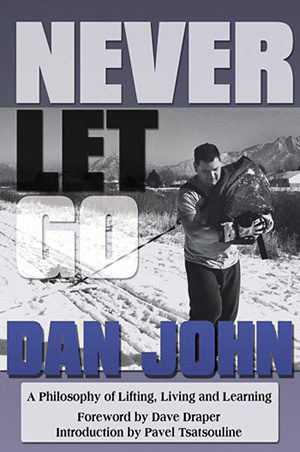
It is what I make my living on: the throws. We put the Farmer Walk into our practice sessions for throwing. Instead of teaching or talking about big chest and “locked down,” I just have the athlete FW. Then, we pick up the implement and say “remember this?” and off they go. It can change, for the better, an athlete in seconds.You also talk about your "fave variation" being "really heavy for a great distance"...
I find this question funny in an odd way. As I tell people, like barefoot running, the Loaded Carries are self correcting. It literally can’t get too screwed up. I had one Strongman with the “inability” to lock out overhead, so I made him do Walks with 100 K locked out overhead. The first five steps were a lesson in the body finding an easier way to lock out! So, this “learning” always seems positive. Now, I know that some people with faster things like sleds to will discover ways to screw up, but that is why I hold them back from quick loaded work for a long time. So, pattern, pattern, pattern…then add speed.Speaking of Speed, you have the the Litvinov sprints in your text - where one sprints out from doing a lift and that your sense is that sprint post lift lets the athlete not think about the lift "too much" but you also focus strongly on quality of reps. That "forget" the lift; just do it and run does seem an advanced post pattern mastered move?
Litvinovs are not done until one masters the patterns, grinds, asymmetry issues and even ballistics on several moves. If you follow my advice, you would never let someone try Litvie work without a fairly good assessment period. From there, you need to end a satori state with the barbell and the ballistic. I can’t be coaching you on “elbows up” or whatever in the front squat, you have to be nailed down technically and focused on the attack.Got it. Patterns before Closer to Reality. Beyond patterns or perhaps as part of them, you also talk about intensity – both in the book and in your other writing. For instance, you write:
It is great for football and rugby and combat because of this. If in a collision sport, you get all caught up on your one on one fight and forget the ball carrier, you are worthless.
"again, the most obvious lesson of my coaching life has been reinforced: the more intense you can train, the better. Yep, you knew that. So did I. Why then don't we follow the rule?"
Would you care to unpack a bit what you mean by "intensity" Is that also "intent" I ask because in Even Easier Strength, one would sense that effort - not feeling it - not being challenged by load - is a pretty important part of that protocol so how think about intensity?
I use intensity in the classic sense, percentage of max. But, there is the rub. What is your max? In “Never Let Go,” my favorite chapter might be the one on all the max terms and how we tend to never use the word correctly. Paul Northway, for example, once pointed out that I was using 225 pounds for my first snatch warm up and 315 for my first warm up for the Jerk Off the Rack. I told him: “These are just warm ups.” So, years later, those would be my attempts on the platform! Same guy, different maxs!Time to talk active recovery perhaps? Moving towards a potentially more dynamic pattern, and programming with patterns, at the Pavel/Dan John workshop last year, we did a whole set on tumbling. You’ve written about the value of the cartwheel – just as a worked example how does this kind of work fit in with the Idea that is Four Steps? Active recovery between sets, or…
So, perception of max and perception of the load are huge points in the Easy Strength program. And, and this is tough, you actually have to do the Easy Strength program to understand it. It’s like dancing. You can talk and write about it, but it might help to actually do it. I was going to say “sex,” but, well, …
Don’t get too caught up in the Four Steps. It is just one way to get people to “condition” with basic patterns and grinds. Tumbling should be taught in its own place. I take two days a month with every athlete to go over fall training (protecting yourself in a fall), tumbling movements, handstands and the various lowest level floor moves. It is an amazing conditioner in all senses of the word. Moreover, it is fun. It makes the body do things on the edge, but in a safe place. Are headstands dangerous? Probably! But, if you find yourself in that position in life from a collision, I have given you a chance to survive it.I sense the blend of “health” and “fitness.” Interns in your world are?
My interns have told me year in and year out that the tumbling was the thing that tied everything together. I also throw a tumbling run into many of my training workouts, but this has to be something your facility can handle. So, Front Squat, Bench Press, Clean and Cartwheels is a great combo, but you have to have the space and mats to do it.
One last thing: I make a lifetime commitment to my athletes. When they are 80, the fall training they learned may save their life. And I mean that from my very heart…
Interns. Someone who comes out, internship, for a few months to learn how I coach. Non paying, lots of work, lots of homework…great career move!Patterns - the Concept And just so we’re all on the same page, mastering the patterns is something you’ve mentioned a lot. Can we clarify how you’re understanding patterns? when you say master, do you mean you.ve hit your benchmarks that you provide in the book of particular loads/reps in these movements?
“Patterns” is a word I got from Brett Jones. It is the basic movement…done correctly and pain free. Your follow up question is the one that I get the most confusion from my people: it depends is the exact right answer! Maybe someday I will take the time to chart out age, gender, background, injuries and goals, but the idea of mastery is simply this: get the movement right without pain. Load and reps will be decided but what you need to do from there and, yes, I know that isn’t what people want as an answer!

We close today's episode with Dan. Next time, we pick up focusing on women's strength: building equivalence of that sought after 125Kg pull with just kettlebells, and looking in more detail at prepping for the Iron Maiden challenge. We'll wrap up with Dan's Intervention publishing plans. So please stay tuned.
Related Posts
- That first interview with Dan John: Pressing Matters
- An overview of the shoulder, Part 1
- An overview of muscle action in the Pistol/ottoman squat
- Pull ups 101
- Bodyweight work with Dennis Frisch
Subscribe to:
Posts (Atom)

 COACHING with dr. m.c.