Saturday, June 8, 2013
A Taste for Lean? A Role for the Senses in Weight Control
Follow @mcphoo
Tweet
Being overweight is not simple. Lest anyone say "just eat less" you have my permission to punch them in the arm (gently, or maybe not so much: use your discretion).
Being Overweight: Complex Interactions. When we get overweight a whole lot of complex interactions happen to make it harder to lose weight.
 One of the factors seems to be we become increasingly, hormonally and sensually numb. By hormonally numb, we can think about things like insulin resistance, chronic fatigue, sometimes not being able to feel full, not being able to concentrate (here's an overview of what hormones are).
Sensually numb can be that our awareness of any of our five senses get diminished. At the extreme end, if we think about certain stages of type II diabetes, often associated with obesity, feet losing sensation is a not uncommon side effect.
PLASTICITY: we can be BETTER. The happy thing about our bodies is that they are incredible resilient; we can recover our sensitivity, and often, our sensitivity comes back on line as we get our weight under control. The inverse may also be true. In other words, helping our senses come back on line might just help us modulate our behaviours around food and so help us get our weight back in line with where we'd be happier.
Making Taste work for Lean Advantage:
Knowing more about how we can get at our weight via different pathways can be a great way into addressing fat. In this piece we're going to look at some work connecting smell awareness and obesity, and propose a way to tune that sense up to our advantage for fat loss.
A recent paper proposed a correlation (not causation) between obesity and taste perception. It seems that obese kids and teens had a lessened taste acuity compared with their non-obese peers [1]. Sensitivity to salty, umami and bitter were particularly low for the obese, but sweet was not great either.
TASTE IS COMPLEX. The authors don't go into why some folks have better taste discrimination than others, but the interesting thing? They note that taste sensitivity is multifactorial, that is there are many components at play that inform taste acuity. Culture is one factor: consider what tastes do we encounter? what quality?
Hormones are also influential. Leptin seems to have a taste influence. Intriguingly leptin acts to give a the shut off signal to the brain (the hypothalamus) to say "don't need to eat now."(Nice research overview of Leptin in [2]; lay overview of Leptin here).
WHITE FAT TALKS TO US Leptin is a really intriguing switch because of where this hormone is generated. It is produced in adipose tissue (white fat). Most of us tend to think of fat as rather innert squishy stuff. On the contrary: there's a lot going on in this live tissue, including hormone production. The relationship of leptin secretion to fat is seemingly simple: less fat, less leptin circulating.
Go on a weight loss program, leptin levels decrease as fat goes away. Great that fat goes, but might feel hungry for more reasons than well, hunger. Depending on the speed of the fat loss created, the body may scream a little louder as it rebalances hormonal sensitivity perhaps. Hence the goal of slower, steady fat loss perhaps rather than rapid - which puts more hormonal and emotional stress on the body (and aside: once again, time needed to drop fat and adjust hormonally may help explain why set point theory is crap)
Leptin and Taste: The consequence of this loss of fat/lower leptin levels seem to be an increased taste awareness -- especially (and perhaps not surprisingly) for Sweet tasting stuff - that would be stuff that is usually high in fast energy sources, like sugar, and sugary starchy carbs [3]. On the plus side again, it seems the sharper our senses of taste, we see from the research sited about that we're (a) likely leaner and (b) possibly leaner because sharper tastes which mean not needing to eat of a sweet taste to get a satisfying hit from taste. We can potentially perceive the sweetness better in more nutrient dense calorie lighter foods. Indeed, one researcher argues that if we upped not so much the sweet, but the savory/umami flavour of foods, we'd get better nutrient balanced meals, and better regulation of food intake [4].
But what about when we have a cold, and can't taste anything or smell anything? It may be tastes are muted because less combined with the smell bits and strong associations of smells with tastes (remember taste is multifactorial)- BUT - it may also be the cold simply affecting our taste buds.
According to Brainfacts, when taste and smell come together, we get flavour. Now you know.
Fasting and Heightened Smell Awareness. You may have noticed that if you fast for any period of time, your sense of smell goes up. Recent research [5] suggests this is not us hallucinating from lack of food. When you think about it, it almost makes a kind of sense: hunger may sharpen precision for detecting sources of nutrients. How about that as a story? Love that smell of a bakery in the early morning before one's first coffee? That may be us on the hunt, and keen to source out our Carb Prey.
Another part of getting systems back online is to activate the nerves that communicate with those systems. Taste is a physiological system. Our systems are plastic (overview of what that means): we are use it or lose it systems. The more we practice something, often the better we get at it.
Since taste is multifactorial - influenced by a variety of factors - we can practice of taste as a skill. Consider Chefs who deliberately practice discerning tastes of various kinds of items that are very different and very similar. Or likewise there are various tasting clubs for everything from olive oils to wines to chocolate.
Something more immediate as a practice tool may be to stimulate the nerves that are engaged in taste.
There are three big nerves in the head (cranial nerves) that are involved in taste: cranial nerves VII, IX and X - by convention the nerves are labelled with Roman numerals. You can see how these nerves map on this list.).
Without going into too much detail, these nerves are mapped to parts of the face, to a lot of swalliwing and well, gagging (the epiglotis has taste receptors on it). So we can actually excite taste buds by association of triggering those nerves.
To activate the facial nerves, we can blow up our cheeks as big as possible. Take a look in the mirror and see if one side semms like it's better able to do it than the other - this may indicate a place where we could practice to get better symmetry.
Swallowing is another thing we can check. With our tongue tip pressed to the roof of our mouth, see how many times we can swallow in a row before we have to quit. If after the second swallow we need a break or it's hard, that may indicate that those nerves don't get much work. Practice can be a real benefit.
Swallowing is really important to the brain, too. At some point we can talk about central pattern generators. But for now, if you find that swallowing repeatedly doesn't get better with practice, think about checking in with your doc.
To check effect, we need to do a pre and post assessment. Remember salty, umami, bitter and to a lesser degree, sweet, were the tastes found affected. So, before doing the exercises, try checking something with one of these tastes - in any individual one taste may be more "numb" than another.
Here are some blends (pdf here for more) for preparing some taste tests.
An approach to test salty for instance might be, taste the salty, rinse the mouth out with water; do one of the exercises for about 5 reps; re-taste. Any difference? If not, try the next exercise; re-test. Take a break, come back try another taste.
If one of those movements helped improve taste, think about incorporating it into your daily activities. Do it throughout the day; do some more reps before you eat.
If NONE of the movements help your taste buds, check out how your diet is in terms of zinc foods, and think about upping these for at least two weeks consistently, and retest.
In this post, the suggestion is: let's see if nudging taste may also help with moving towards better awareness, and perhaps therefore better satiety that leads from better appreciation of food in the mouth. IT's easier to enjoy food more mindfully if we can appreciate the nuances of its taste (about mindful eating).
On another high point: there's no down side to practicing the activation of those cranial nerves targeted by swallowing or blowing up our cheeks: doing so stimulates many associated Good Things in our brains. Likewise, zinc is really important in our diet and often quite low.
No matter our body comp, therefore, using nutrition and movement to affect our brains and bodies to help us move towards optimal wellbeing is a Good Thing.
If you try the above tests, please let me know how your taste improves.
You can post here, to @begin2dig on twitter or begin2dig on facebook.
Look forward to hearing from you.

Being Overweight: Complex Interactions. When we get overweight a whole lot of complex interactions happen to make it harder to lose weight.
One of the factors seems to be we become increasingly, hormonally and sensually numb. By hormonally numb, we can think about things like insulin resistance, chronic fatigue, sometimes not being able to feel full, not being able to concentrate (here's an overview of what hormones are).Sensually numb can be that our awareness of any of our five senses get diminished. At the extreme end, if we think about certain stages of type II diabetes, often associated with obesity, feet losing sensation is a not uncommon side effect.
PLASTICITY: we can be BETTER. The happy thing about our bodies is that they are incredible resilient; we can recover our sensitivity, and often, our sensitivity comes back on line as we get our weight under control. The inverse may also be true. In other words, helping our senses come back on line might just help us modulate our behaviours around food and so help us get our weight back in line with where we'd be happier.
Making Taste work for Lean Advantage:
Knowing more about how we can get at our weight via different pathways can be a great way into addressing fat. In this piece we're going to look at some work connecting smell awareness and obesity, and propose a way to tune that sense up to our advantage for fat loss.
Taste Awareness and Weight Management
 |
| The many hormonal interactions of hunger (image source) |
TASTE IS COMPLEX. The authors don't go into why some folks have better taste discrimination than others, but the interesting thing? They note that taste sensitivity is multifactorial, that is there are many components at play that inform taste acuity. Culture is one factor: consider what tastes do we encounter? what quality?
Hormones are also influential. Leptin seems to have a taste influence. Intriguingly leptin acts to give a the shut off signal to the brain (the hypothalamus) to say "don't need to eat now."(Nice research overview of Leptin in [2]; lay overview of Leptin here).
WHITE FAT TALKS TO US Leptin is a really intriguing switch because of where this hormone is generated. It is produced in adipose tissue (white fat). Most of us tend to think of fat as rather innert squishy stuff. On the contrary: there's a lot going on in this live tissue, including hormone production. The relationship of leptin secretion to fat is seemingly simple: less fat, less leptin circulating.
 |
| white adipose tissue (image source) |
Leptin and Taste: The consequence of this loss of fat/lower leptin levels seem to be an increased taste awareness -- especially (and perhaps not surprisingly) for Sweet tasting stuff - that would be stuff that is usually high in fast energy sources, like sugar, and sugary starchy carbs [3]. On the plus side again, it seems the sharper our senses of taste, we see from the research sited about that we're (a) likely leaner and (b) possibly leaner because sharper tastes which mean not needing to eat of a sweet taste to get a satisfying hit from taste. We can potentially perceive the sweetness better in more nutrient dense calorie lighter foods. Indeed, one researcher argues that if we upped not so much the sweet, but the savory/umami flavour of foods, we'd get better nutrient balanced meals, and better regulation of food intake [4].
Aside: Amusing facts about Smell vs Taste
Smell and Taste? Taste just to be über clear is something more separate from smell than most of us think. These senses are separately wired in the brain. Smell has its own dedicated cranial nerve in the brain (CN I). Taste, however, is fed by several of these cranial nerves. So the brain shares taste accross several important information channels.But what about when we have a cold, and can't taste anything or smell anything? It may be tastes are muted because less combined with the smell bits and strong associations of smells with tastes (remember taste is multifactorial)- BUT - it may also be the cold simply affecting our taste buds.
According to Brainfacts, when taste and smell come together, we get flavour. Now you know.
Fasting and Heightened Smell Awareness. You may have noticed that if you fast for any period of time, your sense of smell goes up. Recent research [5] suggests this is not us hallucinating from lack of food. When you think about it, it almost makes a kind of sense: hunger may sharpen precision for detecting sources of nutrients. How about that as a story? Love that smell of a bakery in the early morning before one's first coffee? That may be us on the hunt, and keen to source out our Carb Prey.
How Boost the Taste for Lean?
Whether or not putting scent crystals on food to tun on smell and so reduce intake actually has about zero research support. Taste on the other hand, as we've seen above, does. There does seem to be a relation between taste perception and dietary intake, where better taste awareness seems to be associated with leanliness. So might their be some value especially if we're overweight in attempting to boost taste perception?
 |
| zinc (and copper) foods |
ZINC CHECK One observation in the literature is that poorer taste acuity is associated with low levels of zinc [6]. Get zinc at healthy levels, both taste AND cognitive function improve. Double win. Just 30mg a day seems to make a taste-y difference. A list of "top ten" zinc foods is here. These include oysters, veal liver (other types of liver have it too), peanuts, and of course, dark chocolate.
Movement Based Taste Assists
Fuel is super critical to our wellbeing. Getting the right nutrients, like Zinc, more of the time takes care of a worls of ills.Another part of getting systems back online is to activate the nerves that communicate with those systems. Taste is a physiological system. Our systems are plastic (overview of what that means): we are use it or lose it systems. The more we practice something, often the better we get at it.
Since taste is multifactorial - influenced by a variety of factors - we can practice of taste as a skill. Consider Chefs who deliberately practice discerning tastes of various kinds of items that are very different and very similar. Or likewise there are various tasting clubs for everything from olive oils to wines to chocolate.
Something more immediate as a practice tool may be to stimulate the nerves that are engaged in taste.
 |
| CNVII aka Facial Nerve (source) |
There are three big nerves in the head (cranial nerves) that are involved in taste: cranial nerves VII, IX and X - by convention the nerves are labelled with Roman numerals. You can see how these nerves map on this list.).
Without going into too much detail, these nerves are mapped to parts of the face, to a lot of swalliwing and well, gagging (the epiglotis has taste receptors on it). So we can actually excite taste buds by association of triggering those nerves.
 |
| The Master of Facial Nerve Symmetry, Jazz horn impresaro, Dizzy Gillespie (Is the left side higher than the right?) Image Source |
Swallowing is another thing we can check. With our tongue tip pressed to the roof of our mouth, see how many times we can swallow in a row before we have to quit. If after the second swallow we need a break or it's hard, that may indicate that those nerves don't get much work. Practice can be a real benefit.
Swallowing is really important to the brain, too. At some point we can talk about central pattern generators. But for now, if you find that swallowing repeatedly doesn't get better with practice, think about checking in with your doc.
Pre / Post Taste Test
Here's the thing: it's great to do these exercises, but even better to check their effect. We can see a difference pretty immediately.To check effect, we need to do a pre and post assessment. Remember salty, umami, bitter and to a lesser degree, sweet, were the tastes found affected. So, before doing the exercises, try checking something with one of these tastes - in any individual one taste may be more "numb" than another.
Here are some blends (pdf here for more) for preparing some taste tests.
- Sweet: table sugar: ½ teaspoon dissolved in 2 tablespoons water
- Salt: table salt: 1/8 teaspoon dissolved in 2 tablespoons water
- Bitter: coffee, brewed or made from instant:
An approach to test salty for instance might be, taste the salty, rinse the mouth out with water; do one of the exercises for about 5 reps; re-taste. Any difference? If not, try the next exercise; re-test. Take a break, come back try another taste.
If one of those movements helped improve taste, think about incorporating it into your daily activities. Do it throughout the day; do some more reps before you eat.
If NONE of the movements help your taste buds, check out how your diet is in terms of zinc foods, and think about upping these for at least two weeks consistently, and retest.
Concept: Better Taste Sensation, More Alive to Food Flavour, Head to Leaner Being?
The authors of the study we started with did not offer a functional application of their findings; they simply noted the correlation between taste and body composition.In this post, the suggestion is: let's see if nudging taste may also help with moving towards better awareness, and perhaps therefore better satiety that leads from better appreciation of food in the mouth. IT's easier to enjoy food more mindfully if we can appreciate the nuances of its taste (about mindful eating).
On another high point: there's no down side to practicing the activation of those cranial nerves targeted by swallowing or blowing up our cheeks: doing so stimulates many associated Good Things in our brains. Likewise, zinc is really important in our diet and often quite low.
No matter our body comp, therefore, using nutrition and movement to affect our brains and bodies to help us move towards optimal wellbeing is a Good Thing.
If you try the above tests, please let me know how your taste improves.
You can post here, to @begin2dig on twitter or begin2dig on facebook.
Look forward to hearing from you.
Research Cited
- Overberg J, Hummel T, Krude H, & Wiegand S (2012). Differences in taste sensitivity between obese and non-obese children and adolescents. Archives of disease in childhood, 97 (12), 1048-52 PMID: 22995095
- Harris RB (2013). Direct and indirect effects of leptin on adipocyte metabolism. Biochimica et biophysica acta PMID: 23685313
- Harris RB (2013). Direct and indirect effects of leptin on adipocyte metabolism. Biochimica et biophysica acta PMID: 23685313
- Mouritsen OG (2012). Umami flavour as a means of regulating food intake and improving nutrition and health. Nutrition and health, 21 (1), 56-75 PMID: 22544776
- Cameron JD, Goldfield GS, & Doucet É (2012). Fasting for 24 h improves nasal chemosensory performance and food palatability in a related manner. Appetite, 58 (3), 978-81 PMID: 22387713
- Tupe RP, & Chiplonkar SA (2009). Zinc supplementation improved cognitive performance and taste acuity in Indian adolescent girls. Journal of the American College of Nutrition, 28 (4), 388-96 PMID: 20368377


 PDF
PDF

Wednesday, May 22, 2013
Eat meat, why not eat beast complete? Explore offal (like liver)
Follow @mcphoo
Tweet
Do you eat meat? Ok, let's assume you've got the grass fed/free range thing down. Now, do you eat Liver? How about kidneys, heart, related giblets?
If not why not? Bad childhood aroma memories? Time for a taste sensation re-education.
 After being vegetarian for a long time, and dealing with some health issues about 18m ago i think i started eating meat. It's not till this last month and reading T.C. Luoma's Zombie Diet article that i began to explore organ meat in the diet - memories of early childhood not withstanding.
What on earth has been keeping people away from this stuff? It's amazing!
If you're gonna eat meat, be complete. If you're gonna eat an animal, dam it EAT THE ANIMAL.
As Luoama writes in Zombie Diet about the nutritional value of liver, just for instance:
I was in Paris at a conference when i started exploring this space. There is pretty much literally a butcher on every corner there. So getting liver - calves liver in particular [nutrition info]- and one shop was quite open about only having horses liver (!) - is pretty much simple. That's grass fed, too, natch.
Soaked in milk a few hours, sauted rare with tons of onions and shallots (and maybe some bacon), served with fresh greens and sweet potato, lots of spices, it's amazing. Super super tender, and so just oddly satisfying this is just not your mama's liver.
Today, rather than liver, it was lamb's heart (high in iron) and sweetbreads (high in vitamin c) (this is the thymus/pancreas, not brains) [nutrition info]. Wow. That was lunch. and again, after eating this uber fast and lovely and easy to prepare food, i felt incredibly restored AND energised. And that without a morning shot of joe. What's in this stuff?
What's not to like? Fat? Cholesterol? Misinformation?
TO folks who are concerned about cholesterol and saturated fat: suck it up. No really, it's ok. Let us liberate ourselves from our "fat is evil" place and understand Balance. The move to liver being safe again - indeed healthy again - shows how our understanding of fat and food is improving.
First, eating dietary cholesterol doesn't increase cholesterol in our blood, and saturated fat is not bad. Saturated Fat does many good things. It's all about balance (overview on balancing fats here). If you're curious about cholesterol, take a peak at this article on cholesterol doing low carb eating.
I'm one with Michael Pollan about "eat less; mostly plants" - and if eating animals, let me add by extension, eat the healthiest types possible like free range & grass fed, and eat as much of the beast as possible. That includes the squishy bits. As Alison Ford writes
If you eat meat, be complete: Give Liver and Offal a try
CAVEAT: winner winner chicken liver - not - While chicken livers [nutrition info] have much to offer nutritionally (and also lower on vitamin a, which is perhaps important if considering od'ing on liver - just remember to get as much vitamin d) I have had one poor experience with a recipe suggesting chicken livers could be cooked rare, like bigger animal liver. Do NOT take that advice.
- or go ahead, try it, and see how long before you hit campylobacter -- you know how we have to cook chicken so it's not pink? same apparently with chicken liver. Here's a recipe that gets them cooked for about 5-7 minutes total (there's two times into the pan). You can also use a thermometer to make sure the innards are at a safe piping temperature (>70C).
If ya don't take this care, Let me tell ya, it's a very special type of reaction - great taste - horrible experience post eating. Again, maybe you'll be lucky and find undercooking chicken livers is grand. Me? i think i'll be making pate with well cooked chicken livers and go rare with other critters. Pate Recipes Here's a Mark's Apple version of chicken pate. And better (as it's blender based) a chicken paleo inspired version or two. irony: chickens are domesticated, so perhaps not paleo beasties? i'm just saying.
 Cooking is FUN and CHEAP. This stuff is really straight forward to cook. It can all be done in a pan. A cast iron one if you like (i like).
Where else get this kind of vitamin and mineral and nutrient profile for this price? I'm shocked.
If you eat meat: why not get in on this amazing value - on every level of the term value: taste, nutrition, price, satiety and energy.
Feeling Groovy?
If you've started doing liver and associated organs and you feel jazzed and energised and satisfied after eating this stuff, please let me know. It would be great to understand why this is such an effect - assuming it's occurring in more than just me.
Related Posts:
Tweet
Follow @begin2dig
If not why not? Bad childhood aroma memories? Time for a taste sensation re-education.

What on earth has been keeping people away from this stuff? It's amazing!
If you're gonna eat meat, be complete. If you're gonna eat an animal, dam it EAT THE ANIMAL.
As Luoama writes in Zombie Diet about the nutritional value of liver, just for instance:
Choline is another good nutrient for the brain, recommended especially for pregnant gals, and beef and chicken liver is high in this. More goodness.Look at this comparison between the Vitamin C content of 100 grams of apple, 100 grams of carrots, 100 grams of red meat, and 100 grams of beef liver.
one may see "ox liver" as interchangeable with beef liver
The apple has 7.0 grams of Vitamin C, the carrots have 6.0 grams, the red meat has 0 grams, and the beef liver has 27.0 grams.
Let's do the same thing with Vitamin B12.
The apple has no measurable B12 and neither do the carrots. The red meat has 1.84 mcg., but the beef liver has 111.3 mcg.
It's no contest.
And it's not much different when you look at other nutrients like phosphorus, magnesium, potassium, iron, zinc, copper, Vitamins A, D, and E, thiamin, riboflavin, pantothenic acid, folic acid, biotin, and Vitamin B6 – beef liver beats them all almost every time. (bold emphasis mine - mc)

I was in Paris at a conference when i started exploring this space. There is pretty much literally a butcher on every corner there. So getting liver - calves liver in particular [nutrition info]- and one shop was quite open about only having horses liver (!) - is pretty much simple. That's grass fed, too, natch.
Soaked in milk a few hours, sauted rare with tons of onions and shallots (and maybe some bacon), served with fresh greens and sweet potato, lots of spices, it's amazing. Super super tender, and so just oddly satisfying this is just not your mama's liver.
Today, rather than liver, it was lamb's heart (high in iron) and sweetbreads (high in vitamin c) (this is the thymus/pancreas, not brains) [nutrition info]. Wow. That was lunch. and again, after eating this uber fast and lovely and easy to prepare food, i felt incredibly restored AND energised. And that without a morning shot of joe. What's in this stuff?
What's not to like? Fat? Cholesterol? Misinformation?
TO folks who are concerned about cholesterol and saturated fat: suck it up. No really, it's ok. Let us liberate ourselves from our "fat is evil" place and understand Balance. The move to liver being safe again - indeed healthy again - shows how our understanding of fat and food is improving.
First, eating dietary cholesterol doesn't increase cholesterol in our blood, and saturated fat is not bad. Saturated Fat does many good things. It's all about balance (overview on balancing fats here). If you're curious about cholesterol, take a peak at this article on cholesterol doing low carb eating.
I'm one with Michael Pollan about "eat less; mostly plants" - and if eating animals, let me add by extension, eat the healthiest types possible like free range & grass fed, and eat as much of the beast as possible. That includes the squishy bits. As Alison Ford writes
Although some people are still squeamish about eating offal, it provides legitimate social and environmental benefits, as well as the nutritional ones. Eating offal shows respect to animals, discourages waste, and fosters a more understanding and intimate relationship between an eater and his food. Plus, as many chefs have pointed out, much processed commercial meat—including ground beef, hot dogs, lunch meat, and sausage—is of indeterminate origin, but offal is impossible to fake—while it can be hard to know exactly what’s in a hot dog, there’s no mistaking that a kidney is a kidney, so you always know exactly what you’re getting.It feels GRRReat! Three things about liver and related offal: taste is awesome; nutrition profile is incredible - in fact unbelievable - but the biggest and most consistent surprise so far has been energy. I have not probed far enough into the goods to get why there is such satisfaction that's incomparable - stake doesn't do it; neither does carrot cake. What is with this stuff? Have you had that experience? we know there's saturated fat, true, and saturated fats seem to be higher in satiety (see this 2013 paper, for example) than other kinds of fats - especially monounsaturated, but heh, i've done high fat coffee and it doesn't have this feel. you know? So what's the nutrient profile that's doing this happy joy post prandial delight? Maybe its shock that offal is so un-offal.
If you eat meat, be complete: Give Liver and Offal a try
 |
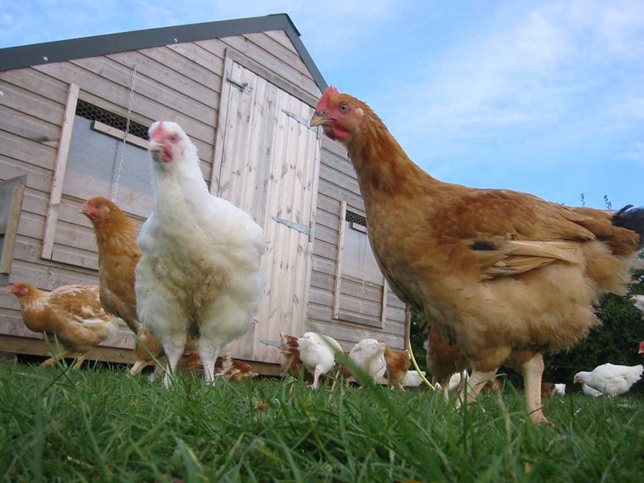
| free range chickies (source of image) - good to the last giblet |
- or go ahead, try it, and see how long before you hit campylobacter -- you know how we have to cook chicken so it's not pink? same apparently with chicken liver. Here's a recipe that gets them cooked for about 5-7 minutes total (there's two times into the pan). You can also use a thermometer to make sure the innards are at a safe piping temperature (>70C).
If ya don't take this care, Let me tell ya, it's a very special type of reaction - great taste - horrible experience post eating. Again, maybe you'll be lucky and find undercooking chicken livers is grand. Me? i think i'll be making pate with well cooked chicken livers and go rare with other critters. Pate Recipes Here's a Mark's Apple version of chicken pate. And better (as it's blender based) a chicken paleo inspired version or two. irony: chickens are domesticated, so perhaps not paleo beasties? i'm just saying.
 Cooking is FUN and CHEAP. This stuff is really straight forward to cook. It can all be done in a pan. A cast iron one if you like (i like).
- Lamb liver - two servings on special - 19p.
- Free range chicken liver, 400g, £2.39 400g is just less than a pound weight.
Where else get this kind of vitamin and mineral and nutrient profile for this price? I'm shocked.
If you eat meat: why not get in on this amazing value - on every level of the term value: taste, nutrition, price, satiety and energy.
Feeling Groovy?
If you've started doing liver and associated organs and you feel jazzed and energised and satisfied after eating this stuff, please let me know. It would be great to understand why this is such an effect - assuming it's occurring in more than just me.
Related Posts:
Subscribe to:
Posts (Atom)

 COACHING with dr. m.c.