Monday, January 10, 2011
Main Muscles in the Ottoman Pistol, Part 2: the butt
Follow @mcphoo
Tweet
In the previous post, we considered the quads' role in the ottoman pistol. This post we'll take a wee look at the butt and hamstrings. Remember the quads are largely knee extensors and hip flexors. The vastus group stabilizes the knee, and particularly helps us as we stand up - contracting the quads locks the knee cap for instance. The butt and hamstrings work the back of the leg and knee and hip to flex the knee and extend the hip, as in the runner's leg going back in the sprint.
SO let's take a look at how this muscle combo works in the pistol.
 The Butt - the Glutius Maximus
 We know that the knees HAVE to straighten for us to stand up in the pistol. But there's another big body part that changes, too, and that's the hip. The hip extends as we move from the squat position where the pelvis is flexed, to standing up, where it's extending. But the movement in the squat not only has the hip extending but the leg externally rotating (turning out) and moving away from midline, or abducting.
 The muscles that extend the hip include the biggest muscle in the body: the gluteus maximus. Hip extension (and external rotation of the leg, or the leg turning out) must take alot of work if it has such mass associated with it.
THis massive muscle is interesting in the way it connects to the body: it attaches to the back of the pelvis - that makes sense since it has to connect with the hip. It also connects along the sacrum - the lowest part of the back, if you will.
The muscle connects into the femur at the gluteal tuberosity and into the iliotibial tract (IT band). That tract connects into the top of the tibia - in other words the butt effectively connects over the hip and past the knee into the lower leg. So the butt also helps support the knee via the IT band when the knee is extended (when we're standing up.
The Hamstrings: Biceps Femoris, Semitendinous and Semimembranous Muscles
Along the back of the the leg run the hamstrings or biceps femorous, semimembranous and semitendinous muscles. .
Origins. The semimembranous and semitendenous muscles along with the long head of the biceps femoris all connect into the ishial tuberosity of the pelvis (into the sitting bones if you will). The short head of the biceps femoris however does not connect to the pelvis. Instead it connects into the femur.
Insertions. The Semis connect into the tibia or the medial side of the knee. The biceps femoris, to the lateral side of the tibia (top of lower leg).
With the hamstrings, then, we have a set of muscles that connects to the pelvis to pull it into extension (to straighten it), and likewise connects with the knee to pull it into flexion (to bend). In the case of the pistol, where the foot is on the floor and stays there, the main action of the hamstrings will be on the hip.
(Aside: It's in running and kicking for instance where the knee is working that we'd see the hamstrings come in more with the knee, but when the leg stays nailed to the floor, or the knee is immobile, the hammies will work the hip).
Working the Pistol
Going Down. As we saw, the quads help the knee, trunk and flexed hip on the way down into the bottom position of the pistol (eccentric contraction). In going down, the glute max and the hamstrings are also on, also eccentrically contracting, actively helping to let the hips flex. That's their main action in the descending leg: eccentric contraction to assist hip flexion.
Coming Back Up. Once down, the glute max will get active to extend the hip (concentric contraction) as we start to come up, and the hamstrings will contribute to pull the hip into extension (concentric contraction) as well.
A note on Eccentric Contraction:
Just to review the knee/hip part of this movement, the quad group (the thigh) on the way down is doing "eccentric contraction" (ec) - controlling the speed of the bend of the knee: it is contracting muscle fibers while the muscle still lengthens to allow the limbs to move. The butt is likewise doing eccentric contraction on the way down to help control the movement of the hip into flexion.
Imagine someone lowering something on a rope: to pay out the rope slowly, one is applying some tension somewhere to control the descent, else the rope will just slide through one's hands. If one is lowering a piano from a building, the important ropes - the ones taking the strain - are the lowering ropes; there may be folks on the ground gathering up rope on either side of the piano to guide it to make sure it doesn't hit a wall on the way down, but the heavy lifting as it were is in the lowering, the paying out of the rope.
Two other points about EC: we're also stronger in eccentric contraction than concentric contraction: it's easier to lower a piano to the ground than pick it up. And finally - a reminder that eccentric contraction kicks off DOMS more so than concentric contraction.
Wrap up of the Butt (really glute max) and Hamstrings
So the pistol is certainly working the legs and butt big time: a lot of eccentric conrtaction for controlling the movement of the hip into flexion on the way down and conversely a lot of concentric contraction to help the hip get back up to neutral.
Plainly this move does a LOT for the lower body - by using one leg, bodyweight becomes a significant challenge for that first rep or multiple reps. Many other stabiliser muscles come into play in these movements; there's also considerable vestibular challenge in this movement as we must add more balance control to succeed. But for now, let's get the biggies figured out.
Next time, in the last of this series, we'll look at the last major bit of the ottoman pistol, the ankles.
Pistol Resources:
- beast skills site
- Pavel Tsatsouline's The Naked Warrior
- Steve Cotter's Mastering the Pistol
Related Articles
SO let's take a look at how this muscle combo works in the pistol.
The Butt - the Glutius MaximusWe know that the knees HAVE to straighten for us to stand up in the pistol. But there's another big body part that changes, too, and that's the hip. The hip extends as we move from the squat position where the pelvis is flexed, to standing up, where it's extending. But the movement in the squat not only has the hip extending but the leg externally rotating (turning out) and moving away from midline, or abducting.The muscles that extend the hip include the biggest muscle in the body: the gluteus maximus. Hip extension (and external rotation of the leg, or the leg turning out) must take alot of work if it has such mass associated with it.THis massive muscle is interesting in the way it connects to the body: it attaches to the back of the pelvis - that makes sense since it has to connect with the hip. It also connects along the sacrum - the lowest part of the back, if you will.
The muscle connects into the femur at the gluteal tuberosity and into the iliotibial tract (IT band). That tract connects into the top of the tibia - in other words the butt effectively connects over the hip and past the knee into the lower leg. So the butt also helps support the knee via the IT band when the knee is extended (when we're standing up.
The Hamstrings: Biceps Femoris, Semitendinous and Semimembranous Muscles
 |
| great kinesiology resource |
Origins. The semimembranous and semitendenous muscles
along with the long head of the biceps femoris all connect into the ishial tuberosity of the pelvis (into the sitting bones if you will). The short head of the biceps femoris however does not connect to the pelvis. Instead it connects into the femur.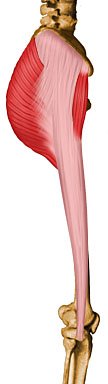 |
| glute max joining IT band into Tibia |
With the hamstrings, then, we have a set of muscles that connects to the pelvis to pull it into extension (to straighten it), and likewise connects with the knee to pull it into flexion (to bend). In the case of the pistol, where the foot is on the floor and stays there, the main action of the hamstrings will be on the hip.
(Aside: It's in running and kicking for instance where the knee is working that we'd see the hamstrings come in more with the knee, but when the leg stays nailed to the floor, or the knee is immobile, the hammies will work the hip).
Working the Pistol
Going Down. As we saw, the quads help the knee, trunk and flexed hip on the way down into the bottom position of the pistol (eccentric contraction). In going down, the glute max and the hamstrings are also on, also eccentrically contracting, actively helping to let the hips flex. That's their main action in the descending leg: eccentric contraction to assist hip flexion.
Coming Back Up. Once down, the glute max will get active to extend the hip (concentric contraction) as we start to come up, and the hamstrings will contribute to pull the hip into extension (concentric contraction) as well.
A note on Eccentric Contraction:
Just to review the knee/hip part of this movement, the quad group (the thigh) on the way down is doing "eccentric contraction" (ec) - controlling the speed of the bend of the knee: it is contracting muscle fibers while the muscle still lengthens to allow the limbs to move. The butt is likewise doing eccentric contraction on the way down to help control the movement of the hip into flexion.
Imagine someone lowering something on a rope: to pay out the rope slowly, one is applying some tension somewhere to control the descent, else the rope will just slide through one's hands. If one is lowering a piano from a building, the important ropes - the ones taking the strain - are the lowering ropes; there may be folks on the ground gathering up rope on either side of the piano to guide it to make sure it doesn't hit a wall on the way down, but the heavy lifting as it were is in the lowering, the paying out of the rope.
Two other points about EC: we're also stronger in eccentric contraction than concentric contraction: it's easier to lower a piano to the ground than pick it up. And finally - a reminder that eccentric contraction kicks off DOMS more so than concentric contraction.
Wrap up of the Butt (really glute max) and Hamstrings
So the pistol is certainly working the legs and butt big time: a lot of eccentric conrtaction for controlling the movement of the hip into flexion on the way down and conversely a lot of concentric contraction to help the hip get back up to neutral.
Plainly this move does a LOT for the lower body - by using one leg, bodyweight becomes a significant challenge for that first rep or multiple reps. Many other stabiliser muscles come into play in these movements; there's also considerable vestibular challenge in this movement as we must add more balance control to succeed. But for now, let's get the biggies figured out.
Next time, in the last of this series, we'll look at the last major bit of the ottoman pistol, the ankles.
Pistol Resources:
- beast skills site
- Pavel Tsatsouline's The Naked Warrior
- Steve Cotter's Mastering the Pistol
Related Articles
- All About Delayed Onset Muscle Soreness, Part 1 - causes
- All about DOMS part 2: aids at reduction of DOMS
- Somatosensory hierarchy: working the other side of the weight room

 PDF
PDF

Sunday, January 2, 2011
Main Muscle Movement in the Ottoman Pistol - Part 1: the Quads
Follow @mcphoo
Tweet
The (let's call it) Ottoman Pistol described yesterday - works a potent combination of muscles. We know what these muscles are because we usually feel them if we haven't pistoled in awhile: quads (front of leg), glutes (butt), sometimes the adds (adductors - inside leg), and some of that core goodness too. In this first post we'll take a quick look at what's happening with the quads - what those muscles are, and especially, why they're firing up in the Ottoman Pistol.
The Quads
Often the most felt muscles in this abbreviated leg squat are those at the front of the leg, aka the quads The quad group has four big muscles: the vastus set of medialis, lateralis, intermedius and the big front and top muscle (lies atop the intermedius), the rectus femoris. All four of these muscles meet at the knee cap - the patella and from there, hook into the lower leg.
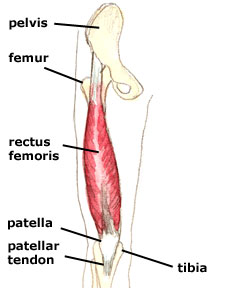 The Vastus Group vs the Rectus Femoris. While the full quad group has a lot in common, there's a big distinction between the rec fem and the vastus group. The vastus set cross the knee and connect along the top of the big honking top-of-the-leg femur bone. The rectus femoris on the other hand actually hooks onto the pelvis itself rather than the femur. Isn't that wild? These four muscles share common connections at the knee, and then diverge where they start: hip vs leg. In other words, the rec.fem. crosses two joints - in this case both the knee and the hip - while the vast group of vastus muscles only cross one joint, the knee.
The Quad Job This difference in hook ups influences the main job of the muscles that make up the quads.
The vastus set acts on the knee to extend it or straighten it out; the rectus femoris, while it also crosses the knee mainly acts to flex the hip or to bring the knee up towards the chest. In the bottom of the squat, the hip is pretty durn flexed.
Integrating the muscle movement with the Pistol. Since we feel the pistol the next day in the front of the legs, we know the quads are involved. We also know now that the quads give us two actions in particular: (1) flexing the hip and (2) extending the knee.
Where's hip flexion in the pistol? IT's in two parts of the movement: the leg controlling the decent (that's going into flexion), and the leg that is extended out. That leg is being held in hip flexion.
In the descending/bending leg, the rectus femoris is stretched. We can see from where it attaches up on the pelvis that as one goes down, and that muscle is activated, it's going to pull the pelvis forward - the pelvis rotates around the hip as the angle between the leg and the pelvis closes down from 180 to 45 degress or less. The RF is not the only muscle involved here, but it's the biggie.
In the extended leg case, a couple core muscles - the psoas and illiacus - are doing more of the work to hold out the extended leg than the rec fem to keep that 90 degree flexion. That's because the RF is at its shortest when the knee is extended and the leg flexed, so it's not getting as big an advantage on the hip.
The more the knee bends, the more the rec fem comes into gear for flexing the leg/hip.
Where's the knee extension in the pistol? When we go to stand back up, the knee extends. That's perhaps the biggest work load of the pistol. And boy do we know that that knee extension, aka standing up, is a challenge. Getting down takes a certain control, absolutely, but gravity guarentees that's the direction we'll move. Getting up is where the money is, and that means knee extension.
Summary: Why we feel the pistol in the Thigh.
There are two big actions in the pistol: hip flexion and knee extension. In other words, going into the squat and coming up from it.
Hip flexion comes in two places: in getting a leg out in front of us and in the descent into the squat position. In the quad group, hip flexion involves the rectus femoris in both of these positions, but in particular in the descent into the squat.
Knee extension comes in majorly as we stand up. The quads pull this off via the vastus muscles pulling over the knee cap by their connection at the top of the femur, the big leg bone. The rectus femoris pulls over the same part of the knee but gets reefed up by that muscle reefing up from the hip. Two big levers therefore pull up the knee into a straightened position.
Next Time
The other big player in the pistol is the butt, aka the glutes. Next time we'll look at how that group of muscles' actions of hip extension, external rotation and abduction contribute to those two big moves in the pistol: the squat and the standing up.
Happy New Year
Pistol Resources:
- beast skills site
- Pavel Tsatsouline's The Naked Warrior
- Steve Cotter's Mastering the Pistol
Related posts:
 |
| from the Beast Skills how to pistol tutorial: a light butt touch for the ottoman pistol |
Often the most felt muscles in this abbreviated leg squat are those at the front of the leg, aka the quads The quad group has four big muscles: the vastus set of medialis, lateralis, intermedius and the big front and top muscle (lies atop the intermedius), the rectus femoris. All four of these muscles meet at the knee cap - the patella and from there, hook into the lower leg.
 |
| From Grant's Dissector (ch6) the rec fem is reflected so we can see the vastus intermedius underneath and the lateralis and medialis to either side. |
The vastus set acts on the knee to extend it or straighten it out; the rectus femoris, while it also crosses the knee mainly acts to flex the hip or to bring the knee up towards the chest. In the bottom of the squat, the hip is pretty durn flexed.
In the descending/bending leg, the rectus femoris is stretched. We can see from where it attaches up on the pelvis that as one goes down, and that muscle is activated, it's going to pull the pelvis forward - the pelvis rotates around the hip as the angle between the leg and the pelvis closes down from 180 to 45 degress or less. The RF is not the only muscle involved here, but it's the biggie.
In the extended leg case, a couple core muscles - the psoas and illiacus - are doing more of the work to hold out the extended leg than the rec fem to keep that 90 degree flexion. That's because the RF is at its shortest when the knee is extended and the leg flexed, so it's not getting as big an advantage on the hip.
The more the knee bends, the more the rec fem comes into gear for flexing the leg/hip.
Where's the knee extension in the pistol? When we go to stand back up, the knee extends. That's perhaps the biggest work load of the pistol. And boy do we know that that knee extension, aka standing up, is a challenge. Getting down takes a certain control, absolutely, but gravity guarentees that's the direction we'll move. Getting up is where the money is, and that means knee extension.
Summary: Why we feel the pistol in the Thigh.
There are two big actions in the pistol: hip flexion and knee extension. In other words, going into the squat and coming up from it.
Hip flexion comes in two places: in getting a leg out in front of us and in the descent into the squat position. In the quad group, hip flexion involves the rectus femoris in both of these positions, but in particular in the descent into the squat.
Knee extension comes in majorly as we stand up. The quads pull this off via the vastus muscles pulling over the knee cap by their connection at the top of the femur, the big leg bone. The rectus femoris pulls over the same part of the knee but gets reefed up by that muscle reefing up from the hip. Two big levers therefore pull up the knee into a straightened position.
Next Time
The other big player in the pistol is the butt, aka the glutes. Next time we'll look at how that group of muscles' actions of hip extension, external rotation and abduction contribute to those two big moves in the pistol: the squat and the standing up.
Happy New Year
Pistol Resources:
- beast skills site
- Pavel Tsatsouline's The Naked Warrior
- Steve Cotter's Mastering the Pistol
Related posts:
- The magic shoulder part one: scapula rigging
- The magic shoulder part two: g/h joint
- overview of fat
- magnificent protein - not just about muscles
Subscribe to:
Posts (Atom)

 COACHING with dr. m.c.