Sunday, December 7, 2008
Why "Fire the Lats" in a Kettlebell swing?
Follow @mcphoo
Tweet
 When swinging a kettlebell in the RKC Hardstyle, you will regularly hear an RKC instructor say "fire the lats" as an aid to "pack the shoulder" or to keep the shoulder from flying out of its socket
(is Lance, pictured left, firing those lats?? aren't those shoulders a bit high?)
When i saw my first RKC and heard this, i had no idea what the above instruction meant or to feel whether or not i was achiving it. Much tough love was administered in an effort to trigger the phenomena.
At the RKC cert, lat firing was realized, along with many other refinements to the swing, such that i understood Pavel's idea of the swing firing down and INTO THE GROUND rather than out. The nirvana moment happened for me when i felt/got that with "lats fired" the kettlebell swing could barely reach chest height - the arms just did not go higher.
Didn't really think about the causes of that effect, but have tried since then to instill it as a heuristic in the folks i coach: when that big side muscle is working, the shoulders stay in the sockets and the arms just will not go more than chest height - individual variation will be a bit below (like me) or maybe a bit above (haven't seen that as much).
So why, you might ask, would the lats being ON have what i've called a "braking effect" on the apogee or top point of a swing?
We can go back to the pull up as a lat exercise to put this picture. As i wrote there:
 So, the lat works on the shoulder, or in particular the shoulder joint, by its connection on the upper arm. Firing it will therefore brake the top arc of the swing, and maintain the shoulder control when the arm adducts or crosses slightly in front of the body to do two handed or one handed swings.
You can try this out yourself without a kettlebell. Lock your elbow and first start with your arm at your side, relaxed, and just try raising your arm by moving your arm in front of you and all the way up so your upper arm is close to your ear (if you can't get it to your ear we have another thing to talk about). Look at how great the arc is of that arm. from your side all the way up, like 180 degrees.
Now get your arm by your side and try flexing the muscles you feel along your sides. When you have that "grr" tight feel, now see how high you can raise your arm comfortably. Somewhere around 90 degrees, give or take?
In other words, and here's what at least to me seems so amazing, the muscle is not working within the shoulder to hold it back in its socket, but is actually using this mass of back muscle tied into the inside of the upper arm, to put a brake the arm action forward when it's flexed, and THAT the main action keeping the shoulder "packed" in the swing.
One more visualization: imagine someone tied a thick jump band to the inside of your arm, and held it going under your armpit and across your back. Initially when the band is relaxed, you can move your arm up in a full arc. If that person tightens that elastic up, that's going to limit the degree of the arc the arm can now be raised (this may also help reinforce why the lats are so big in pull ups: that lat muscle wants to get that arm down and back, in the direction of the muscle fiber).
SO the arm is kept from flying up (or out) of the socket with the help of the lats that both hold it back and limit its arc / range of motion when the muscle is flexed.
What is the shoulder socket or glenohumeral joint? If we talk about "packing the shoulder" in the swing, therefore, we are talking about a joint - the shoulder joint. A joint is where two bones come together to act as a lever. In the shoulder joint, the top of the upper arm bone or humerous, connects with the scapula, or shoulder blade.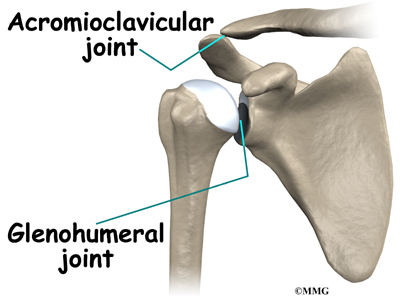
The way the lat is connected to the upper arm, therefore, pretty literally, helps keep the arm in its socket.
It's not the only muscle acting on the shoulder joint. There are a bunch of muscles stabilizing the shoulder like the rotator cuff set, but beyond these stabilizers, there are three main actors on the shoulder: the delts, which take the arm to the sides, the pecs which helps bring the arm up (think bench press) or forward (baseball throw) and the lats.
In the swing, while the deltoids and pecs do some work, the major action on the shoulder is the lat. Remeber, the swing is not a pull (from the pec). The swing is carried forward on momentum from the hips. The lat acts first like a brace and then a brake, as said, to keep that momentum from throwing the arm out. This effect is reminiscent of the action of the hamstrings when sprinting: the hamstring acts as a brake so that the leg doesn't go flying out from all that quad power: it wants to pull that leg back down into extension.
The second action is bringing the bell down, keeping the shoulders packed with lats fired, lets one accelerate it beyond what gravity/momentum allows if the arms just come down with the descent of the swing. Pavel demonstrated this powerful pull down into the ground rather than way out in front at the cert using a super light (8K) bell, saying with the right form/muscle work, you should be able to get that power drive acting on any size bell you can swing - even tiny ones. The difference in feel is that the energy of the bell is coming down into the ground. As we practiced this over the cert weekend, many of us started to find ourselves being propelled backwards in our swings just at the end of the swing, showing heel skid marks in the sand.
Note: as RKC Randy Hauer points out, the down phase of the swing is initiated with the hips flexing (hinge at the hips). My point is that in the upper body part of this move, the flexed lats keep that move solid. Thanks for the clarification, Randy.
Putting the muscle together with the movement
By seeing how the lat is connected to the arm, and knowing that a flexed muscle means a muscle that is being shortened in the contraction, you can probably see how that muscle - again with all that muscle mass along the back of the lat working - is going to be able to support the transfer of power from the hips and out through the arms without the arms projectiling out of the shoulder. Likewise, keeping those lats fired and the arms stable while coming down with the bell insures the same protection coming down again, whether with gravity alone at 32m/s/s or overspeeding down.
Summary
By considering both how/where the lat is connected to the arm and how it operates on the shoulder joint has helped me understand why "firing the lats" supports excellent form in the swing, as doing so:
Bonus benefit to lat firing? Spine stabilization. Look at that lat images above: the lat's knit through so much of the spine, right into the butt, you get that working both sides, that spine is gonna be solid through the swing. ya ya, there are all the erectors and stuff in the lumbar spine too, and good thing, but look at that lat go! Thanks to Dev Chengkalath for reminding me that the lats connet to and affect the spine as well as the shoulder in the swing. Tweet Follow @begin2dig
When swinging a kettlebell in the RKC Hardstyle, you will regularly hear an RKC instructor say "fire the lats" as an aid to "pack the shoulder" or to keep the shoulder from flying out of its socket(is Lance, pictured left, firing those lats?? aren't those shoulders a bit high?)
When i saw my first RKC and heard this, i had no idea what the above instruction meant or to feel whether or not i was achiving it. Much tough love was administered in an effort to trigger the phenomena.
At the RKC cert, lat firing was realized, along with many other refinements to the swing, such that i understood Pavel's idea of the swing firing down and INTO THE GROUND rather than out. The nirvana moment happened for me when i felt/got that with "lats fired" the kettlebell swing could barely reach chest height - the arms just did not go higher.
Didn't really think about the causes of that effect, but have tried since then to instill it as a heuristic in the folks i coach: when that big side muscle is working, the shoulders stay in the sockets and the arms just will not go more than chest height - individual variation will be a bit below (like me) or maybe a bit above (haven't seen that as much).
So why, you might ask, would the lats being ON have what i've called a "braking effect" on the apogee or top point of a swing?
We can go back to the pull up as a lat exercise to put this picture. As i wrote there:
... [the Lats] enable the trunk to be pulled up via shoulder (or glenohumeral joint) extension. How does that work? The lat is like a big triangle of tough stretchy stuff that is nailed down along the spine from the middle of the back, just under the shoulder blade, right down into the butt at the sacrum. That's a lot of back. So the mid (or thoracic) spine is one point on the triangle; the sacrum (at the butt) is the second, and the third is in the arm, on the "medial side of the intertubercular groove of the humerus"
The lat connected in this way supports four movements of the shoulder joint: extension (movement of the humerus straight, posteriorly), bringing it across and in front of the body (adduction); internal rotation (putting your lower arm behind your back); bringing your arm up and around so that you can grab the opposite shoulder to the upraised arm (horizontal abduction).
You can try this out yourself without a kettlebell. Lock your elbow and first start with your arm at your side, relaxed, and just try raising your arm by moving your arm in front of you and all the way up so your upper arm is close to your ear (if you can't get it to your ear we have another thing to talk about). Look at how great the arc is of that arm. from your side all the way up, like 180 degrees.
Now get your arm by your side and try flexing the muscles you feel along your sides. When you have that "grr" tight feel, now see how high you can raise your arm comfortably. Somewhere around 90 degrees, give or take?
In other words, and here's what at least to me seems so amazing, the muscle is not working within the shoulder to hold it back in its socket, but is actually using this mass of back muscle tied into the inside of the upper arm, to put a brake the arm action forward when it's flexed, and THAT the main action keeping the shoulder "packed" in the swing.
One more visualization: imagine someone tied a thick jump band to the inside of your arm, and held it going under your armpit and across your back. Initially when the band is relaxed, you can move your arm up in a full arc. If that person tightens that elastic up, that's going to limit the degree of the arc the arm can now be raised (this may also help reinforce why the lats are so big in pull ups: that lat muscle wants to get that arm down and back, in the direction of the muscle fiber).
SO the arm is kept from flying up (or out) of the socket with the help of the lats that both hold it back and limit its arc / range of motion when the muscle is flexed.
What is the shoulder socket or glenohumeral joint? If we talk about "packing the shoulder" in the swing, therefore, we are talking about a joint - the shoulder joint. A joint is where two bones come together to act as a lever. In the shoulder joint, the top of the upper arm bone or humerous, connects with the scapula, or shoulder blade.
The way the lat is connected to the upper arm, therefore, pretty literally, helps keep the arm in its socket.
It's not the only muscle acting on the shoulder joint. There are a bunch of muscles stabilizing the shoulder like the rotator cuff set, but beyond these stabilizers, there are three main actors on the shoulder: the delts, which take the arm to the sides, the pecs which helps bring the arm up (think bench press) or forward (baseball throw) and the lats.
In the swing, while the deltoids and pecs do some work, the major action on the shoulder is the lat. Remeber, the swing is not a pull (from the pec). The swing is carried forward on momentum from the hips. The lat acts first like a brace and then a brake, as said, to keep that momentum from throwing the arm out. This effect is reminiscent of the action of the hamstrings when sprinting: the hamstring acts as a brake so that the leg doesn't go flying out from all that quad power: it wants to pull that leg back down into extension.
The second action is bringing the bell down, keeping the shoulders packed with lats fired, lets one accelerate it beyond what gravity/momentum allows if the arms just come down with the descent of the swing. Pavel demonstrated this powerful pull down into the ground rather than way out in front at the cert using a super light (8K) bell, saying with the right form/muscle work, you should be able to get that power drive acting on any size bell you can swing - even tiny ones. The difference in feel is that the energy of the bell is coming down into the ground. As we practiced this over the cert weekend, many of us started to find ourselves being propelled backwards in our swings just at the end of the swing, showing heel skid marks in the sand.
Note: as RKC Randy Hauer points out, the down phase of the swing is initiated with the hips flexing (hinge at the hips). My point is that in the upper body part of this move, the flexed lats keep that move solid. Thanks for the clarification, Randy.
Putting the muscle together with the movement
By seeing how the lat is connected to the arm, and knowing that a flexed muscle means a muscle that is being shortened in the contraction, you can probably see how that muscle - again with all that muscle mass along the back of the lat working - is going to be able to support the transfer of power from the hips and out through the arms without the arms projectiling out of the shoulder. Likewise, keeping those lats fired and the arms stable while coming down with the bell insures the same protection coming down again, whether with gravity alone at 32m/s/s or overspeeding down.
Summary
By considering both how/where the lat is connected to the arm and how it operates on the shoulder joint has helped me understand why "firing the lats" supports excellent form in the swing, as doing so:
- holds the arm into the shoulder joint socket (packs it in) and thus protects the shoulder during the momentum up of the swing
- acts to brake the upper motion of the swing for optimal moment of the down stroke
- supports that big in front of the body DOWN pull on the arms during that hip hinge down stroke of the swing
Bonus benefit to lat firing? Spine stabilization. Look at that lat images above: the lat's knit through so much of the spine, right into the butt, you get that working both sides, that spine is gonna be solid through the swing. ya ya, there are all the erectors and stuff in the lumbar spine too, and good thing, but look at that lat go! Thanks to Dev Chengkalath for reminding me that the lats connet to and affect the spine as well as the shoulder in the swing. Tweet Follow @begin2dig

 PDF
PDFIf you enjoy these posts by all means you should


Subscribe to:
Post Comments (Atom)

 COACHING with dr. m.c.



15 comments:
Another tip for lats to work better is cervical (upper neck) mobility as the main nerve to the lats exits around C5-C7--right at the base of the neck. Also, don't stick your neck out in front like a chicken--keep the head/neck nice and neutral.
Rock on!
Mike N
thanks for stopping by, Mike,
great tip
There's more on keeping the head nice and neutrally aligned and why that's a good thing in this discussion of the front squat, ref'ing ec on eye movement
I read through this three days in a row and i still think i am missing it while i do my swings.
The only way i am really feeling it is if i take a 48 or 56kg bell and choke a JS band on it for swings. When i do it myself, i hike pass it hard, but i do not feel anything in the lat or upper back. I do not think my arms are floating, but i could be wrong. I will shoot a vid tomorrow of some swings, check it out this week and let me know if it looks correct.
Good stuff here MC, keep it up.
Adam, do come back - so let's check - what happens if you try the lat firing self-test with the arm raise? that's unweighted. do you feel it then?
and if you get that vibe, what happens if you try to fire the lat even before you grab the kb, remembering what it feels like from the self-test and then swing?
thanks for posting
mc
(hours later) Lat firing - and the need thereof may be proportional to load. Being the strong-like-ox guy you are, you may not require much tension/feel on your lats cuz of their strength.
So...
it kinda makes sense that you wouldn't be "feeling" it except in the bigger swings, but i'd still be keen to know if with that lat self-test you can induce it?
helps me learn to hear your experiences, too.
thanks for dropping by
mc
My biased thoughts are most probably go through 2 phases
1)the lats are not firing 100% but due to SMA there is no "feel"
2) once SMA is removed, they will tend to feel their lats more
ALL of these should be dependent upon movement quality. I personally don't want to feel my lats all the time during an exercise, I want to do the exercise in perfect form.
Perhaps in Adam's case, there is no feel unless a heavy load is used and assuming the form is good (which it probably is in his case) I don't think trying to feel the lats more with a lighter weight is of much benefit.
If I punch you really really hard in the lat before you do a KB swing you will "feel" that much more, but your exercise quality will probably be less. That is not ideal. The ultimate end of the spectrum is pain--injury your lat and pretty much anything provides tons of "feel"--again not ideal.
Make any sense? I need to thank Frankie for his ideas behind this concept.
A video would be stellar!
Thoughts?
Rock on
Mike N
Mike, so glad you pitched in
"Perhaps in Adam's case, there is no feel unless a heavy load is used and assuming the form is good (which it probably is in his case) I don't think trying to feel the lats more with a lighter weight is of much benefit."
This reinforces my hypothesis that without a heavier weight it won't be felt.
The quest/test to check it with zero weight is *just* to see if the sensation can be triggered on demand.
I think this is important for neophytes who do tend to (a) not realize they're not doing this and (b) let the arms consequently come forward at risk.
Also, i dunno, but i find even with a light weight on the accelerated eccentrics i do feel the lats pending on the strength of the down you know?
And what do you mean by SMA?
awesome input Mike
mc
Another great post.
Carried out arm by side test, yep 90 degs is about there. One observation when arm is raised to ear then the lats fired do not feel the arm being pulled down to 90 degs. However if arm is partially lowered and then try to re raise = no.
When I first read this post some days ago I had an idea of trying to mimic the swing but in a static way so I could switch the lats on and off.
I stood in a door way with palms out and holding on the the door frame at shoulder height and leaning back. Only tension is in the fingers holding me in this position, shoulder joint is being pulled apart by gravity and body mass. Fire up the lat and the shoulder joint closes up (packs), relax joint opens, fire lats joint closes.
Does that make sense to others?
Trying to switch on and off during a swing there is a lot going on in a short space of time to feel/observe the difference. Hopefully trying the above sets up a situation where you leaning back has the same effect as a KB pulling your shoulder apart at the top of a swing, but you can observe your shoulder joint as you fire the lats on and off.
Jason
Jason, that's a cool test with the doorway. I wonder if that would help folks new to swinging to get the difference right off? cool idea. thank you for posting
mc
My whole point is that we may want to be careful driving athletes to always searching for a "feeling" all the time. The goal is perfect reps/movement. When your movement is really good, do you have more or less feeling? Some feeling is fine, but to always cue them to keep searching for more feeling I think is going down the wrong path.
SMA= Sensor Motor Amnesia (Thomas Hanna - 1988 "Somatics")
Thoughts? Make sense? Agree? Disagree?
Rock on
Mike N
ok mike, i'll take this one:
when i started swinging i didn't really know what a lat was, where it was or why i should "fire" it to protect my shoulders. Demonstrations by an RKC saying "see where my shoulder is when the lat is on? when off?" helped me not a whit.
Now i'd like to believe i was firing my lat in all those swing sessions i'd done before the RKC, but i didn't *get* the whole lat thing until something else was being discussed about the swing, and watching a few guys drive themselves backwards into the ground. To get that, woe baby, those lats went ON. then my own epiphany about how high can you get in the swing really if your lats are actually working?
I hypothesize, from working with a few students who have been given a few of these cues now, and seem to be getting the swing a bit better, that maybe initial cuing to be aware of something mayn't be a bad idea - it can enable the connections to take place to get that whole movement, embed it in practice, and eventually let go of it?
So i'm not sure this is about cueing to always feel something, is it? but to find it to begin with?
i may not be quite one with your zen yet here, Mike. time for an experiment: group a swing without lat firing instruction. group b swing with - well how would you instruct the move so as not to frankenstein the parts?
what fun. thanks for dropping by again, Mike.
Think of it as a multi step process (I need to thank Frankie F for his thoughts on this).
1) Any cues that you give them to improve their movement and swing mechanics is much much better than nothing and less than stellar mechanics! I know that is a duh.
2) I personally cue them on HOW I WANT THEM TO MOVE, NOT which body part to use. The latter assumes that I know their body better than they do and assume that it is their lats or whatever body part. Maybe it was their serratus? Maybe posterior delt? Rhomboid? Teres minor? You get the idea.
Now, I will use some very basic instruction for more "body parts" with athletes that have less than stellar body awareness. In those cases I do the following
A) lat muscle test--if weak, my new goal is to get it to work better
B) many times this can be "fixed" with a Z sliding nod since the main nerve to the lats has a tendency to be "kinked"
C) walk, repeat muscle test--if strong, move on to the swing again. This is a demo to show them that they do have lats and they are working now.
Now when I instruct them on a swing and see less than stellar arm movement, I will tell them where to place their arms! I don't cue them to use a certain muscle groups (except in rare cases), but use a drill to fix it. Towel swings work great, as does getting a heavier KB at times too. Even fixing a lower body leg motion can improve the arm movement. Z Health drills for opposite hip, shoulder, etc help improve their body's map, thus improving form.
Make any sense? The body is so complicated that I prefer to cue based on the motion I want them to do, and let their brain figure it out. If still piss poor, use a Z Health drill to sharpen the map and repeat.
As you pointed out, Occam's razor--simpler is better! That is another whole post though about cues and simplicity and performance.
Rock on
Mike N
wow. cool mike. thanks. very much food for thought and ideas for practice.
mc
Great post. I just experimented with this phenomena for a little while myself.
I tried a set of swings with a 16kg bell L/R arm as I usually do it (keeping the arm straight and using hips to generate power), then a set of swings with a flexed/partially flexed lat.
I definitely noticed a difference, most notably on the downswing. The bell swung downward much faster, allowing the entire movement to feel more solid and connected. On the upward arc it stopped at about chest level. This made me realize that any distance above this level is unnecessary in a normal swing.
I will be practicing my normal swing regimen with this tip in mind...until it becomes out of mind.
Thanks again!
glad it's working for you, B. Broham
thanks for letting me know
mc
Post a Comment